
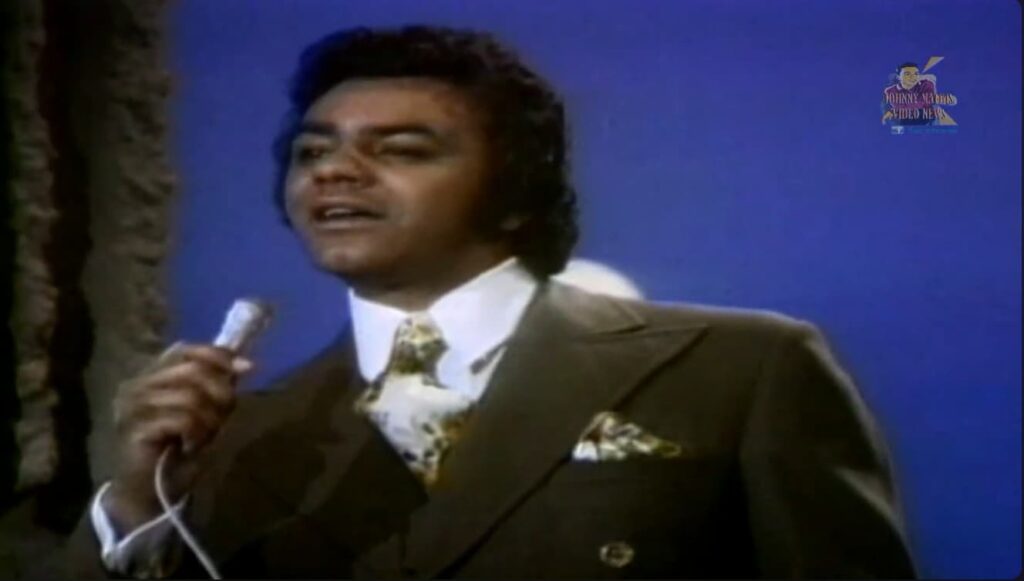
A Love That Defies Time and Circumstance — “A Time For Us” Finds Quiet Eternity in the Voice of Johnny Mathis
When Johnny Mathis lends his voice to “A Time For Us,” the result is not merely a performance but a meditation on love that persists even when the world seems unwilling to make room for it. The song itself carries a history already rich with emotion, yet in Mathis’s interpretation, it becomes something softer, more reflective — a kind of whispered promise that time, no matter how unforgiving, cannot fully erase what the heart once knew.
Originally composed by Nino Rota with lyrics by Larry Kusik and Eddie Snyder, “A Time For Us” emerged in 1968 as the love theme from Romeo and Juliet, the film adaptation directed by Franco Zeffirelli. The instrumental version of the theme, often titled “Love Theme from Romeo and Juliet,” achieved remarkable commercial success, reaching No. 1 on the Billboard Hot 100 in 1969 — a rare accomplishment for an orchestral piece in the rock dominated era.
The vocal version, “A Time For Us,” followed soon after, giving lyrical expression to the timeless story of two lovers separated by forces beyond their control. While many artists recorded the song, Johnny Mathis brought to it a distinctive emotional clarity that aligned perfectly with his long established reputation as one of the finest interpreters of romantic ballads.
By the late 1960s and early 1970s, Johnny Mathis was already a defining voice in popular music. His earlier successes, including “Chances Are” and “Misty,” had established him as a master of intimacy in song. His albums consistently performed well on the charts, particularly within the adult contemporary and easy listening formats, where his warm tenor voice found its most devoted audience.
Although Mathis’s version of “A Time For Us” did not become a major chart topping single in the way the instrumental theme had, it became a cherished part of his repertoire, frequently included in his live performances and romantic compilations. It was within these quieter spaces — beyond the urgency of chart competition — that the song found its lasting home.
The meaning of “A Time For Us” rests in its delicate balance between hope and inevitability. The lyric speaks of a future moment when love will finally be allowed to exist freely, untouched by conflict or separation. Yet beneath that hope lies an awareness that such a moment may never fully arrive.
This tension gives the song its emotional weight.
In the hands of Johnny Mathis, that tension is expressed with remarkable restraint. He does not overstate the longing within the lyric. Instead, he allows each phrase to settle gently, as though the words themselves are fragile.
The arrangement typically surrounding his version remains faithful to the song’s cinematic origins. Sweeping strings echo the grandeur of Nino Rota’s original composition, while subtle orchestral movements create a sense of space and distance. It feels as though the music itself is reaching toward something just beyond its grasp.
What sets Mathis’s interpretation apart is the way he personalizes that grand theme. Rather than presenting the song as a dramatic declaration, he transforms it into a quiet reflection — the kind that lingers in the mind long after the final note fades.
There is a sense, while listening, that the singer is not simply recounting a story from a famous film, but recalling something deeply felt. The performance carries the weight of memory, as though the “time for us” described in the lyric exists not in the future, but somewhere in the past.
That subtle shift in perspective changes everything.
It turns the song from a hopeful promise into something more complex — a recognition that love, even when it cannot survive in the present, leaves behind traces that continue to shape the heart.
In a career filled with beautifully rendered ballads, “A Time For Us” stands as a reminder of Johnny Mathis’s unique gift. He does not merely sing about love. He reveals its quiet endurance, its ability to exist even in absence.
And so the song remains, much like the story that inspired it — a gentle, enduring echo of something that once was, and perhaps, in some distant sense, still is.