
A Quiet Question About Love and Loneliness, Carried by a Voice That Knows the Weight of Time
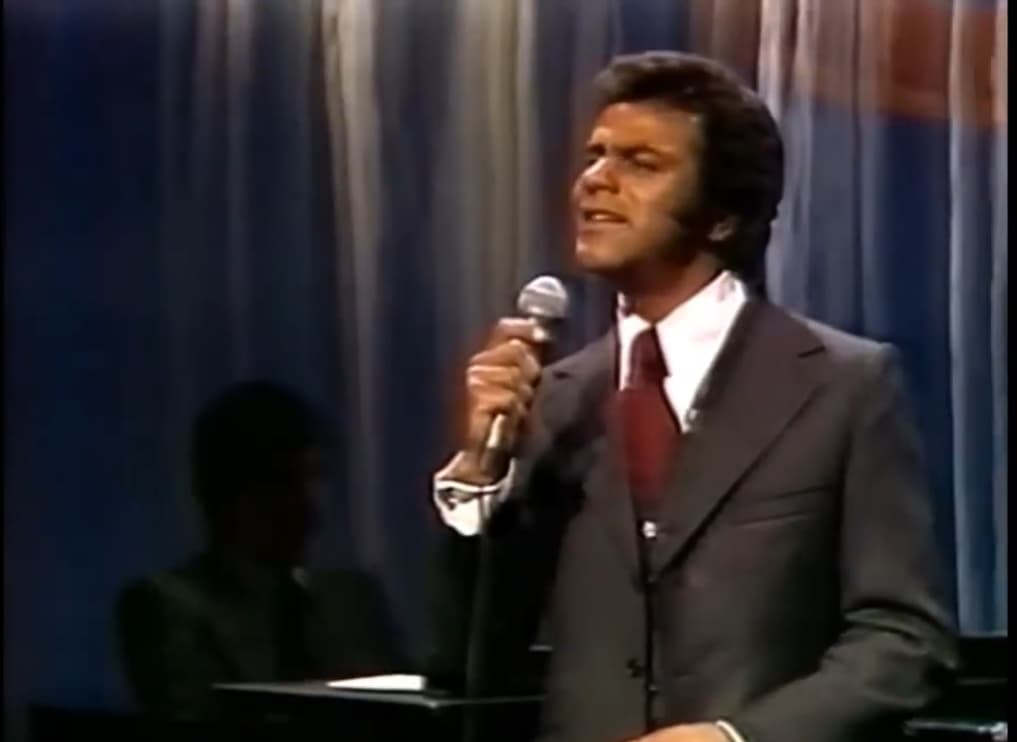
When Johnny Mathis performed “What’ll I Do” on The Mike Douglas Show in 1978, the moment felt less like a televised appearance and more like a private reflection unfolding in front of an audience. The song itself, written by Irving Berlin in 1923, had already lived many lives long before Mathis brought it into that studio. It was not a new release, nor did it carry contemporary chart rankings in 1978, but its history is deeply rooted in the American Songbook, where it has been interpreted by countless artists across generations.
Originally introduced in the early 1920s and popularized through recordings by artists like Paul Whiteman and later Frank Sinatra, “What’ll I Do” never relied on chart positions in the modern sense. Its success belonged to a different era—one measured not by weekly rankings, but by how deeply a song could settle into the cultural fabric. By the time Johnny Mathis approached it in 1978, the song had already become a standard, a piece of music that carried its own quiet authority.
Yet what makes this particular performance so enduring is not the song’s history, but the way Mathis inhabits it.
There has always been something distinct about Johnny Mathis’ voice—its clarity, its smoothness, and above all, its ability to convey emotion without excess. In “What’ll I Do”, that quality becomes especially important. The song is built on a simple, almost fragile premise: the question of what remains when love is no longer present. It does not dramatize heartbreak. Instead, it lingers in the space that follows—the quiet, uncertain moments where absence becomes real.
In the setting of The Mike Douglas Show, the performance feels intimate, unhurried. There is no need for grand gestures or elaborate arrangements. The orchestration is gentle, allowing the melody to unfold naturally. Each phrase is given room to breathe, and in that space, the meaning begins to deepen.
Mathis does not rush the question at the heart of the song—“What’ll I do?” He lets it settle, almost as if he is asking it not only for the audience, but for himself. There is a softness in his delivery, but also a subtle gravity, a sense that the question is not rhetorical. It carries with it the weight of experience, of moments lived and remembered.
By 1978, Johnny Mathis was already an established figure in music, with a career that had spanned decades. Songs like “Chances Are” and “Misty” had defined his earlier years, each marked by a kind of romantic optimism. But in this performance, there is a noticeable shift. The optimism is still present, but it is tempered by reflection. The voice remains beautiful, but it now carries something more—an understanding that love, once lost, does not simply disappear. It leaves behind echoes.
This is where “What’ll I Do” finds its true meaning.
It is not about dramatic loss or overwhelming sorrow. It is about the quieter side of absence—the routines that no longer exist, the conversations that no longer happen, the small moments that once felt ordinary but now feel distant. The song does not attempt to resolve these feelings. It simply acknowledges them.
And in doing so, it creates a connection that feels deeply personal.
There is something almost timeless in the way Johnny Mathis approaches this material. He does not reinterpret it to fit a modern context, nor does he attempt to alter its essence. Instead, he trusts the song as it is, allowing its simplicity to carry the emotion. That trust is what gives the performance its lasting impact.
Looking back, the 1978 appearance on The Mike Douglas Show stands as a quiet reminder of what music can be when it is allowed to speak honestly. No spectacle, no urgency—just a voice, a melody, and a question that lingers long after the final note.
Because in the end, “What’ll I Do” is not meant to be answered.
It is meant to be felt.