
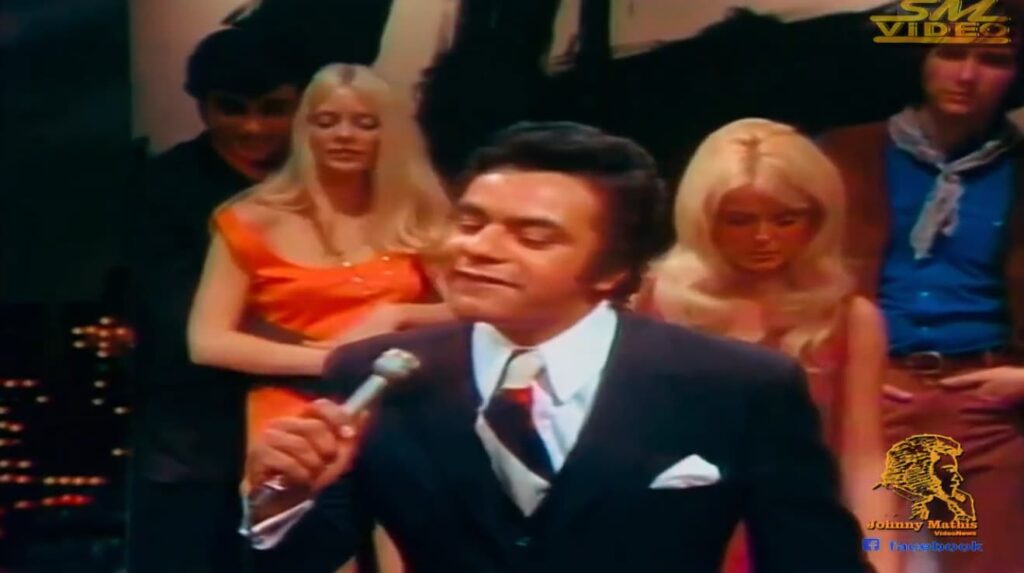
A Gentle Reminder That Life Moves Forward — “Raindrops Keep Fallin’ on My Head” Finds New Warmth in the Voice of Johnny Mathis
When Johnny Mathis recorded “Raindrops Keep Fallin’ on My Head” in 1970, the song was already one of the most beloved melodies of its time. Written by the legendary songwriting duo Burt Bacharach and Hal David, the composition had first captured the world’s attention through B.J. Thomas’s recording for the film Butch Cassidy and the Sundance Kid in 1969. That original version became a major international success, reaching No. 1 on the Billboard Hot 100 in January 1970 and winning the Academy Award for Best Original Song.
Yet when Johnny Mathis approached “Raindrops Keep Fallin’ on My Head,” he did not attempt to replicate the carefree charm of the original recording. Instead, he brought his own unmistakable style to the song. His interpretation, included on the 1970 album Raindrops Keep Fallin’ on My Head, transforms the familiar melody into something more reflective and intimate.
By the time Mathis recorded the song, he had already built one of the most respected careers in American popular music. Since the late 1950s, his voice had become synonymous with romantic ballads and elegant orchestral arrangements. Songs like “Chances Are” and “It’s Not for Me to Say” had reached the Top 10 on the Billboard Hot 100 in 1957, while his album Johnny’s Greatest Hits remained on the Billboard album chart for an extraordinary 490 weeks, one of the longest runs in chart history.
This background made Mathis uniquely suited to reinterpret a song like “Raindrops Keep Fallin’ on My Head.” The lyric, written with subtle wit by Hal David, tells the story of someone facing life’s disappointments with calm resilience. The narrator acknowledges that troubles will come, just as rain inevitably falls. But rather than surrender to frustration, the song embraces a quiet optimism.
Lines such as “I’m never gonna stop the rain by complaining” reveal a philosophy that resonates deeply. The message is simple but powerful: life may not always cooperate with our plans, yet the spirit remains free to keep moving forward.
Musically, Burt Bacharach’s composition is deceptively sophisticated. The melody shifts gently through unexpected chord changes, creating a relaxed yet slightly playful atmosphere. In the original film version, the arrangement carried a breezy, almost whimsical tone.
Johnny Mathis, however, approaches the song with a softer emotional palette. His voice moves gracefully through the melody, supported by warm orchestration and delicate instrumental textures. Rather than emphasizing lighthearted humor, Mathis allows the reflective side of the lyric to emerge.
Listening closely, one hears the quiet assurance that defines his vocal style. Mathis does not rush the phrasing. Each line unfolds with patience, as though he is thoughtfully considering the meaning behind the words. The result is a version that feels personal and comforting.
In many ways, the song itself reflects the cultural mood of its era. The late 1960s and early 1970s were years of enormous change. Amid social upheaval and uncertainty, a melody that encouraged quiet perseverance carried a special kind of reassurance.
That message remains timeless. The idea that rain will fall but cannot control the spirit continues to resonate across generations.
Through his elegant interpretation, Johnny Mathis reminds listeners that resilience does not always need to be loud or dramatic. Sometimes it is expressed in the gentle confidence of a voice that refuses to lose hope.
Decades later, hearing “Raindrops Keep Fallin’ on My Head” still feels like a small moment of calm in a complicated world. The clouds may gather from time to time, but somewhere beyond them the sunlight continues to wait.
And in the warm, unmistakable voice of Johnny Mathis, that quiet optimism becomes something truly enduring.