
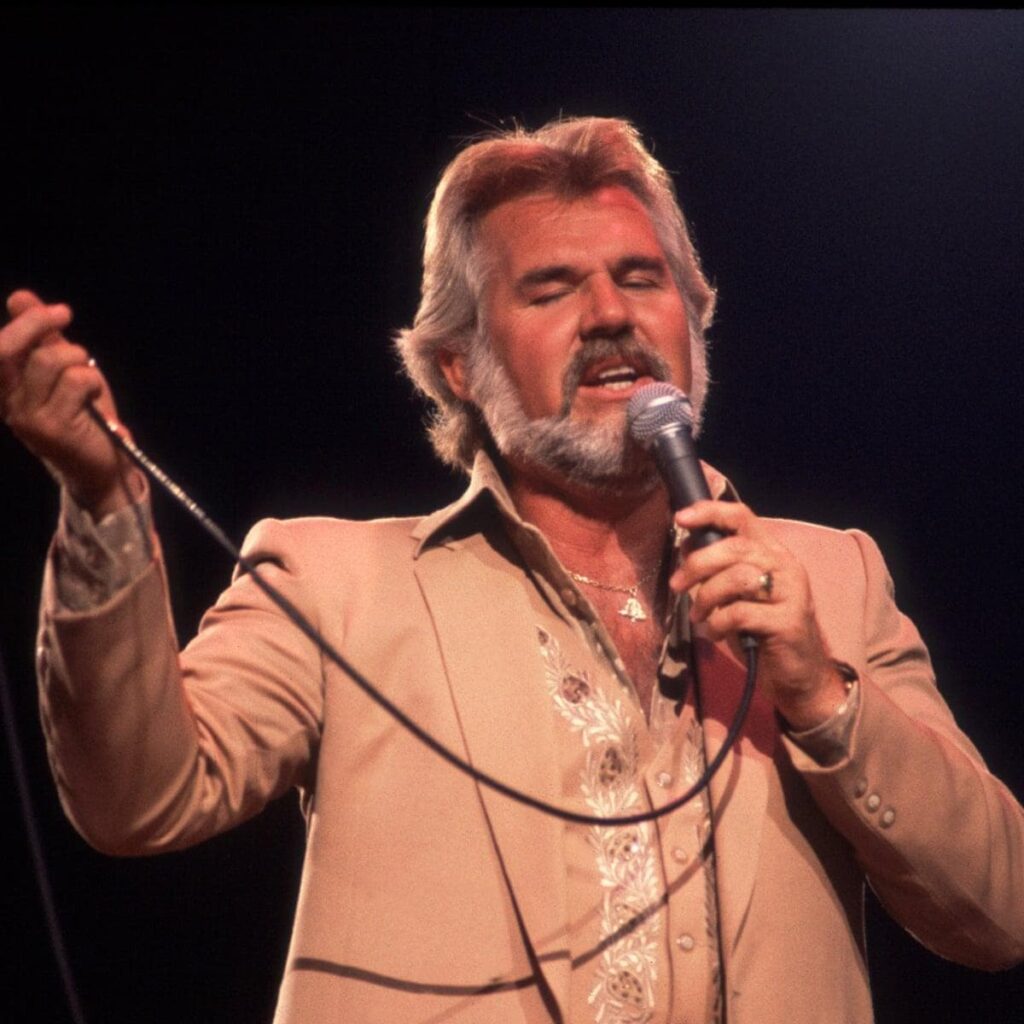
A tender reflection on time’s quiet passage—a man looking back on love, loss, and the memories that refuse to fade
When “Twenty Years Ago” by Kenny Rogers was released in 1987 as part of the album “I Prefer the Moonlight”, it quickly found its place among the most emotionally resonant songs of his later career. The track climbed to No. 2 on the Billboard Hot Country Singles chart, reaffirming Rogers’ enduring ability to connect with listeners even as the musical landscape around him continued to evolve. By this stage, he was no longer simply a chart-topping artist—he had become a storyteller of memory, someone who understood that the most powerful songs often whisper rather than shout.
At first listen, “Twenty Years Ago” unfolds like a quiet conversation with the past. The narrative centers on a man returning—physically or emotionally—to a place once filled with love, only to find that time has altered everything. The house remains, perhaps the streets too, but the life that once animated them has slipped away. It is a theme that resonates deeply: the realization that while places may endure, the moments that defined them cannot be reclaimed.
Written by Wood Newton, Michael Noble, and C. Michael Spriggs, the song is built on a foundation of simplicity. There are no elaborate twists in the lyrics, no dramatic revelations. Instead, it offers a steady stream of reflection, each line carrying the quiet weight of years gone by. This restraint is precisely what gives the song its power. It does not tell the listener how to feel—it simply presents a memory and allows the emotion to emerge naturally.
Kenny Rogers, with his unmistakable voice—warm, slightly weathered, and deeply expressive—delivers the song with remarkable sensitivity. By the late 1980s, his vocal style had matured into something uniquely his own. There is a gentleness in his phrasing, a willingness to let the silence between words speak just as loudly as the words themselves. In “Twenty Years Ago”, that quality becomes central. Each verse feels like a step further into reflection, each chorus a quiet acceptance of what cannot be changed.
Musically, the arrangement complements this introspective tone. Soft piano lines, understated guitar, and subtle orchestration create an atmosphere that feels almost suspended in time. There is no urgency here, no push toward resolution. The song moves at its own pace, much like memory itself—lingering in certain places, passing quickly over others. It is this sense of stillness that allows the listener to fully inhabit the story.
Behind the song lies a broader meditation on the passage of time. By the time “Twenty Years Ago” was released, Kenny Rogers had already experienced immense success, from country to pop crossover hits like “The Gambler” and “Lady.” Yet this track feels different. It is less concerned with narrative drama or romantic grandeur, and more focused on something quieter: the way life gradually reshapes our connections to the past.
There is also an undercurrent of acceptance running through the song. While it is undeniably tinged with melancholy, it does not dwell in sorrow. Instead, it acknowledges that change is inevitable, that the people and places we once held close may drift beyond reach. And yet, there is a certain peace in that realization—a recognition that memories, though intangible, remain a vital part of who we are.
The success of the song on the charts reflects its universal appeal. It speaks to anyone who has ever looked back and felt the distance between then and now. Not with regret alone, but with a kind of quiet gratitude for having experienced those moments at all.
In the broader context of his career, “Twenty Years Ago” stands as a testament to Kenny Rogers’ ability to evolve without losing his emotional core. It shows an artist willing to embrace reflection, to explore the softer, more contemplative corners of the human experience. And in doing so, he created a song that does not simply recount the past—it invites us to sit with it, to understand it, and perhaps to make peace with it.
Long after the final note fades, what remains is not just the melody, but the feeling it leaves behind—a gentle reminder that while time may carry us forward, it never truly takes away the moments that shaped us.