
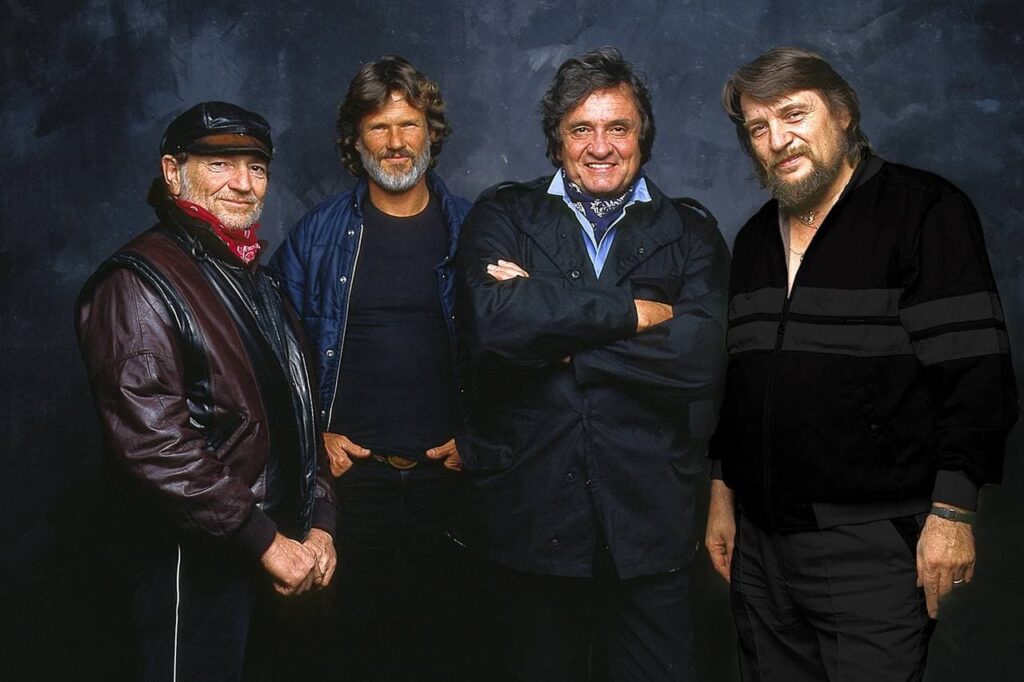
“The Road Goes On Forever” is a dark, restless story about youth, desire, crime, and the consequences that keep following us down the highway.
There are country songs that tell you a story, and then there are songs that make you feel as though you have driven through that story yourself. “The Road Goes On Forever” belongs firmly in the second category. Recorded by The Highwaymen and released on April 4, 1995, it became the title track of the group’s third and final studio album. The album reached No. 42 on Billboard’s Top Country Albums chart in the United States and No. 2 on the UK Country Albums chart.
But there is an important detail behind the song: “The Road Goes On Forever” was not originally written by The Highwaymen. It came from Texas singer-songwriter Robert Earl Keen, who first recorded it for his 1989 album West Textures. Keen had created something much more ambitious than an ordinary country song. It was a compact crime story, filled with young people, bad decisions, restless nights, violence, betrayal, and the irresistible feeling that the night might never end. The Highwaymen gave that story an entirely different weight.
Hearing Willie Nelson, Johnny Cash, Waylon Jennings, and Kris Kristofferson share the song is almost like watching four old roads converge into one. Each man had spent decades singing about outsiders, gamblers, prisoners, lovers, wanderers, rebels, and people who had discovered that life rarely gives anyone a clean way back home. By 1995, these were no longer young outlaws singing about the edge of society. They were seasoned storytellers, carrying years of experience in their voices. That makes their version especially compelling.
The song opens with Sherry, a waitress in a small town, and Sonny, a lonely young man preparing to leave for the Navy. Their lives intersect through the kind of restless nighttime world that country music has always understood so well. There is a river, a car, cigarettes, beer, friends, dreams, and trouble waiting just beyond the next turn. Eventually, the story moves toward Miami, murder, betrayal, and a desperate attempt to escape the consequences of one terrible night. The Texas State University history of the song describes it as a “little movie,” and that is perhaps the perfect way to understand it.
What makes the song memorable is that the chorus sounds almost cheerful while the story becomes increasingly tragic: “The road goes on forever, and the party never ends.” The contrast is devastating. The road represents freedom, but it also represents escape. The party represents youth and excitement, but it can just as easily become a place where people lose control of their lives. That is the genius of Robert Earl Keen’s writing. He does not stop the story to explain who is right or wrong. He simply keeps the wheels turning. One event leads to another, and another, until the characters are far beyond the point where turning around is easy.
When The Highwaymen recorded it, the song acquired another layer of meaning. Their voices sound as though they understand something that the young characters in the story do not. There is a certain weariness underneath the performance, a knowledge that roads really do go on forever, but people do not. The four singers had already lived through decades of American music, changing fashions, personal struggles, triumphs, disappointments, and countless miles on the road. Their presence transforms the song from merely a tale of reckless youth into something broader: a meditation on how choices follow us. The recording also carries the remarkable history of The Highwaymen themselves. The group had first come together in the mid-1980s after Johnny Cash invited Willie Nelson, Waylon Jennings, and Kris Kristofferson to participate in a television project. Their chemistry was strong enough to become something far more permanent. Their first album, Highwayman, became a major country success, and the four returned for Highwayman 2 in 1990.
By the time The Road Goes On Forever appeared in 1995, there was no need for these four men to prove anything. They simply sounded like themselves. Contemporary coverage noted that the group had gathered again for the pleasure of making music together, away from the pressures of their individual careers.
And perhaps that is why this particular song feels so fitting. “The Road Goes On Forever” is ultimately about movement without escape. The characters keep driving, running, drinking, loving, lying, and trying to outrun what they have done. Yet the road remembers everything. There is something deeply American about that image: an endless highway stretching toward another town, another night, another possibility. It promises freedom while quietly reminding us that wherever we go, we carry ourselves with us.
For listeners who remember the great country voices of the 1960s, 1970s, and 1980s, the recording can feel almost like a final gathering around a campfire. Cash, Jennings, Nelson, and Kristofferson were not simply singing another song. They were lending their accumulated years to a story written by a younger songwriter who had already understood something important about life.
Sometimes the road really does seem endless. The parties end. The cars eventually stop. People disappear from our lives. But the stories remain, traveling from one generation to another. And when those four unmistakable voices sing “The Road Goes On Forever,” the line no longer sounds like a celebration. It sounds like a warning, a memory, and perhaps, after all these years, a quiet truth about the way life keeps moving forward whether we are ready for the next mile or not.