
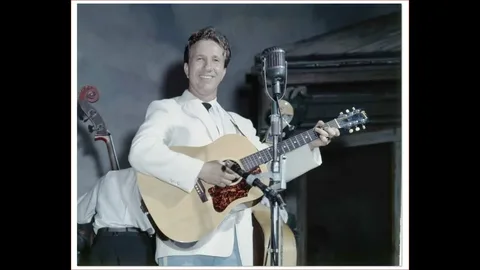
Marty Robbins – A White Sport Coat (And a Pink Carnation): The Anthem of High School Dreams
In the early spring of 1957, Marty Robbins took a sharp turn away from the traditional honky-tonk sound and drove straight into the heart of American youth culture. “A White Sport Coat (And a Pink Carnation)” was more than just a hit; it was a phenomenon. Released on Columbia Records, it soared to #1 on the Billboard Country chart and crossed over to reach #2 on the Pop charts. Inspired by a glimpse of teenagers dressed for a prom while Marty was driving through Ohio, the song captured the “Velvet Voice” at a transformative moment, proving he could serenade the bobby-soxers just as effectively as the cowboys.
The Polished Mirror of 1950s Elegance
To listen to “A White Sport Coat” today is to be instantly transported to a world of gymnasium dances, slow songs under crepe paper streamers, and the heavy anticipation of a Saturday night. For those of us who remember the late fifties, this song is the ultimate “time machine.”
It arrived during an era when the “Country-Politan” style was just beginning to bloom. Marty’s voice—nimble, youthful, and incredibly clean—was the perfect vessel for this story of teenage heartbreak. For the mature listener, this track is a nostalgic powerhouse, evoking the smell of a fresh corsage and the stinging disappointment of a date that never showed. It is a “bright” song with a melancholy soul, a musical snapshot of a time when the world felt both small and infinitely important.
The Tragedy of the “Solo” Dance
The narrative of the song is a masterclass in the “dramatic” vignette. It tells the story of a young man who has spared no expense—the white coat, the pink carnation—only to find himself standing alone while the music plays. It’s about the vulnerability of putting yourself out there and the quiet dignity of a “lonely” walk home.
“A white sport coat and a pink carnation / I’m all dressed up for the dance.”
For the reader who has lived through the decades, these lyrics are a poignant reminder of the “firsts” in our lives—the first big dance, the first real suit, and the first time a heart was truly bruised. Marty’s vocal performance is a marvel of “pop-country” crossover. He hits the melodic leaps with an effortless, breezy grace, yet he infuses the lyrics with a subtle, rhythmic “sigh” that lets you know he feels the protagonist’s pain. There is a profound, “Technicolor” nostalgia in his delivery—a man who understood that a high school heartbreak feels like the end of the world when you’re in the middle of it.
The Rhythmic Snap of the Rockabilly Era
The production of this track is a quintessential example of the Mitch Miller and Don Law collaboration at Columbia. It features a bright, “jangly” rhythm guitar and the iconic, steady “clip-clop” percussion that gives the song its infectious, walking pace. The addition of the Ray Conniff singers providing the “doo-wop” style backing vocals was a stroke of genius, bridging the gap between Nashville and New York. It is a “crisp” and vibrant recording, capturing the high-fidelity warmth of the fifties where every instrument—from the walking bass to the subtle piano—is perfectly in its place.
As we revisit “A White Sport Coat”, we see it as the bridge that allowed Marty Robbins to become a global superstar. It is a nostalgic masterpiece because it honors the sincerity of our younger selves. It serves as a gentle reminder that even our “faded” memories were once vibrant and full of hope. When Marty’s final, melodic note fades, he leaves us with a bittersweet smile—reminding us that while the dance eventually ends, the song remains as timeless as a pink carnation.
 Music Legend