
A Timeless Confession of Love and Regret — When Johnny Mathis Revisited “Crazy” with Grace and Memory
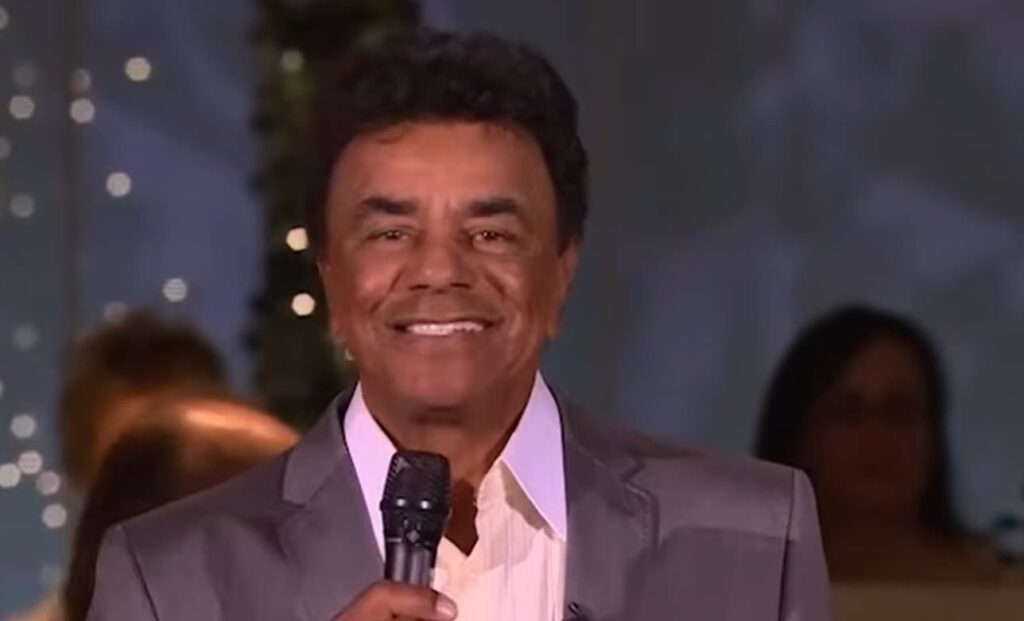
There are songs that never truly belong to a single voice, and then there are songs that seem to gather new meaning each time they are sung. “Crazy”, written by Willie Nelson and immortalized by Patsy Cline in 1961, is one of those rare compositions. When Johnny Mathis performed “Crazy” on The Oprah Winfrey Show on November 22, 2010, it was not simply a rendition — it was a quiet conversation across decades, a meeting point between past and present, memory and interpretation.
To understand the weight of that performance, one must return to the origins of the song. “Crazy” became one of the most enduring standards in American music history after Patsy Cline’s version reached No. 2 on the Billboard Hot Country Singles chart in 1962 and crossed over to the Billboard Hot 100, peaking at No. 9. Its success was not explosive but lasting — a slow-burning triumph that would eventually earn a place among the most played songs in jukebox history. The song’s structure, with its sophisticated chord changes influenced by jazz, set it apart from typical country compositions of its time.
By the time Johnny Mathis approached “Crazy” in 2010, he was already a living institution. Known for his velvet voice and romantic ballads, Mathis had spent decades shaping a style that blurred the lines between pop, jazz, and traditional standards. His decision to interpret “Crazy” was not surprising — it was almost inevitable. The song’s emotional subtlety and melodic richness fit seamlessly into his musical identity.
Yet what makes this particular performance so affecting is not technical mastery, though it is certainly present. It is the passage of time embedded in his voice. Unlike the youthful ache in Patsy Cline’s original, Mathis delivers the song with a reflective calm, as though the pain described is no longer immediate, but remembered. The famous opening line — “Crazy, I’m crazy for feeling so lonely” — does not sound like a cry for help here. Instead, it feels like an acknowledgment, a quiet acceptance of something long understood.
There is a story behind “Crazy” that deepens its meaning even further. Willie Nelson, then a struggling songwriter, originally penned it as a ballad with a different phrasing. It was Patsy Cline who reshaped it, stretching its melody into the now-iconic phrasing that gave the song its emotional weight. In many ways, every subsequent version carries both their imprints — Nelson’s introspection and Cline’s interpretive genius.
Johnny Mathis, in 2010, adds yet another layer. His version does not attempt to outshine or redefine. Instead, it honors. There is restraint in his delivery, a sense of reverence not only for the song itself but for the history it carries. Backed by elegant orchestration, his voice glides rather than reaches, suggesting that some emotions do not need to be emphasized — they simply need to be remembered.
Watching that performance, one cannot help but feel a gentle pull toward reflection. The song becomes less about heartbreak in the present and more about the quiet persistence of feeling over time. It speaks to the way certain memories linger, not sharply, but softly — like a melody that refuses to fade completely.
The meaning of “Crazy” has always been tied to vulnerability — the willingness to admit longing, confusion, and emotional surrender. In Mathis’s hands, that vulnerability matures into something deeper: acceptance. It is no longer about questioning why one feels this way, but about recognizing that such feelings are part of the human experience.
In the end, Johnny Mathis – “Crazy” (Oprah, 2010) stands as a testament to the enduring power of great songwriting and timeless interpretation. It reminds us that songs, like memories, evolve with us. They do not change in structure, but in meaning — shaped by the years we carry and the lives we have lived.
And perhaps that is why this performance resonates so deeply. It does not ask us to relive the past. It simply invites us to sit with it, quietly, and listen.