
A Cowboy Returns to His Own Legend — “El Paso City” Reflects the Memory and Mystery Behind Marty Robbins’ Most Famous Story
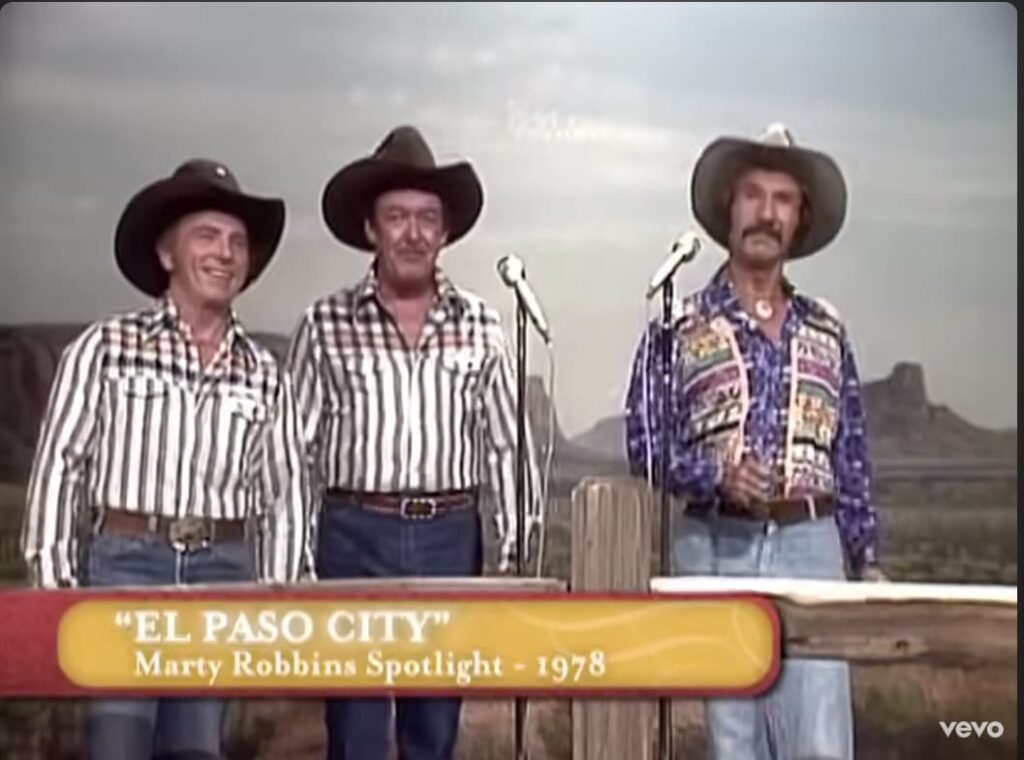
When Marty Robbins performed “El Paso City” live on The Marty Robbins Spotlight in 1978, the moment carried a special kind of resonance. It was not simply a performance of a country song. It was the continuation of a musical story that had begun nearly two decades earlier, when Robbins introduced one of the most famous ballads in country music history. In “El Paso City,” he revisited that legendary tale, not by repeating it, but by reflecting upon it with the wisdom and nostalgia of an artist looking back at his own past.
To understand the importance of “El Paso City,” one must first remember the enormous cultural impact of “El Paso,” the groundbreaking ballad Robbins released in 1959. That song, featured on the album Gunfighter Ballads and Trail Songs, became a landmark recording. “El Paso” reached No. 1 on the Billboard Hot 100 in 1960, an extraordinary achievement for a western-style narrative ballad. It also topped the Billboard Country Chart and later won the Grammy Award for Best Country & Western Recording in 1961. The song’s cinematic storytelling about a cowboy fleeing after a gunfight captivated audiences and established Robbins as one of the most imaginative storytellers in country music.
Nearly twenty years later, Robbins returned to that landscape with “El Paso City.” Released in 1976 as the title track from the album El Paso City, the song quickly climbed the Billboard Hot Country Singles chart, reaching No. 1 in 1976. This achievement was particularly remarkable because it showed that the emotional power of the original story still resonated with audiences many years later.
But “El Paso City” is not simply a sequel to the earlier ballad. Instead, it approaches the legendary tale from a fascinating new perspective. In the song, the narrator is an airplane pilot flying over the region near El Paso, Texas. As he looks down at the desert landscape, he experiences an eerie sense of familiarity, as though he has lived this story before.
The lyric gently suggests the possibility of reincarnation. The narrator begins to wonder whether he might somehow be connected to the cowboy from the original “El Paso” story, the man who rode desperately through the desert after a fatal gunfight. This unusual narrative twist transforms the song from a straightforward western tale into something more reflective and mysterious.
Musically, “El Paso City” carries the unmistakable sound that made Marty Robbins such a distinctive figure in country music. The arrangement blends traditional country instrumentation with subtle Spanish guitar influences that evoke the atmosphere of the American Southwest. The rhythm moves with calm confidence, allowing Robbins’ voice to guide the listener through the unfolding story.
When Robbins performed the song live on The Marty Robbins Spotlight in 1978, the performance felt deeply personal. By that point in his career, he had already spent more than two decades shaping the sound of country music. His catalogue included numerous chart successes such as “A White Sport Coat (And a Pink Carnation)”, which reached No. 2 on the Billboard Hot 100 in 1957, and “Don’t Worry,” a No. 1 country hit in 1961 that also introduced the famous distorted guitar sound later associated with rock music.
Yet storytelling had always remained at the heart of Robbins’ artistry. Songs like “El Paso,” “Big Iron,” and later “El Paso City” demonstrated his rare ability to turn country songs into vivid cinematic experiences.
Watching the 1978 live performance reveals an artist completely at ease with the material that had defined his career. Robbins delivers the lyric with quiet authority, never rushing the narrative. His voice carries a reflective tone, as though he too is contemplating the strange connection between past and present described in the song.
What makes “El Paso City” especially compelling is the way it blends nostalgia with imagination. It acknowledges the power of the original story while also suggesting that some legends never truly disappear. They remain alive in memory, waiting to be rediscovered in new forms.
Listening today, the song feels like a conversation between different chapters of Marty Robbins’ career. It connects the bold storytelling of the 1950s with the reflective maturity of the 1970s.
And as the melody fades beneath Robbins’ steady voice, the listener is left with the same quiet mystery that drifts through the desert landscape of the song: perhaps some stories are so powerful that they never truly end—they simply return, echoing across time like distant hoofbeats on the open plains.