
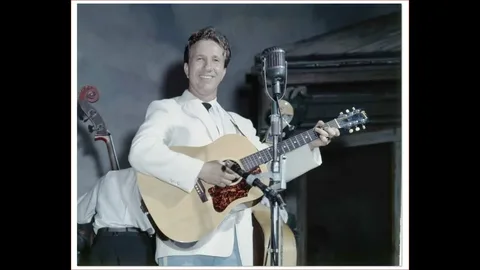
Marty Robbins – Making Believe: A Velvet Veil Over a Broken Heart
In the mid-1960s, during an era when country music was becoming increasingly “cosmopolitan,” Marty Robbins took one of the most heartbreaking standards in the genre and made it shimmer. “Making Believe”, originally a massive hit for Kitty Wells in 1955, found a new, more sophisticated life on Marty’s 1962 album Portrait of Marty. Released on Columbia Records, this version took the raw, honky-tonk sorrow of the original and dressed it in the elegant “Velvet” robes that only Marty could provide. It remains a masterclass in how to sing about a dream while standing in the middle of a nightmare.
The Soft Glow of a Mid-Century Heartbreak
To listen to Marty Robbins sing “Making Believe” today is to experience the “high-fidelity” ache of the early sixties. For those of us who grew up with the radio as our constant companion, Marty was the voice that understood the “quiet” side of losing.
While other singers might have wailed or cried, Marty’s delivery—rich, steady, and impeccably smooth—suggested a deeper, more private kind of grief. For the mature listener, this song is a nostalgic treasure, evoking memories of those long, reflective evenings when we realized that sometimes, the only way to get through the night was to pretend things were different than they were.
The Psychology of the “Sweet Pretender”
The narrative of “Making Believe” is one of the most relatable stories in all of country music. It is a song about the survival mechanism of the lonely—the act of “making believe” that a lost love is still there, just to keep the cold at bay. It’s about the courage it takes to live in a fantasy when the reality is too much to bear.
“Making believe that you still love me… it’s leaving me alone and so blue.”
For the reader who has navigated the long, winding roads of life and love, these lyrics strike a resonant chord. We have all had those seasons where we “made believe” just to keep our spirits up. Marty’s vocal performance is a marvel of “controlled vulnerability.” He uses his trademark “crying” tenor—that subtle break in his voice—to let us know that beneath the smooth surface, his heart is in pieces. There is a profound, dignified nostalgia in his tone; he sounds like a man who has mastered the art of the “brave face.”
The Lonesome Elegance of the Nashville Sound
The production of this track is a perfect example of the Don Law era at Columbia. It features a sparse, rhythmic acoustic guitar and a weeping steel guitar that provides the perfect “echo” to Marty’s voice. The arrangement is clean and uncluttered, allowing every nuance of his phrasing to shine. It is a recording that values “space,” capturing the high-fidelity warmth of the era where you could hear the breath between the notes. The subtle addition of a soft harmony or a gentle piano lilt adds a layer of “Country-Politan” class without ever losing the song’s emotional core.
As we revisit “Making Believe”, we are reminded of why Marty Robbins remains a titan of the genre. He had the rare ability to take a common sorrow and make it feel like a royal tragedy. This song is a nostalgic masterpiece because it honors the quiet resilience of the human heart. It serves as a gentle reminder that even when we are “making believe,” there is a shared, universal dignity in our desire to hold on to what we love. When Marty’s final, velvet note fades, he leaves us with a sense of quiet understanding—a reminder that in the world of the heart, we are all just doing our best to get back home.
 Music Legend