
A young voice learning that love can be brief, yet the memory of it lasts far longer than the moment itself.
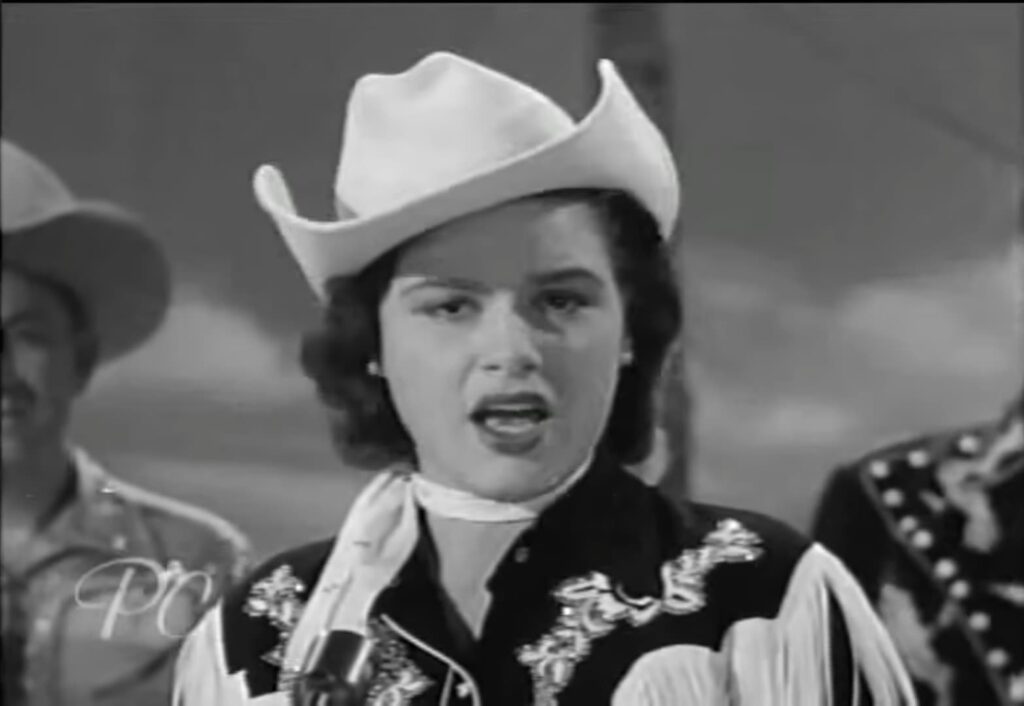
In 1957, long before stadium lights and crossover stardom, Patsy Cline stepped onto the modest television stage of Tex Ritter’s Ranch Party and sang I’ve Loved and Lost Again. For many viewers at home, it was not just another country performance. It was an early glimpse of an artist who already understood heartbreak with a depth far beyond her years.
The appearance came at a crucial moment in Cline’s life. She was still fighting for recognition, still shaping the sound and confidence that would later define her legacy. Television variety shows like Ranch Party were lifelines for young singers in the 1950s, offering exposure to families gathered around black and white sets after dinner. Patsy stood there simply dressed, no dramatic staging, no spectacle. What carried the moment was her voice.
I’ve Loved and Lost Again is a quiet song, restrained and almost conversational. There is no bitterness in it, only acceptance. In that performance, Cline sang not as a wounded woman, but as someone who had already learned that love does not always stay, and that losing it does not erase its value. Her phrasing was careful, her tone steady, but the ache was unmistakable. She did not overplay the sadness. She trusted the song to speak for itself.
What makes this television moment especially moving today is how clearly it foreshadows the Patsy Cline the world would soon come to know. Even then, she possessed that rare ability to sound both strong and vulnerable at once. Each line felt lived in, as though she were recalling a personal memory rather than delivering lyrics written for her. For older listeners, that quality resonates deeply. It recalls a time when singers told stories instead of chasing trends.
Tex Ritter’s Ranch Party itself now belongs to a vanished era of American entertainment. The set was informal, the audience close, the atmosphere unpolished and sincere. These shows did not rush their performers. They allowed a song to breathe. Watching Patsy Cline in that setting is like opening an old photo album and finding an image that suddenly brings back the sound of a room, the feeling of a year, the mood of a life once lived.
In hindsight, there is a gentle poignancy to this performance. Patsy Cline would go on to sing some of the most enduring songs of love and loss ever recorded. Yet here she was, at the beginning, already fluent in the emotional language that would define her career. The song’s title feels almost prophetic, not just about romance, but about the fleeting nature of moments themselves.
For those who remember the era, or who grew up with her voice as a companion through the years, this 1957 performance is more than archival footage. It is a reminder of when country music spoke softly and honestly, and when a young woman on a small television stage could make an entire living room fall silent, simply by telling the truth in song.
 Oldies Songs