
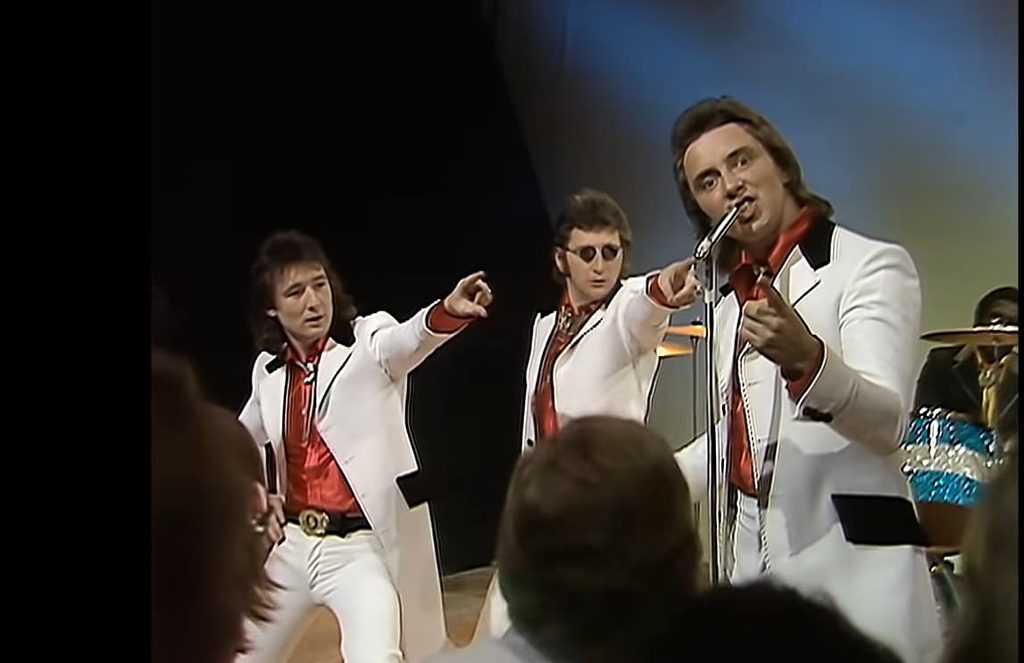
“Trocadero” captured Showaddywaddy at a restless moment in 1976, standing between the fading momentum of their early success and the spectacular breakthrough that was waiting just months ahead.
On May 20, 1976, Showaddywaddy appeared on BBC’s legendary Top of the Pops to perform “Trocadero,” their brand new single and the title track of their forthcoming album. The performance came at an interesting moment because the record had not yet entered the UK chart. When the programme was broadcast, “Trocadero” was listed as a new release, and it would make its first appearance on the Official UK Singles Chart at No. 49 on May 23, 1976. The following week, it climbed to No. 32, which became its highest position. The single spent three weeks on the chart, while the album Trocadero, released on May 7, 1976, later reached No. 41 on the UK Albums Chart.
At first glance, “Trocadero” might seem like a small footnote in the remarkable career of Showaddywaddy. After all, the group would go on to score their only UK No. 1 hit later that same year with “Under the Moon of Love,” beginning an extraordinary run of seven consecutive Top Five singles. But this makes the story of “Trocadero” even more interesting. It captures the band before the explosion, before the chart dominance, and before they became one of the most familiar groups on British television and radio. In the spring of 1976, their future was not yet certain.
The single was released on April 30, 1976, backed with “Teenage Love Affair.” Unlike many of Showaddywaddy’s most famous hits, “Trocadero” was an original composition, written by members of the band. The song’s title immediately suggests a glamorous meeting place, a world of bright lights, dancing, romance, and youthful excitement. It fits perfectly into Showaddywaddy’s musical universe, where rock and roll was not simply something from the past but a living world filled with jukeboxes, dance floors, memories, and dreams.
The performance on Top of the Pops is especially fascinating because the programme itself was a snapshot of British music at the time. Presented by David Hamilton, the May 20 episode featured artists including ABBA, The Rolling Stones, Wings, Cliff Richard, Tina Charles, Peter Frampton, and Showaddywaddy. The musical world was already changing, with disco growing in popularity and rock music moving in new directions. Yet Showaddywaddy remained unmistakably themselves, carrying the spirit of classic rock and roll into the middle of the 1970s.
Their strength had always been their ability to make nostalgia feel alive. They did not simply dress in vintage clothes and perform old songs as museum pieces. Their music had energy, humour, and movement. Even when looking back toward the 1950s and early 1960s, Showaddywaddy made those influences feel immediate. “Trocadero” showed another side of the group because it came from within their own creative world, appearing on an album that contained nine original compositions alongside three cover versions.
Yet the single did not become the major hit the band might have hoped for. The official Showaddywaddy history notes that “Trocadero” reached only No. 32, despite what the band regarded as a strong Top of the Pops performance. The timing may also have played a part. The single was released just one week before the album, meaning many listeners could buy the song as part of the LP rather than purchasing the single itself.
Looking back today, that May evening in 1976 feels almost like the quiet scene before a dramatic change in the story. Showaddywaddy were still working, still appearing on television, still recording and touring, but the great breakthrough was just months away. Their next single, “Take Me in Your Arms,” failed to chart entirely. Then, in October, everything changed. “Under the Moon of Love” was released and eventually climbed all the way to No. 1, transforming the band’s fortunes and beginning their most successful period.
That is why “Trocadero” on Top of the Pops deserves to be remembered. It preserves Showaddywaddy in a rare moment before history knew what was coming next. The cameras captured a band still searching for the next big hit, still believing in their own sound, and still carrying the joyous spirit of rock and roll onto one of Britain’s most important television stages. Sometimes the performances that become most interesting with time are not the ones made at the height of success, but the ones recorded just before everything changed.