
A restless declaration of freedom, where desire speaks louder than reason and the road never quite ends
When Status Quo released “Whatever You Want” in 1979, it arrived with a clarity that felt almost defiant. The single climbed to No. 4 on the UK Singles Chart, becoming one of the band’s most recognizable hits and a defining statement of their late 1970s sound. It was also the title track of their album “Whatever You Want” (1979), a record that reaffirmed their place in a musical landscape that was rapidly shifting around them.
By the end of the decade, rock music was being pulled in different directions. Punk had already made its mark, new wave was beginning to rise, and many established bands were either adapting or fading into the background. Status Quo, however, chose a different path. They stayed grounded in the straightforward, driving boogie rock that had defined their identity, and “Whatever You Want” stands as one of the clearest expressions of that commitment.
Written by Rick Parfitt and Andy Bown, the song is built on a simple but unmistakable guitar riff—direct, unpolished, and immediately recognizable. There is no attempt at complexity in its structure. Instead, it relies on repetition and rhythm, allowing the groove to carry the weight of the song. This approach, often underestimated, is precisely what gives it its enduring strength.
Lyrically, “Whatever You Want” revolves around a sense of insistence—an almost stubborn declaration of giving, wanting, and taking. The repeated phrase “whatever you want” can be interpreted in different ways. On the surface, it suggests generosity, a willingness to provide without condition. Yet beneath that, there is a tension. The tone is not entirely soft. It carries a hint of urgency, even frustration, as though the act of giving has its limits.
This ambiguity is part of what makes the song resonate. It does not settle into a single emotional space. Instead, it moves between confidence and restraint, between offering and expectation. The listener is left to decide where that balance lies.
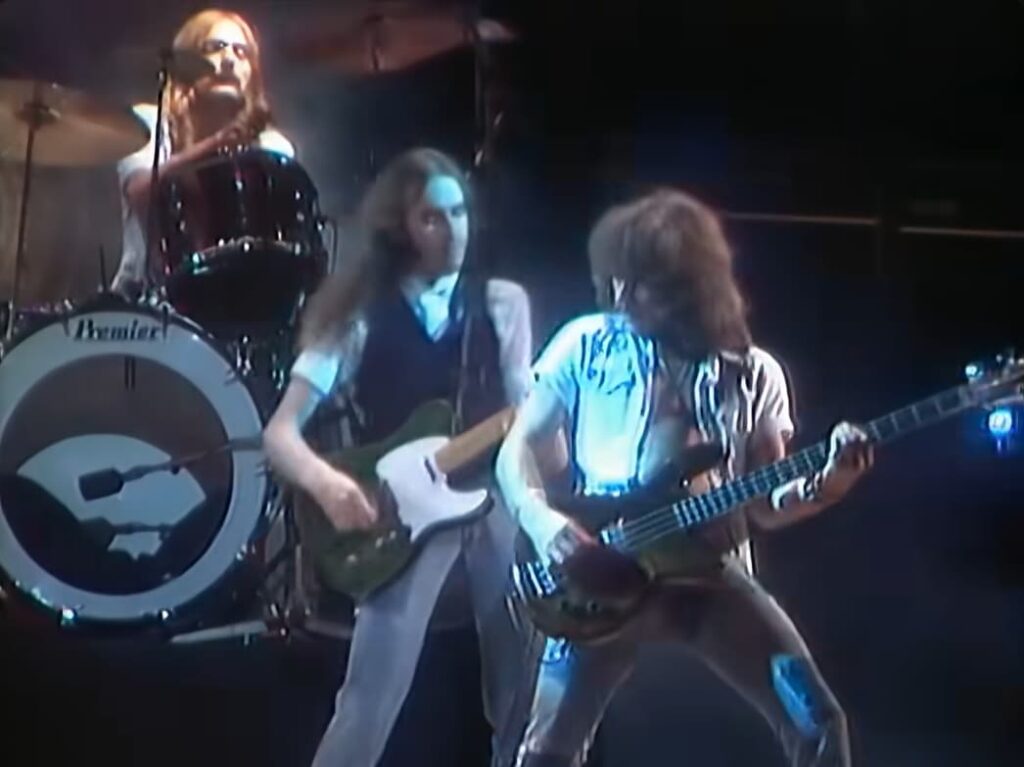
Musically, the performance reflects the band’s long standing chemistry. The guitars drive forward with steady momentum, the rhythm section remains tight and unyielding, and the vocals—delivered with a characteristic roughness—anchor the song in a sense of authenticity. There is no excess, no unnecessary embellishment. Everything serves the groove.
What sets Status Quo apart during this period is their refusal to overcomplicate their music in response to changing trends. While others experimented with new sounds and production techniques, they remained focused on what they did best. This was not a lack of evolution, but a deliberate choice. They understood that their strength lay in consistency—in delivering a sound that felt reliable, even as the world around it changed.
Listening to “Whatever You Want” now, there is a sense of immediacy that has not faded. The song does not feel tied to a specific moment in time, despite its origins in 1979. Its energy remains intact, carried by a rhythm that continues to feel both familiar and alive.
There is also something quietly reflective in its persistence. The song speaks to a kind of determination—not just in its lyrics, but in its existence. It represents a band choosing to remain true to their identity, even when the industry suggested otherwise.
In the end, “Whatever You Want” is more than a successful single or a memorable riff. It is a statement of intent. A reminder that sometimes, the most enduring music is not the kind that changes direction, but the kind that holds its ground.
And as the final chords settle, what remains is not just the echo of a song, but the feeling of movement—the sense of a road that continues forward, steady and unbroken, carrying with it everything that came before.