
A fleeting chase wrapped in melody—“Fox On The Run” captures the moment when love slips away, leaving only rhythm and reflection behind
By early 1975, Sweet stood at a turning point in their career, and “Fox On The Run” became the record that quietly—but decisively—redefined who they were. Released in March 1975 as a standalone single, the song marked a significant shift: it was one of the first major hits written and produced entirely by the band themselves, without the guiding hand of the Chinn Chapman songwriting team. That alone gives the song a certain weight, a sense of independence that can be heard in every polished note.
The commercial success followed swiftly. “Fox On The Run” reached No. 2 on the UK Singles Chart, held off the top spot only briefly, and went on to climb to No. 5 on the Billboard Hot 100 in the United States, confirming Sweet’s place as not just glam rock performers, but serious hitmakers with a global reach. It also appeared on the American version of their album Desolation Boulevard, further cementing its identity as a defining track of their mid 1970s period.
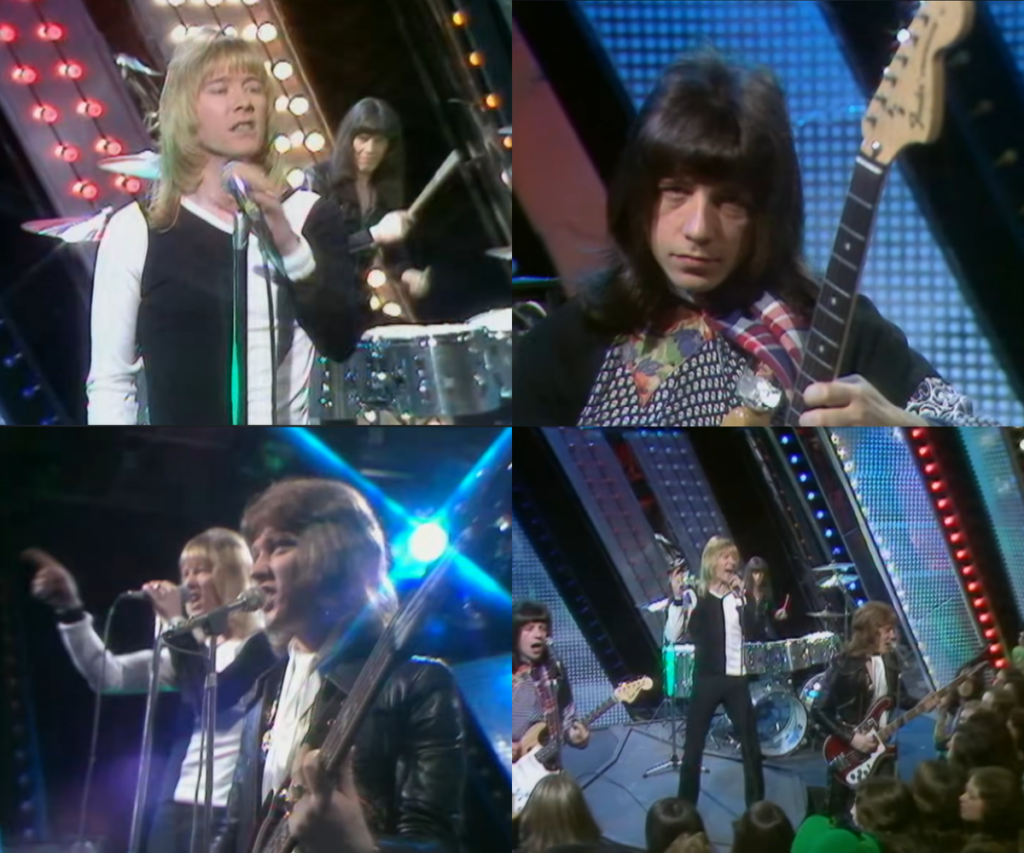
What makes the Top Of The Pops performance on March 13, 1975, so memorable is its sense of control. Unlike the explosive chaos of their earlier hit “The Ballroom Blitz,” this performance reveals a more measured side of Sweet. The energy is still there, unmistakably so, but it is refined, shaped into something smoother and more deliberate. The band no longer seems like they are reacting to the moment—they are guiding it.
The song itself begins with one of the most recognizable openings of its time: that shimmering, almost mechanical vocal effect that feels both futuristic and distant. It is an unusual choice, especially for 1975, and yet it works precisely because it contrasts with what follows. When the rhythm settles in, steady and confident, it carries the listener forward with a sense of inevitability. This is not a song that rushes. It moves with purpose.
Lyrically, “Fox On The Run” tells a story that feels familiar, though never overstated. The “fox” in the song is often interpreted as a woman who is elusive, independent, perhaps even unattainable—someone who moves through life on her own terms, leaving others behind without explanation. But there is no bitterness in the telling. Instead, there is a quiet recognition, almost an acceptance, that some connections are not meant to last.
That sense of emotional restraint is what gives the song its lasting appeal. Sweet does not dramatize the loss. They do not linger on regret. Instead, they let the melody carry the weight, allowing the listener to find meaning in the spaces between the lines. It is a subtle shift from their earlier, more theatrical style, and it reveals a maturity that is often overlooked when discussing the glam rock era.
Visually, the Top Of The Pops performance reflects this transition. The costumes, still rooted in glam aesthetics, appear slightly more subdued. The movements are less exaggerated, more focused. Lead vocalist Brian Connolly delivers the song with a calm assurance, his voice steady, never forced. Around him, the band maintains a tight cohesion, each element of the performance aligned with the song’s understated confidence.
Looking back, “Fox On The Run” feels like a bridge between two identities. On one side, the flamboyant, high energy world of early glam rock. On the other, a more polished, radio friendly sound that would come to define much of late 1970s pop rock. Sweet managed to stand in both spaces at once, and in doing so, created something that feels both immediate and timeless.
There is also something quietly reflective about the song’s enduring presence. It does not demand attention in the way some of their earlier hits did. Instead, it lingers. It returns unexpectedly, often bringing with it a sense of distance—not just from the song itself, but from the time in which it was first heard.
In the end, “Fox On The Run” is not just about someone slipping away. It is about the recognition that not everything can be held onto, and that sometimes, the act of letting go carries its own kind of clarity. And in that understanding, Sweet found a different voice—one that speaks not through spectacle, but through quiet certainty, leaving behind a song that continues to resonate long after the chase has ended.