
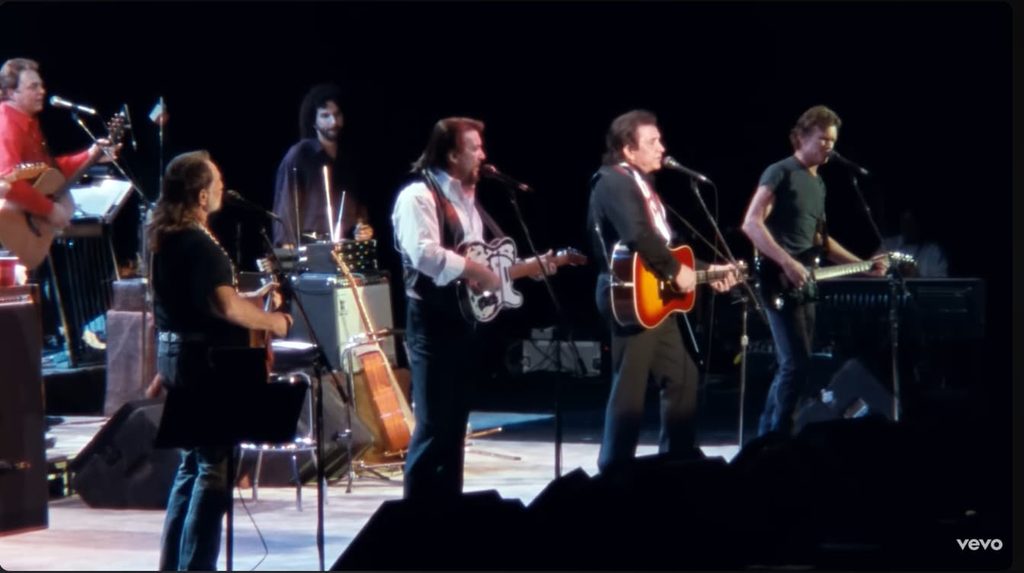
“The Last Cowboy Song” mourns the fading of an old America, and in the hands of The Highwaymen, its farewell to the cowboy becomes a gathering of four men who had spent their own lives singing against the passing of time.
When The Highwaymen performed “The Last Cowboy Song” at Nassau Coliseum in Uniondale, New York, on March 14, 1990, the song seemed almost destined for the four men standing together on that stage. Johnny Cash, Willie Nelson, Waylon Jennings, and Kris Kristofferson were not merely country music stars performing an old cowboy song. Each of them had become a symbol of a disappearing kind of musical independence, artists who had spent much of their careers resisting the rules and expectations of Nashville. Their live performance was later released as part of The Highwaymen Live: American Outlaws, a collection drawn from the complete Nassau Coliseum concert and officially released in 2016.
“The Last Cowboy Song” was written by Ed Bruce and Ron Peterson and originally recorded by Ed Bruce for his 1980 self titled album. Bruce’s version, featuring background vocals by Willie Nelson, became a major country hit, reaching No. 3 on Billboard’s Hot Country Singles chart in 1980. That success made the song one of Bruce’s most important recordings, but its meaning extended far beyond the charts. It was a song about the gradual disappearance of the American West as it had existed in popular imagination and, more importantly, about the disappearance of a way of life built around open land, independence, and freedom from fences.
The central image is heartbreaking in its simplicity. The cowboy is still there, but the world around him is changing. The great open spaces are being divided, the old trails are becoming memories, and the voices of the past are slowly fading. “The Last Cowboy Song” does not celebrate the cowboy as a glamorous Hollywood figure riding triumphantly into the sunset. Instead, it recognises that the sunset has already begun. The song is an elegy for something that may never completely disappear from American culture, yet can never truly return to the way it once was.
That feeling made it particularly powerful for The Highwaymen.By 1990, Johnny Cash, Willie Nelson, Waylon Jennings, and Kris Kristofferson had each travelled long and difficult roads. They had survived changing musical fashions, personal struggles, conflicts with the industry, and the constant pressure placed upon artists who refuse to become predictable. Together, they represented the spirit of the outlaw movement, but the word “outlaw” had always meant something more complicated than rebellion for its own sake. It meant protecting the right to make music honestly, to live outside carefully constructed expectations, and to remain yourself even when the business preferred something easier to sell.
In that sense, “The Last Cowboy Song” became almost autobiographical when these four voices sang it together. The Nassau Coliseum performance is especially moving because each singer brings his own history into the song. Johnny Cash had spent decades turning the figure of the American wanderer into one of the central characters of his music. Willie Nelson had become synonymous with the freedom of the open road, the battered guitar, and the refusal to belong entirely to any musical category. Waylon Jennings had helped redefine country music by fighting for creative control and bringing a harder, more independent sound into Nashville. Kris Kristofferson, perhaps more than anyone, understood the poetry of men who lived between freedom and failure.
When they stood together, the song became larger than its original story.The four men were themselves survivors of another disappearing America, one where country singers were expected to build careers through years of touring, radio shows, dance halls, and long nights on the road. They had all come from different backgrounds, yet their paths had eventually crossed because they believed in many of the same things: independence, authenticity, friendship, and the right to tell difficult stories without polishing away their rough edges.
The performance took place during a concert that was extraordinary in its scale and historical significance. The set ran through the defining songs of all four artists, allowing each man to revisit the music that had shaped his career. Audiences heard “Folsom Prison Blues,” “Blue Eyes Crying in the Rain,” “Sunday Morning Coming Down,” “Always on My Mind,” “Me and Bobby McGee,” and many other classics. “The Last Cowboy Song” appeared on the second half of the Nassau concert, surrounded by songs that reflected the same themes of wandering, memory, independence, and lives lived beyond conventional boundaries.
That context matters because “The Last Cowboy Song” was not simply another item in a long concert. It was part of a larger conversation between the four artists and their own musical pasts. The Nassau performance captured them at a point when they could look back across decades without becoming trapped by nostalgia. They were still working, still touring, still singing, but they also understood that time had changed the landscape around them.
The song’s famous image of “the end of a hundred year waltz” carries much of that emotional weight. A waltz is gentle, circular, and repetitive. For a hundred years, the mythology of the American cowboy had moved through songs, films, novels, and stories. Cowboys became heroes, outlaws, lovers, loners, and symbols of freedom. But every dance eventually reaches its final turn.
That is what “The Last Cowboy Song” recognises.
Yet the song is not entirely hopeless. Its sadness comes from remembering, and remembering is itself a form of survival. The cowboy may be disappearing from the physical landscape, but he remains alive in the songs. The old trails may have changed, but someone can still sing about them. The fences may have gone up, but the imagination still remembers what existed before them. Perhaps that is why the song sounds so natural when performed by The Highwaymen. They understood that songs can preserve things that history cannot. Johnny Cash, Willie Nelson, Waylon Jennings, and Kris Kristofferson were all storytellers, and each had spent a lifetime carrying fragments of America into music.
The Highwaymen’s version does not attempt to improve upon Ed Bruce’s original by making the song louder or more dramatic. Its power comes from the presence of four men who seemed to understand the words from experience. Their voices are different, their phrasing is different, and their personalities could hardly be mistaken for one another. Yet when they join together, the song feels like a conversation between old friends looking at a world they recognise and barely recognise at the same time. The Nassau Coliseum concert was recorded on March 14, 1990, and its complete performance later became one of the most valuable visual and musical documents of The Highwaymen. It captured four individual legends on one stage, performing the songs that had made them famous while also revealing how much their separate stories had become connected.
Today, “The Last Cowboy Song” carries an even deeper meaning when viewed through the history that followed. Waylon Jennings would die in 2002. Johnny Cash followed in 2003. Kris Kristofferson died in 2024. Willie Nelson remains the last surviving member of the group, carrying forward the memory of an extraordinary brotherhood that could never be recreated. That is why this performance feels different now. Four men once stood together and sang about the end of an era. At the time, they were singing about cowboys, open land, and the fading mythology of America. Looking back today, it is impossible not to hear another story inside the song: the story of The Highwaymen themselves, four voices from a musical world that will never exist in quite the same way again. And perhaps that is the quiet power of “The Last Cowboy Song.” It does not ask us to stop time. It simply asks us to remember what was there before the landscape changed.