
A restless rhythm that refuses to settle, where repetition becomes freedom and the road stretches on without destination.
There is something almost hypnotic about Status Quo when they fall into a groove, and few songs capture that essence more purely than “Gerdundula.” First released in 1970 on the album Ma Kelly’s Greasy Spoon, the track did not enter the UK singles chart, nor was it designed to. It belonged to a different part of the band’s identity, one that lived outside commercial expectations and closer to the raw, unfiltered pulse of their evolving sound. By the time of the Live 2004 performances, “Gerdundula” had long since outgrown its origins, becoming a cornerstone of the band’s live identity—a piece not measured by chart position, but by endurance and atmosphere.
The title itself, curious and almost playful, carries a story that feels distinctly human. It is widely understood to have been inspired by a schoolteacher of Francis Rossi, remembered not with bitterness, but with a kind of amused defiance. That small, personal reference somehow transformed into a driving, relentless composition that would follow the band across decades. In a way, it reflects the unpredictable nature of creativity—how something ordinary, even fleeting, can take on a life far beyond its origin.
Musically, “Gerdundula” marks an important turning point in the evolution of Status Quo. Before this period, the band had experimented with psychedelic influences, searching for direction in a rapidly changing musical landscape. But with this track, they began to settle into the sound that would define them: a hard edged, boogie driven rhythm built on repetitive guitar patterns and an almost trance like consistency. It is not a song that unfolds in the traditional sense. It does not build toward a dramatic climax or resolve into a clear conclusion. Instead, it moves forward with quiet determination, as if the journey itself is the only purpose.
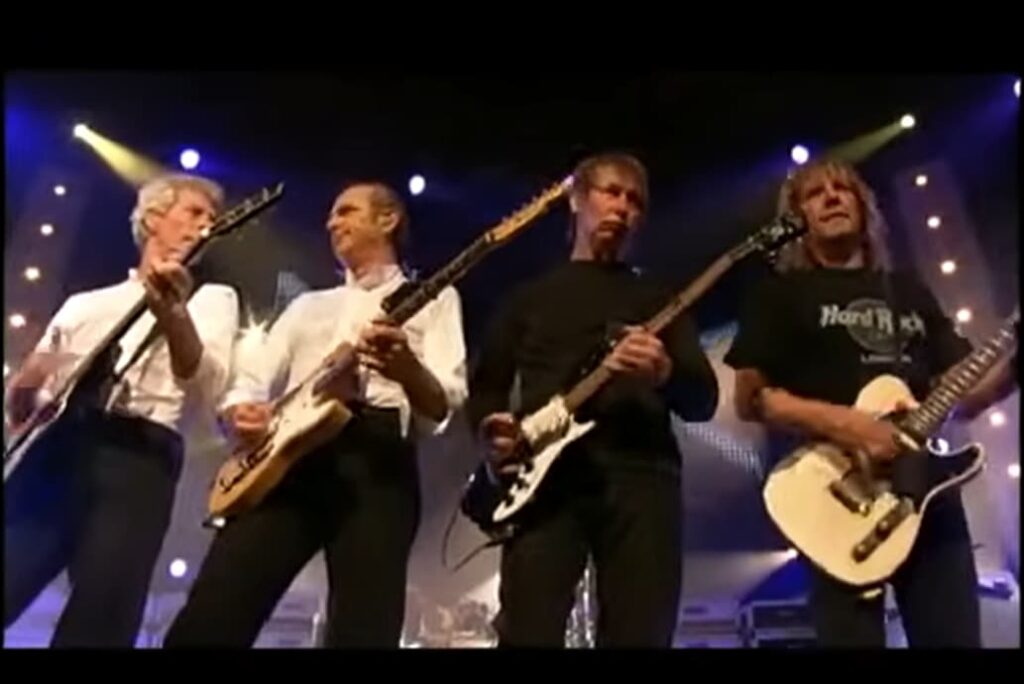
By 2004, when the band revisited “Gerdundula” on stage, that sense of movement had deepened into something more reflective. The years of touring, the countless performances, the subtle shifts in lineup and energy—all of it seemed to settle into the song without altering its core. Rick Parfitt and Francis Rossi still locked into that familiar interplay of rhythm and lead, their guitars weaving together in a way that felt instinctive rather than rehearsed. There is a quiet understanding between them, built not in moments, but over decades.
What stands out most in the 2004 live rendition is not precision, but continuity. The tempo holds steady, the groove remains unbroken, and the audience becomes part of that rhythm almost without realizing it. There is no need for elaborate arrangement or reinvention. The power of “Gerdundula” lies in its refusal to change. It invites listeners not to follow a story, but to inhabit a feeling—a sense of forward motion that asks nothing and gives everything in return.
In contrast to many of the band’s more widely recognized hits, this track carries a certain anonymity. It does not rely on memorable lyrics or a sing along chorus. Instead, it exists in the space between structure and spontaneity, where repetition becomes its own form of expression. And perhaps that is why it has endured so strongly in live settings. Each performance feels slightly different, shaped by the moment, yet unmistakably the same at its core.
Looking back, the absence of chart success feels almost irrelevant. “Gerdundula” was never meant to capture a moment in time. It was meant to stretch across time, to exist in that continuous present that live music creates. In the hands of Status Quo, it becomes less a song and more a state of mind—steady, unyielding, and quietly liberating.
And as the guitars continue their endless cycle, there is a sense that the music could carry on indefinitely, long after the stage has emptied. Not because it demands attention, but because it no longer needs to. It simply exists, moving forward, just as it always has.