
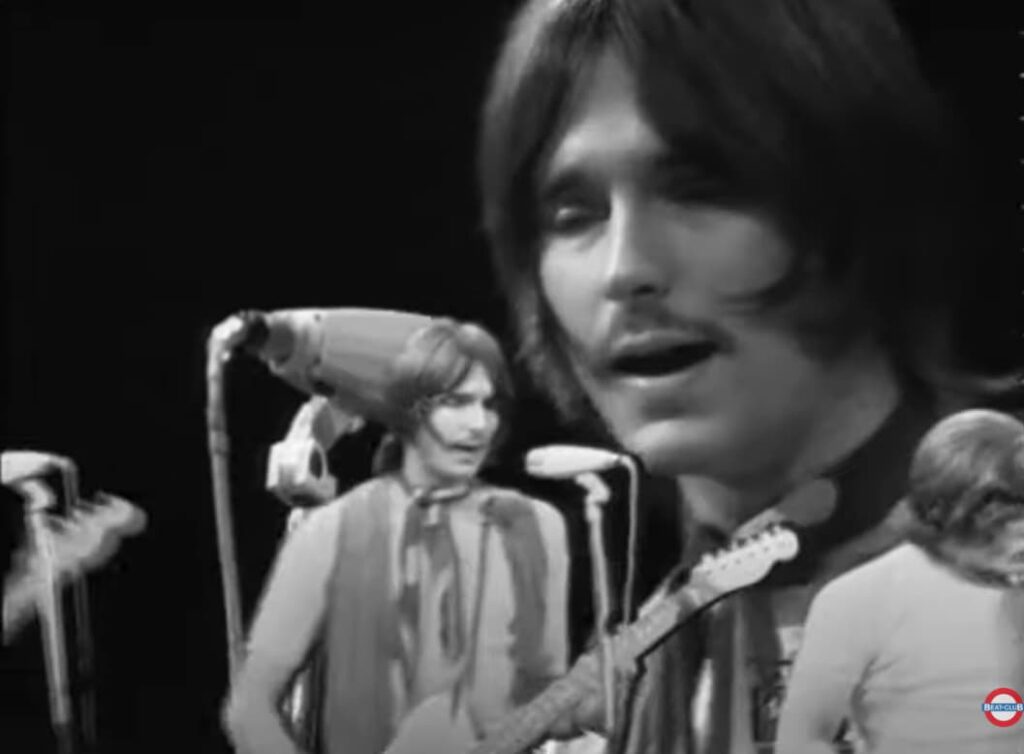
A fleeting glimpse of color in a changing world, where youthful imagination meets the uncertainty of a band searching for its true voice.
Before the denim, before the driving boogie rhythms that would come to define them, Status Quo existed in a different light entirely—one tinted with the soft haze of late 1960s psychedelia. “Technicolour Dreams,” released in 1969 as part of the album Spare Parts, stands as a delicate artifact from that transitional moment. The album itself did not achieve major commercial success, failing to chart significantly in the UK, and the song was never issued as a charting single. Yet its importance lies not in numbers, but in what it reveals about a band still in the process of becoming.
By 1969, the musical landscape in Britain was shifting rapidly. Psychedelic rock, once the dominant force of the mid sixties, was beginning to fade, giving way to harder edged sounds and more grounded songwriting. Status Quo, who had already tasted success with earlier hits like “Pictures of Matchstick Men,” found themselves at a crossroads. “Technicolour Dreams” reflects that uncertainty, carrying echoes of the past while quietly hinting at the future.
The song itself is gentle, almost fragile in its construction. Built on soft melodies and a drifting arrangement, it leans heavily into the psychedelic aesthetic—its lyrics evoking color, imagination, and a kind of dreamlike detachment from reality. There is no urgency here, no driving force pushing the music forward. Instead, it lingers, as though suspended between waking and dreaming. It is a sound that feels deeply rooted in its time, capturing the final glow of an era that was already beginning to dim.
Listening closely, one can hear a different Status Quo than the one that would later fill arenas. The guitars are less aggressive, more atmospheric. The rhythm does not insist, but rather suggests. And the vocals carry a softness that contrasts sharply with the confident, almost rugged delivery that would come later. It is as if the band is still trying on identities, exploring possibilities without yet committing to any single direction.
There is something quietly poignant in that uncertainty. Because in hindsight, we know where the road leads. Within a year, with the release of Ma Kelly’s Greasy Spoon in 1970, Status Quo would abandon much of this psychedelic texture in favor of the stripped down, boogie driven sound that became their signature. Songs like “Gerdundula” would mark the beginning of that transformation, grounding the band in a style that would carry them through decades of success.
Seen in this context, “Technicolour Dreams” becomes more than just a song. It becomes a moment preserved—a glimpse of what might have been, or perhaps what needed to be left behind. Its lack of chart success feels almost fitting. This was not music designed to dominate the airwaves. It was exploratory, introspective, and, in many ways, transitional.
And yet, there is a certain beauty in that. The song does not strive for permanence. It exists in the present tense of its own creation, capturing a band in motion, even if that motion is subtle and inward. The imagery of “technicolour dreams” suggests a world rich with possibility, but also one that cannot quite be held onto. Dreams, after all, have a way of fading when confronted with reality.
For listeners returning to this track after years of knowing Status Quo in their later form, the experience can feel almost disorienting. It is familiar, yet distant. The seeds of what the band would become are there, but they are buried beneath layers of sound that would soon be shed.
Still, the song endures, not because it defines Status Quo, but because it humanizes them. It reminds us that even the most recognizable sounds are born out of uncertainty, out of moments where direction is unclear and the future is unwritten.
And perhaps that is the quiet truth at the heart of “Technicolour Dreams.” Not every step along the way is meant to last. Some are meant simply to be taken, to be experienced, and then to fade—leaving behind just enough color to be remembered, even as the music moves on.