
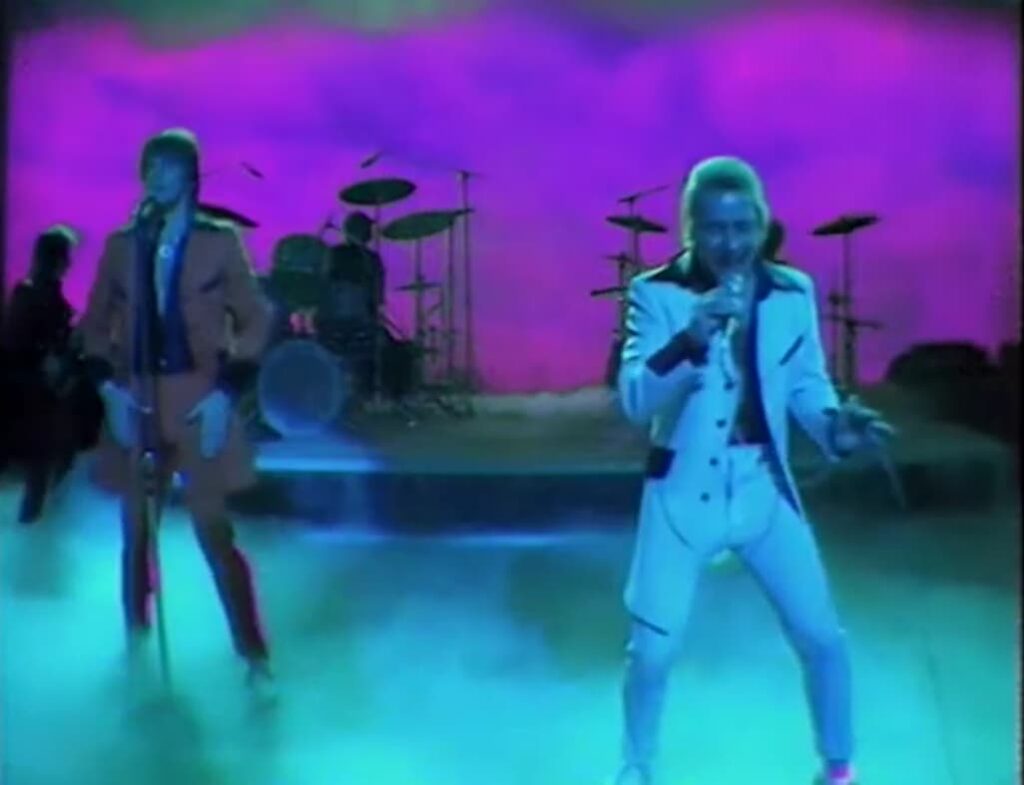
A voice calling from beyond memory, where love lingers like an echo that time cannot fully silence.
When Showaddywaddy performed “Johnny Remember Me” on their television program The Showaddywaddy Show in 1980, they were revisiting a song already steeped in atmosphere and mystery. Their version did not aim to replace the original, but rather to reinterpret it through the warm, nostalgic lens that had come to define their identity. In doing so, they transformed a haunting early 1960s recording into something both familiar and gently renewed.
The song itself was first recorded by John Leyton in 1961, produced by the innovative Joe Meek. Upon its release, “Johnny Remember Me” reached No. 1 on the UK Singles Chart, a remarkable achievement for a track so unconventional in tone. Its success lay not only in its melody, but in its eerie production—Meek’s use of echo and layered sound created a ghostly atmosphere that set it apart from the brighter, more straightforward pop songs of its time.
By 1980, when Showaddywaddy brought the song to their own television audience, its legacy was already well established. Yet the context had changed. The band, known for their revival of 1950s and early 1960s rock and roll, approached the material with a sense of affection rather than experimentation. Their version does not attempt to replicate the unsettling edge of Joe Meek’s production. Instead, it softens it, allowing the song’s emotional core to come forward more clearly.
Lyrically, “Johnny Remember Me” tells a story that borders on the surreal. A voice calls out from beyond, asking not to be forgotten. Whether interpreted as a ghostly presence or as a metaphor for memory itself, the song carries a sense of longing that feels both distant and immediate. The repetition of the title phrase becomes less a plea and more a quiet insistence, as if memory itself is speaking.
In the hands of Showaddywaddy, this narrative takes on a slightly different tone. The harmonies are fuller, the delivery more grounded. Where the original recording felt suspended in an otherworldly space, this version feels closer, more human. The mystery remains, but it is tempered by warmth, by a sense that the past, however distant, is still something that can be gently held rather than feared.
The performance on The Showaddywaddy Show reflects this balance. The staging is simple, the focus placed squarely on the music and the voices. There is no need for elaborate effects to convey the song’s atmosphere. Instead, the band relies on their strength in harmony and their understanding of the material’s emotional weight.
Unlike their earlier chart successes, Showaddywaddy’s version of “Johnny Remember Me” was not released as a major single and did not achieve notable chart positions. But its significance lies elsewhere. It forms part of a broader effort to preserve and reinterpret songs from an earlier era, ensuring that they remain present within a changing musical landscape.
There is something quietly reflective about this approach. By 1980, music had moved through multiple transformations—yet here was a band choosing to look back, not out of resistance, but out of recognition. Recognition that certain songs carry something essential, something that does not diminish with time.
Listening to this version of “Johnny Remember Me,” one is reminded that memory is rarely clear or complete. It comes in fragments, in echoes, in voices that seem to arrive from somewhere just beyond reach. And yet, those fragments are enough. They carry meaning, even when their origin is uncertain.
In the end, the song endures not because of its chart history or its production techniques, but because of the feeling it leaves behind. A quiet call, repeated across time, asking not to be forgotten. And in performances like this, that call is answered—not loudly, not dramatically, but with a steady, enduring presence that ensures it continues to be heard.