
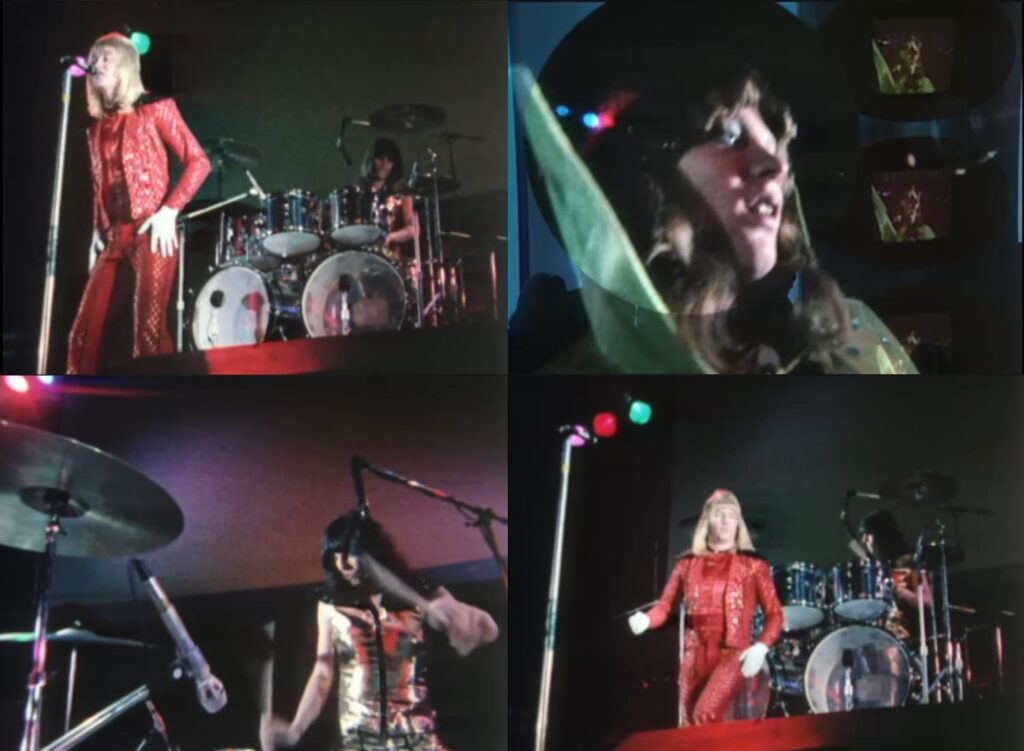
A sudden eruption of sound and chaos turned into rhythm, where confusion becomes energy and a night of unrest transforms into rock and roll history.
When Sweet released “The Ballroom Blitz” in September 1973, it did not simply climb the charts—it exploded into them. The single reached No. 2 on the UK Singles Chart and climbed to No. 5 on the US Billboard Hot 100, becoming one of the band’s most recognizable and enduring hits. Drawn from their album Desolation Boulevard, the song marked a defining moment in glam rock, capturing both the theatrical energy of the genre and something far more unpredictable beneath the surface.
The story behind “The Ballroom Blitz” is not imagined, nor is it exaggerated for effect. It is rooted in a real incident that occurred earlier in 1973, when Sweet performed at the Grand Hall in Kilmarnock, Scotland. What began as a routine concert quickly descended into chaos when sections of the audience turned hostile, throwing bottles and forcing the band to leave the stage abruptly. That experience—confusing, unsettling, and charged with sudden aggression—became the foundation for the song. Written by the prolific songwriting duo Nicky Chinn and Mike Chapman, the track transforms that moment of disorder into something structured, even exhilarating.
From its very first seconds, “The Ballroom Blitz” signals that it is not a conventional rock song. The spoken introduction, with its roll call of band members—“Are you ready, Steve? Andy? Mick?”—feels almost like a gathering of forces before impact. It is theatrical, yes, but also oddly grounded, as if preparing the listener for something that is about to spiral beyond control. And then the music arrives—fast, urgent, relentless.
Musically, the track embodies the glam rock aesthetic at its peak. Driving drums, sharp guitar riffs, and layered vocals combine to create a sound that feels both polished and chaotic. The contrast is essential. Beneath the tight arrangement lies the memory of disorder, of a crowd turning against the very performance it came to witness. Yet instead of resisting that memory, Sweet embraces it, reshaping it into something almost celebratory.
The lyrics reflect this tension. Lines describing a man in the back shouting “everyone attack” are delivered not with fear, but with a kind of detached observation. It is as though the band is recounting the event from a distance, turning confusion into narrative, and narrative into rhythm. In this way, “The Ballroom Blitz” becomes more than just a retelling—it becomes a reinterpretation, where the emotional weight of the experience is transformed into energy that drives the song forward.
The success of the single in both the UK and the United States speaks to its universal appeal. While rooted in a specific incident, the song captures a broader feeling—those moments when control slips, when order gives way to unpredictability, and when the only response is to move with the momentum rather than resist it.
For Sweet, this track represented both a peak and a turning point. It solidified their place within the glam rock movement, alongside other acts that valued image and performance as much as sound. Yet “The Ballroom Blitz” stands apart even within that context. It is less about style and more about experience, less about appearance and more about reaction.
Looking back, there is something almost paradoxical about the song’s legacy. A moment of disruption, something that might have been forgotten or dismissed, instead became one of the most enduring tracks of the era. The chaos of that night in Kilmarnock did not end the performance—it extended it, carried it forward into a recording that would outlast the memory of the event itself.
And perhaps that is what gives “The Ballroom Blitz” its lasting resonance. It reminds us that not every story begins in harmony. Some begin in confusion, in noise, in moments that seem to fall apart. But in the hands of the right artists, even those moments can be reshaped into something that endures—something that continues to move, long after the original chaos has faded into silence.