
A rhythm borrowed from the past becomes a living pulse again, where joy is simple, direct, and impossible to resist.
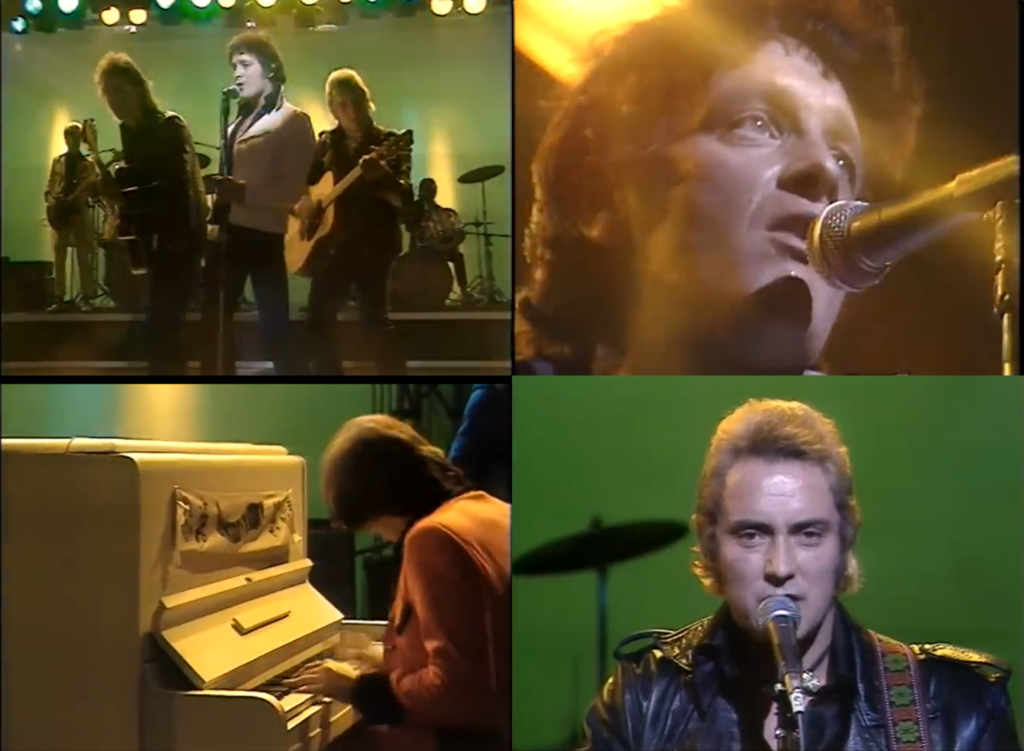
When Showaddywaddy performed “Say Mama” on The Showaddywaddy Show, the moment carried a kind of unpretentious vitality that defined their entire career. It was not about reinvention or reinterpretation in the modern sense. It was about preservation through performance, about taking a song rooted in the early days of rock and roll and allowing it to breathe again in a different time, without losing its original spirit.
The song itself traces back to Gene Vincent, who recorded “Say Mama” in 1958. Vincent’s version, built on a raw, driving rhythm and his unmistakable vocal edge, reflected the restless energy of rock and roll in its formative years. It was not a major chart hit in the way some of his earlier recordings had been, but it carried a certain authenticity—a sense that the music was still close to its roots, still unpolished, still searching.
By the time Showaddywaddy brought “Say Mama” to television audiences, that rawness had been reshaped into something warmer, more communal. The late 1970s and early 1980s saw the band firmly established as torchbearers of the rock and roll revival movement. While much of the contemporary music scene was moving toward new wave, synth driven sounds, and more complex production, Showaddywaddy chose a different path. They returned to the basics—strong rhythm, clear melodies, and harmonies that felt both familiar and immediate.
Their version of “Say Mama” does not attempt to replicate Gene Vincent’s intensity. Instead, it reframes the song through their own identity. The arrangement is tighter, more polished, with layered vocals that give the track a fuller, almost celebratory feel. Where Vincent’s performance carried a sense of urgency, Showaddywaddy brings a sense of enjoyment, as if the song itself has become something to be shared rather than something to be expressed alone.
On The Showaddywaddy Show, this transformation becomes especially clear. The performance is straightforward, without unnecessary embellishment. The focus remains on the music, on the interplay between voices, on the steady rhythm that drives the song forward. There is a sense of ease in the way the band performs, a confidence that comes not from innovation, but from familiarity. They know exactly what the song requires, and they give it just that—nothing more, nothing less.
Lyrically, “Say Mama” is as direct as its title suggests. It does not delve into complex storytelling or layered metaphor. Instead, it captures a feeling—simple affection, expressed without hesitation or complication. This simplicity is part of its strength. It allows the listener to engage with the song immediately, without needing to interpret or analyze.
What makes this performance resonate is not the uniqueness of the material, but the sincerity of its delivery. Showaddywaddy does not treat the song as a relic. They treat it as something alive, something that still has a place in the present moment. And in doing so, they remind us that not all music needs to evolve in order to remain meaningful. Some songs endure precisely because they remain unchanged.
Unlike many of the band’s singles, this particular performance of “Say Mama” was not tied to a charting release during this period. Its significance lies in its role within the band’s broader catalogue—a continuation of their commitment to keeping early rock and roll alive for new audiences.
There is a quiet honesty in that commitment. It does not seek recognition or reinvention. It simply continues, steady and unassuming, much like the rhythm at the heart of the song itself.
And as the performance unfolds, what becomes clear is that “Say Mama” does not belong to any single moment in time. It exists wherever it is played, wherever its rhythm is felt. In the hands of Showaddywaddy, it becomes not just a memory of what rock and roll once was, but a reminder of what it still can be—direct, joyful, and enduring in its simplicity.