
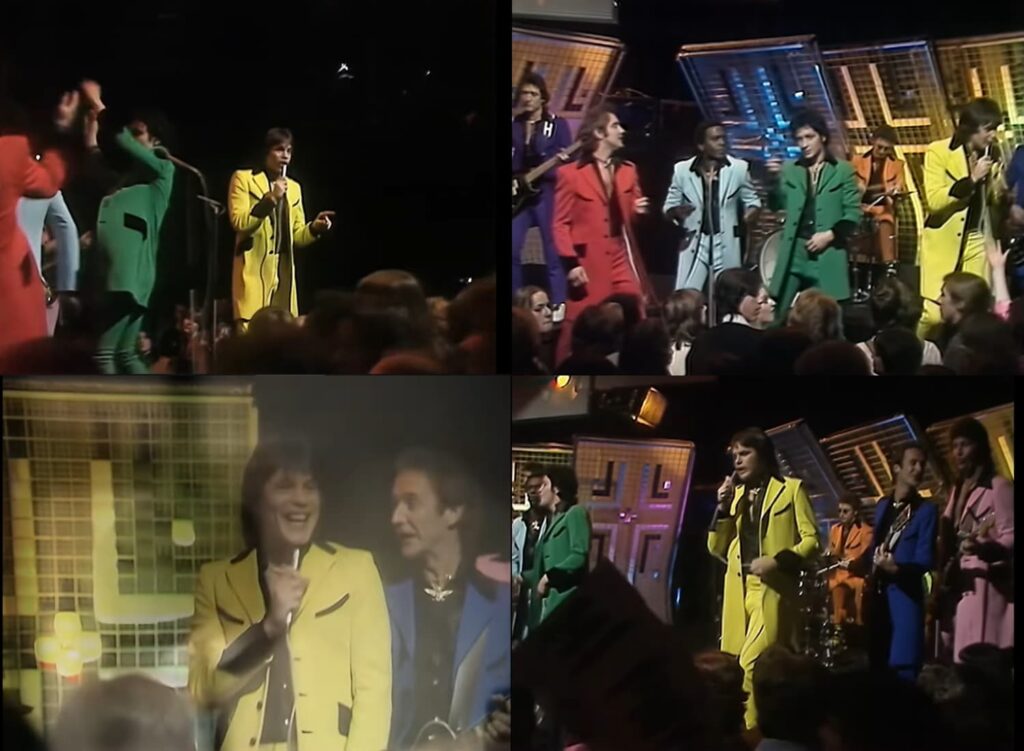
A night built on rhythm and memory, where the dance floor becomes a refuge and time quietly folds back on itself
When Showaddywaddy performed “A Night At Daddy Gees” on Top of the Pops on November 15, 1979, the moment carried more than the pulse of a chart hit. It carried the echo of a past that refused to fade, a past where music was not only heard, but lived in crowded rooms, under dim lights, with a rhythm that seemed to belong to everyone at once.
Released earlier that year, “A Night At Daddy Gees” became one of the band’s most successful singles, reaching No. 4 on the UK Singles Chart. At a time when disco still dominated and new wave was beginning to reshape the musical landscape, Showaddywaddy remained committed to something more grounded. Their sound, rooted in the spirit of 1950s rock and roll and early 1960s pop, offered a kind of continuity that felt increasingly rare.
The song itself was not drawn from a single earlier recording, but rather constructed as a tribute to an era. “Daddy Gees” is not a specific place, but it feels like one—a club, a hall, a gathering point where music and memory intertwine. It represents the countless venues where rock and roll first took shape, where people came together not to analyze music, but to feel it.
Musically, “A Night At Daddy Gees” is built on a steady, driving rhythm, supported by layered harmonies that reflect the doo wop influences central to Showaddywaddy’s identity. The arrangement is tight, purposeful, and unpretentious. There is no attempt to modernize the sound beyond recognition. Instead, the band leans into familiarity, allowing the structure of the song to carry its own weight.
On Top of the Pops, this approach becomes even more apparent. The performance is direct, almost understated. There are no elaborate effects, no distractions from the music itself. The focus remains on the interplay between voices, on the rhythm that moves steadily forward, on the sense that the band knows exactly what it wants to convey.
Lyrically, the song evokes a night out that feels both specific and universal. It speaks of anticipation, of stepping into a space where the outside world briefly disappears. There is a sense of belonging within the music, a feeling that whatever exists beyond those walls can wait. It is not a story with a defined beginning or end. It is a moment, captured and held just long enough to be remembered.
What gives “A Night At Daddy Gees” its lasting resonance is not complexity, but atmosphere. It does not rely on intricate storytelling or emotional intensity. Instead, it creates a space—one that listeners can step into, even years later. That space is filled with sound, with movement, with the quiet understanding that music can transform an ordinary evening into something meaningful.
For Showaddywaddy, the song represents more than another entry in their catalogue. It reflects their broader purpose. While many artists sought to redefine music for a changing world, they chose to preserve a certain feeling, a certain way of experiencing sound that might otherwise have been lost.
Watching the 1979 performance now, there is a sense of distance, but also of clarity. The band is not chasing relevance. They have already found their place. Every note, every harmony, every movement feels intentional, as if guided by a memory that remains just within reach.
And perhaps that is what “A Night At Daddy Gees” ultimately offers. Not a return to the past, but a reminder that the past is never entirely gone. It lingers in melodies, in rhythms, in the quiet spaces between notes.
In the end, the song does not ask to be understood. It simply invites the listener to step inside, to stay for a while, and to remember what it felt like when music was not just something you heard, but something you lived.