
A playful song about love’s lightness, where joy replaces longing and the past dances easily into the present
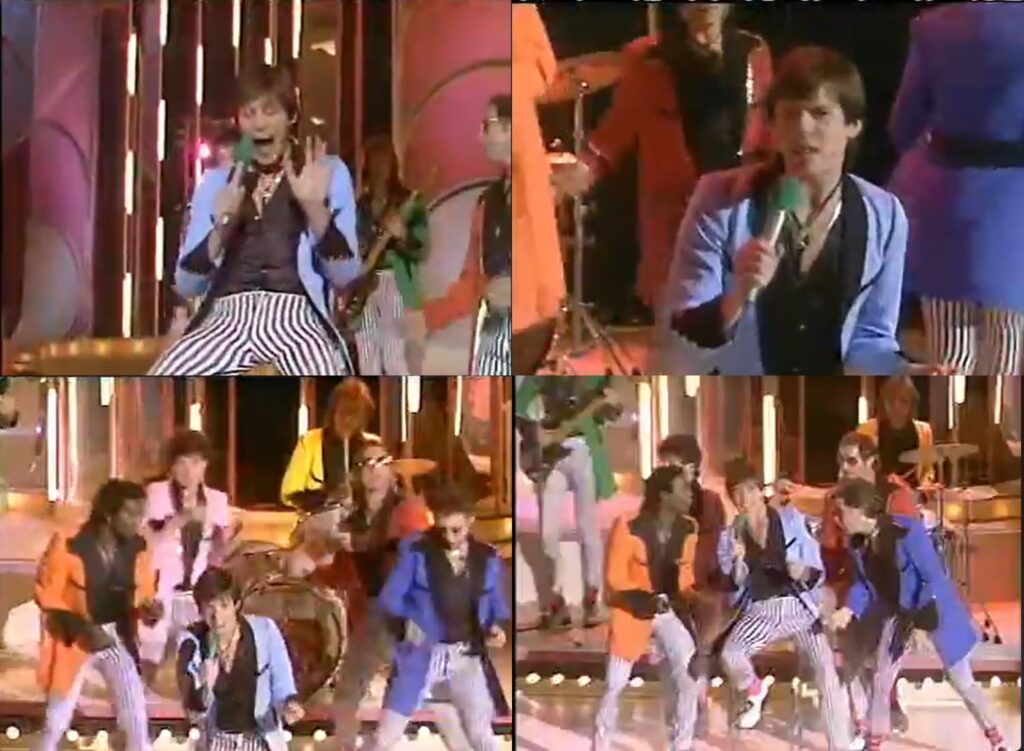
By the time Showaddywaddy appeared on Rod & Emu’s Saturday Special on January 15, 1983, performing “Goody Goody”, they were no longer simply a band chasing chart success. They had become something steadier, something more enduring—a living bridge between eras, carrying the spirit of early popular music into a world that had already begun to move on.
The song “Goody Goody” itself reaches far back, long before the age of rock and roll. Written in 1936 by Matty Malneck and Johnny Mercer, it was first popularized by Benny Goodman and his orchestra, with vocals by Helen Ward. That original version reached No. 1 on the charts in the United States in 1936, embodying the buoyant optimism of the swing era. It was a song built not on heartbreak, but on a kind of cheerful resilience—the idea that if love goes wrong, one can simply smile and move on.
Decades later, the song found renewed life through artists like Frankie Lymon & the Teenagers, who reintroduced it to a younger audience in the 1950s, adding a youthful energy that connected swing to the emerging language of rock and roll. By the time Showaddywaddy approached it, “Goody Goody” had already lived several lives, each one slightly different, yet all tied together by its unmistakable melody and spirit.
Showaddywaddy’s version, released as a single in late 1982, reached No. 10 on the UK Singles Chart, marking one of their final major chart successes. It was a reminder that even as musical trends shifted toward new wave and electronic sounds, there remained a place for something more rooted, more familiar. Their arrangement leaned into the doo-wop style, with layered harmonies and a rhythmic clarity that felt both nostalgic and immediate.
The performance on Rod & Emu’s Saturday Special captured that balance perfectly. There was no attempt to modernize the song beyond recognition, no desire to reshape it into something it was never meant to be. Instead, the band embraced its simplicity. The vocals were clean, the rhythm steady, the presentation unadorned. It felt less like a performance and more like a continuation—another moment in the long life of a song that refused to fade.
Lyrically, “Goody Goody” offers a perspective that feels almost rare in its lightness. Rather than dwelling on loss or regret, it chooses a different path. It acknowledges disappointment, but refuses to be defined by it. There is a quiet strength in that choice, a sense that moving forward does not always require struggle. Sometimes, it simply requires acceptance.
For Showaddywaddy, this song fit naturally within their identity. Their music had always been about more than revival. It was about preservation, about keeping certain sounds and sentiments alive in a world that often moves too quickly to remember them. With “Goody Goody”, they did not just revisit the past. They allowed it to exist comfortably in the present.
There is something deeply reassuring in that approach. It does not demand attention. It does not seek to overwhelm. It simply remains, steady and unchanged, offering a reminder that not everything needs to be reinvented to remain meaningful.
And as the performance unfolds, what lingers is not just the melody, but the feeling it carries. A sense of ease, of quiet confidence, of knowing that even when things do not turn out as expected, there is still a way forward—light, unburdened, and perhaps even a little joyful.