
A quiet confession wrapped in simplicity—“Just Get Up and Close the Door” reveals how love can fade not in anger, but in silence
When Johnny Rodriguez recorded “Just Get Up and Close the Door” in 1975, he was no longer a newcomer trying to prove himself—he was already one of the most distinctive voices in country music. Released as a single that same year, the song climbed to No. 1 on the Billboard Hot Country Singles chart, becoming another defining success in a career that had, remarkably, risen with unusual speed. For an artist who had only recently broken through with hits like “You Always Come Back (To Hurting Me)” and “Ridin’ My Thumb to Mexico,” this achievement confirmed something deeper than popularity. It confirmed staying power.
Yet the true weight of “Just Get Up and Close the Door” is not found in its chart position, but in its restraint. Written by Bob McDill, a songwriter known for his ability to express complex emotions with disarming simplicity, the song tells a story that feels almost too quiet to notice at first. There is no dramatic confrontation, no raised voices, no attempt to assign blame. Instead, it unfolds in the stillness of a moment when everything that needed to be said has already been said—or perhaps never said at all.
The central image is striking in its modesty: one person asking the other to simply get up and close the door on the way out. It is not an act of anger, but of acceptance. Love has already ended; what remains is the dignity of letting go without turning it into something louder than it needs to be. In that sense, the song captures a kind of emotional maturity that country music has always understood well—the idea that heartbreak does not always arrive with chaos. Sometimes, it arrives quietly, sits beside you for a while, and then leaves just as quietly.
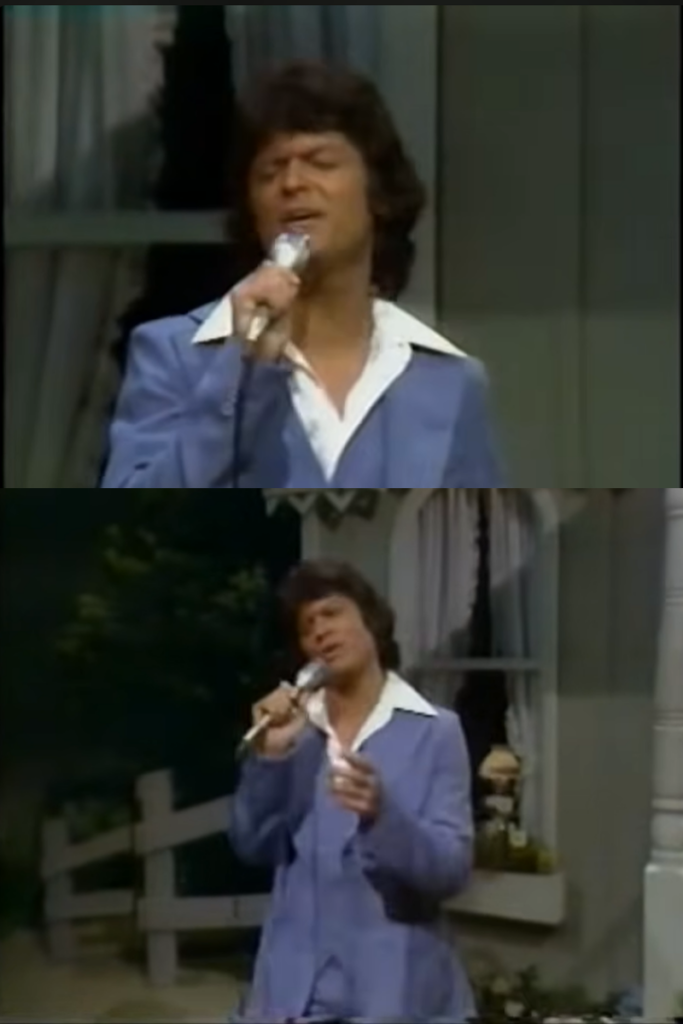
In live performances from 1975, Johnny Rodriguez brought an even deeper sense of intimacy to the song. His voice—warm, steady, and unmistakably sincere—carried the weight of the lyrics without ever forcing them. There is a certain stillness in the way he delivers each line, as if he understands that the power of the song lies in what is left unsaid. Unlike many performers who might lean into the sorrow, Rodriguez holds back, allowing the listener to step into the space between the words.
This approach reflects something essential about his artistry during that period. As one of the first Mexican-American artists to achieve major success in mainstream country music, Johnny Rodriguez brought a perspective that felt both fresh and deeply rooted in tradition. His phrasing, his timing, even the subtle textures in his voice—all of it suggested a storyteller who had lived with these emotions long enough to no longer need to exaggerate them.
There is also a broader cultural context to consider. By the mid-1970s, country music was beginning to shift, with the outlaw movement gaining momentum and artists exploring new forms of expression. Yet songs like “Just Get Up and Close the Door” remained anchored in the classic storytelling tradition. It did not chase trends; it simply told the truth as plainly as it could. And in doing so, it achieved something that many more elaborate songs could not—it felt real.
Listening to that 1975 live rendition now, one might notice how little has changed in the way the song resonates. The setting may feel distant, the sound slightly softer around the edges, but the emotion remains immediate. It is the kind of performance that does not demand attention, but quietly earns it.
In the end, “Just Get Up and Close the Door” is not about endings as much as it is about understanding them. It reminds us that not every goodbye needs to be spoken aloud, and not every story needs a dramatic conclusion. Sometimes, all it takes is a simple gesture—a door closing softly—to say everything that words no longer can.