
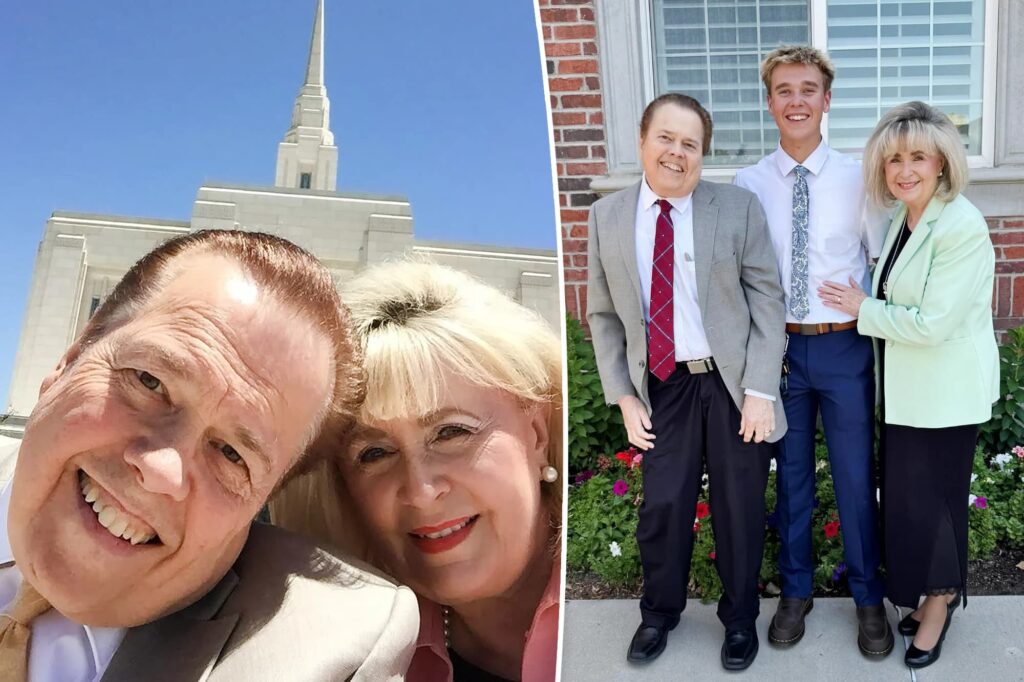
A love that never needed the stage—only time, loyalty, and the quiet strength to endure
There are love stories in music that unfold loudly, surrounded by applause and bright lights, and then there are those that live quietly behind the stage—steady, enduring, and perhaps even more meaningful because of it. The life of Alan Osmond, the eldest member of The Osmonds, belongs to the latter kind. It is not only a story of harmony and performance, but of a lifelong devotion that remained constant even as the music softened and the years moved forward.
When Alan spoke about his wife, Suzanne Pinegar, there was always a noticeable shift in his voice—not in volume, but in feeling. He never treated their relationship as something ordinary or expected. Instead, he spoke of it as something that had, from the very beginning, quietly reshaped his life. He often recalled the first time he saw her, a young cheerleader at Brigham Young University, and how, in his own words, she had “stolen his heart.” It is a phrase often used lightly, but in Alan’s telling, it carried a sincerity that felt untouched by time.
Their courtship moved quickly, almost unexpectedly so. With a world tour approaching, Alan faced a choice that revealed more about his character than any performance ever could. “You can’t take a girlfriend on a world tour,” he once explained, “only a wife.” And so, in less than a month, a decision was made—not out of impulse, but out of a quiet certainty. It was the kind of certainty that does not ask for time to prove itself. It simply knows.
As the years passed, the stage lights dimmed, and life introduced challenges that no audience could see. Alan’s battle with multiple sclerosis became a defining part of his later life, a condition that gradually took more than it gave. Yet, in every account, every reflection, one presence remained unchanged—Suzanne. He spoke of her not as someone who simply stood beside him, but as someone who carried him through moments when strength was no longer something he could rely on alone.
There is something deeply revealing in the way Alan described her support. He did not frame it as sacrifice, nor as obligation. Instead, he spoke of it as love in its most natural form—quiet, unwavering, and without the need for recognition. It is easy to celebrate love in its early days, when everything feels new and certain. It is something else entirely to recognize it after decades, when it has been tested, reshaped, and proven in ways that words can barely capture.
Even in the final chapter of his life, in April 2026, that connection remained visible in the simplest of gestures. Alan shared bright, smiling selfies with Suzanne—images that, at first glance, seemed ordinary. But within them was something far more lasting. There was no need for grand declarations. The years had already spoken. What remained was presence—the quiet reassurance of two people who had walked through life together and had never truly let go.
In a world where stories often seek dramatic endings, Alan Osmond’s life offers something different. It reminds us that the most enduring forms of love are rarely the loudest. They are found in the decisions made without hesitation, in the support given without condition, and in the quiet moments that continue long after the music fades.
And perhaps that is what lingers most. Not the fame, not the performances, but the image of a man who, even at the end, still looked at the woman beside him with the same recognition he felt all those years ago—when she first, so effortlessly, stole his heart.