
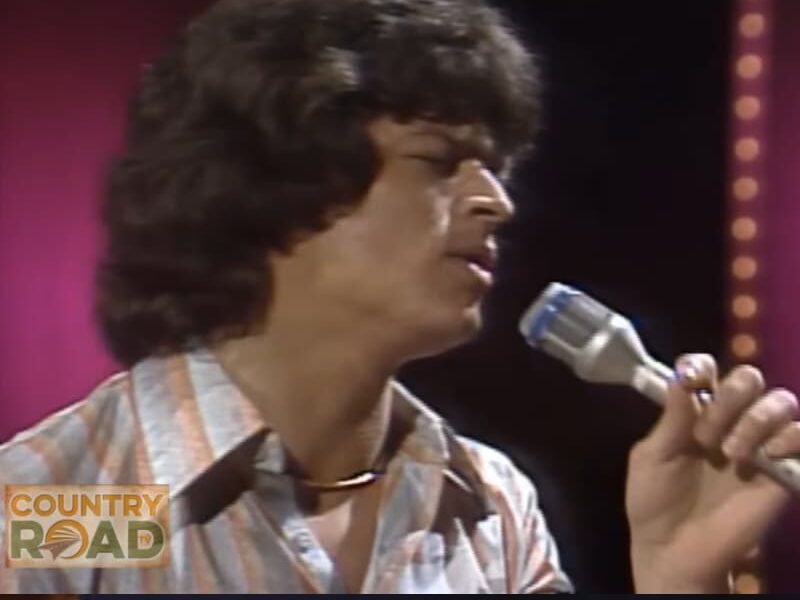
A gentle truth about love’s imperfections—“If Practice Makes Perfect” reminds us that the heart never quite learns the way we hope it will
In 1977, Johnny Rodriguez released “If Practice Makes Perfect”, a song that quietly found its place among the most thoughtful recordings of his career. Issued as a single from the album Practice Makes Perfect, the track climbed to No. 11 on the Billboard Hot Country Singles chart—a respectable showing in a period when Rodriguez was navigating the evolving landscape of country music while holding onto the emotional clarity that had defined his earlier success. Though it did not reach the top as some of his previous hits had, the song endures in a different way, not through chart dominance, but through the honesty it carries.
Written by Johnny Rodriguez himself, alongside composer Earl Montgomery, “If Practice Makes Perfect” feels deeply personal, almost as if it were drawn from moments that resist easy explanation. The title alone suggests a familiar idea—the notion that repetition leads to mastery—but the song gently challenges that belief. When it comes to love, no amount of experience seems to prepare the heart for what it will face next. Each attempt feels new, uncertain, and strangely fragile, no matter how many times one has been there before.
There is something quietly disarming in the way the song unfolds. The melody is unhurried, allowing space for reflection, while Rodriguez’s voice carries a tone that is neither bitter nor defeated. Instead, it suggests understanding—an awareness that some things in life are not meant to be perfected. His delivery avoids excess; there is no dramatic emphasis, no attempt to push emotion beyond its natural limits. This restraint becomes the song’s strength, drawing the listener inward rather than overwhelming them.
By the late 1970s, Johnny Rodriguez had already established himself as one of the most distinctive voices in country music, blending traditional influences with subtle elements of his Mexican-American heritage. Yet with “If Practice Makes Perfect”, there is a noticeable shift toward introspection. It feels less like a performance aimed at the charts and more like a quiet conversation, one that acknowledges the complexities of love without trying to resolve them.
The song’s narrative speaks to a universal experience—the realization that even after repeated heartbreaks, the next one still carries the same weight. There is no emotional immunity, no gradual hardening that makes things easier. If anything, each experience deepens the understanding of what is being lost. This idea is expressed not through elaborate storytelling, but through simple, carefully chosen lines that linger long after they are heard.
Listening to “If Practice Makes Perfect” today, there is a sense of time folding in on itself. The production, with its gentle instrumentation and warm tones, places it firmly within its era, yet the feeling it conveys remains unchanged. It is the kind of song that does not demand attention, but quietly stays with you, resurfacing in moments when its meaning becomes unexpectedly clear.
There is also a subtle courage in the song’s message. In a world that often values certainty and control, it accepts that some aspects of life remain beyond both. Love, in this sense, is not a skill to be mastered, but an experience to be lived—again and again, despite the risk.
In the end, “If Practice Makes Perfect” stands as a reminder that the heart does not follow rules. It does not improve through repetition, nor does it learn to avoid pain entirely. Instead, it continues, quietly and persistently, finding its way through each new beginning and each inevitable ending. And perhaps that is where its true strength lies—not in perfection, but in its willingness to keep going, even without it.