
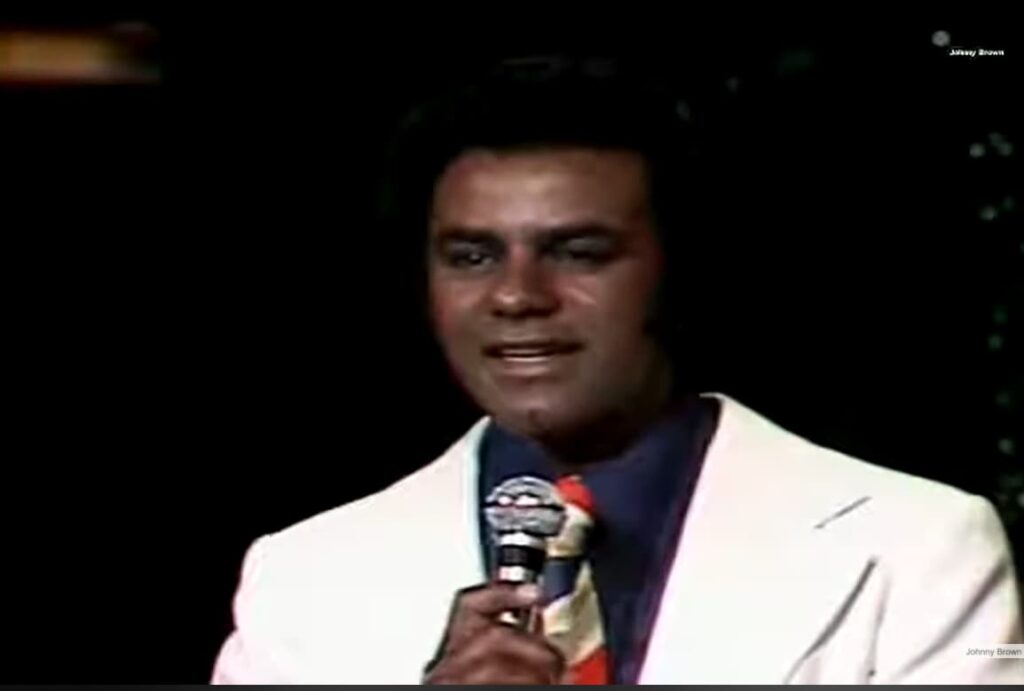
A quiet hymn for a divided world—“If We Only Have Love” turns simplicity into something enduring, where hope is not loud, but deeply felt
When Johnny Mathis performed “If We Only Have Love” in Paris, 1975, it felt less like a concert moment and more like a gentle offering—one that asked for stillness rather than applause. By then, Johnny Mathis was already a voice long associated with elegance and emotional clarity, a singer whose phrasing carried a kind of patience rarely heard in popular music. Yet this performance revealed something even quieter: a willingness to step away from romance and into something more reflective, almost spiritual in its intention.
The song itself, “If We Only Have Love,” originates from the work of Jacques Brel, adapted into English by Rod McKuen. It was never designed to dominate charts, and indeed, Johnny Mathis’s version was not released as a major commercial single, nor did it achieve notable chart positions on the Billboard Hot 100. Instead, it found its place within his broader repertoire—often associated with live performances and special recordings that leaned toward interpretation rather than commercial ambition. In many ways, that absence from the charts only deepens its meaning. This is not a song measured by numbers. It is measured by what it leaves behind in the listener.
By 1975, the world had already moved through decades marked by conflict, uncertainty, and shifting ideals. Songs about love were no longer just about romance—they had begun to carry a wider resonance. And “If We Only Have Love” stands firmly in that tradition. It speaks not of personal longing, but of collective hope. A fragile belief that even in the absence of everything else—certainty, security, permanence—love might still be enough to hold something together.
What makes Johnny Mathis’s Paris performance so memorable is not simply the setting, though the city itself seems to echo the sentiment of the song. It is the restraint in his delivery. He does not push the message forward. He allows it to unfold. Each line is given space, as if he understands that the song does not need to convince—it only needs to be heard.
There is a particular quality in his voice during this period—smooth, controlled, yet carrying an undercurrent of something unspoken. It is not sadness, exactly. Nor is it optimism in the conventional sense. It is closer to acceptance. The recognition that the world may not change easily, but that the act of hoping still holds value.
The lyrics themselves move with a quiet determination. They do not promise resolution. They do not offer easy answers. Instead, they return, again and again, to a single idea—that love, in its simplest form, might be enough. In lesser hands, such a message could feel naïve. But in the voice of Johnny Mathis, it becomes something else entirely. Something grounded. Something that feels lived rather than imagined.
Looking back, the performance carries an added layer of meaning. It belongs to a time when music still allowed for moments of stillness—when a song could ask for reflection without needing to justify itself through immediacy or spectacle. There is no urgency here, no attempt to capture attention quickly. It unfolds at its own pace, trusting that the listener will follow.
And perhaps that is why it continues to resonate. Not because it stands out in the way of a hit record, but because it lingers. It stays. It returns in quiet moments, when the noise of the world feels too heavy, and something simpler is needed.
In the end, “If We Only Have Love” is not a solution. It is not even a conclusion. It is a thought—held gently, repeated carefully, and offered without insistence. And in that offering, Johnny Mathis leaves behind something that does not fade easily: a reminder that sometimes, the most enduring truths are the ones spoken the softest.