
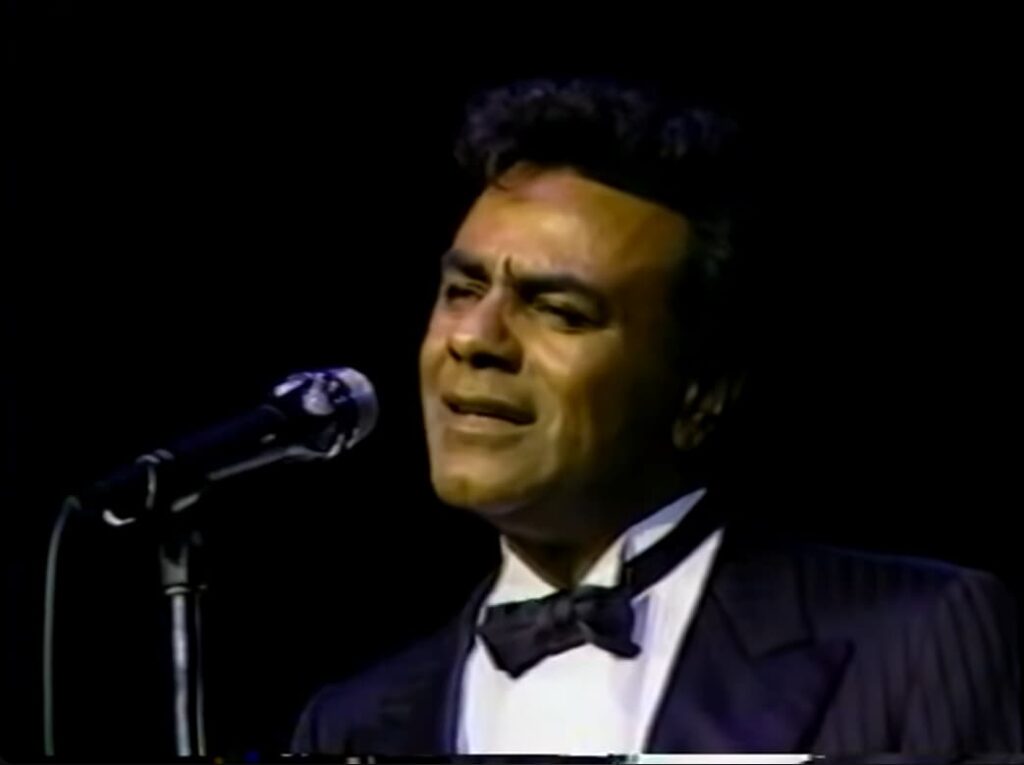
A question that lingers beyond the final note—“How Do You Keep the Music Playing” becomes a meditation on love, time, and the fragile art of holding on
When Johnny Mathis performed “How Do You Keep the Music Playing” in concert in 1988, he was not introducing a new song to the world, but rather revisiting a composition that had already earned its place among the great modern standards. Written by Michel Legrand, with lyrics by Alan Bergman and Marilyn Bergman, the song was originally featured in the 1982 film Best Friends and went on to receive an Academy Award nomination for Best Original Song. Though it did not dominate the pop charts in the traditional sense, it found a lasting home on Adult Contemporary radio and within the repertoire of artists who understood its emotional depth.
By the time Mathis brought it to the stage in 1988, the song had already matured—its meaning deepened by years of interpretation, its questions more resonant with time. And yet, in his voice, it felt as though it had only just been asked.
There is something unmistakably reflective in the way Johnny Mathis approaches this performance. He does not rush the opening lines. Instead, he allows them to unfold with patience, as though the question itself requires space to be understood. “How do you keep the music playing?”—it is not delivered as a dramatic plea, but as a quiet inquiry, one that carries within it both hope and uncertainty.
The arrangement, typical of Mathis’ late 1980s concert style, leans into orchestral elegance. Strings rise gently beneath the melody, never overwhelming, always supporting. The tempo is unhurried, almost suspended, giving each phrase time to settle. It is a setting that invites listening rather than reaction, reflection rather than applause.
What makes this performance particularly affecting is the stage of life from which it emerges. By 1988, Johnny Mathis had long since established himself as one of the defining voices of romantic music. He had sung of first love, of longing, of fleeting moments of connection. But here, the perspective is different. This is not a song about beginnings. It is about continuation. About what happens after the initial spark, when the reality of time begins to press against feeling.
The lyrics themselves are deceptively simple, yet profoundly searching. They do not offer answers. Instead, they circle around the central question, examining it from different angles. How does one sustain something as delicate as love? How does one preserve the harmony when life inevitably introduces discord? These are not questions that can be resolved within the confines of a song—and perhaps that is precisely why the song endures.
Mathis understands this. He does not attempt to resolve the tension within the lyrics. Instead, he leans into it. His phrasing is careful, measured, allowing certain words to linger just a moment longer than expected. There is a subtle weight in his delivery, not heavy, but present—suggesting that the question has been lived with, not merely sung.
Unlike many performances that seek to impress through vocal power, this one finds its strength in restraint. Mathis does not push his voice beyond what the song requires. He trusts the material, and in doing so, allows the listener to meet him halfway. It is a performance built on understanding rather than display.
There is also a quiet universality in “How Do You Keep the Music Playing.” While it speaks directly of romantic love, its reach extends further. It touches on the broader idea of continuity—of maintaining meaning in the face of change, of holding onto something that cannot remain exactly as it once was. In that sense, the “music” becomes more than metaphor. It becomes a symbol of everything that endures, even as it evolves.
Looking back on that 1988 concert performance, one is struck not by any single moment, but by the overall atmosphere it creates. It is not a performance that demands to be remembered for its grandeur. Instead, it settles quietly into memory, much like the question it poses.
In the end, Johnny Mathis does not answer the question posed by “How Do You Keep the Music Playing.” He leaves it open, unresolved. And perhaps that is the most honest approach. Because some questions are not meant to be answered once and for all. They are meant to be returned to, again and again, each time revealing something slightly different.
And so the music continues—not because it has been perfectly preserved, but because it is allowed to change, to breathe, to carry within it the passage of time.