
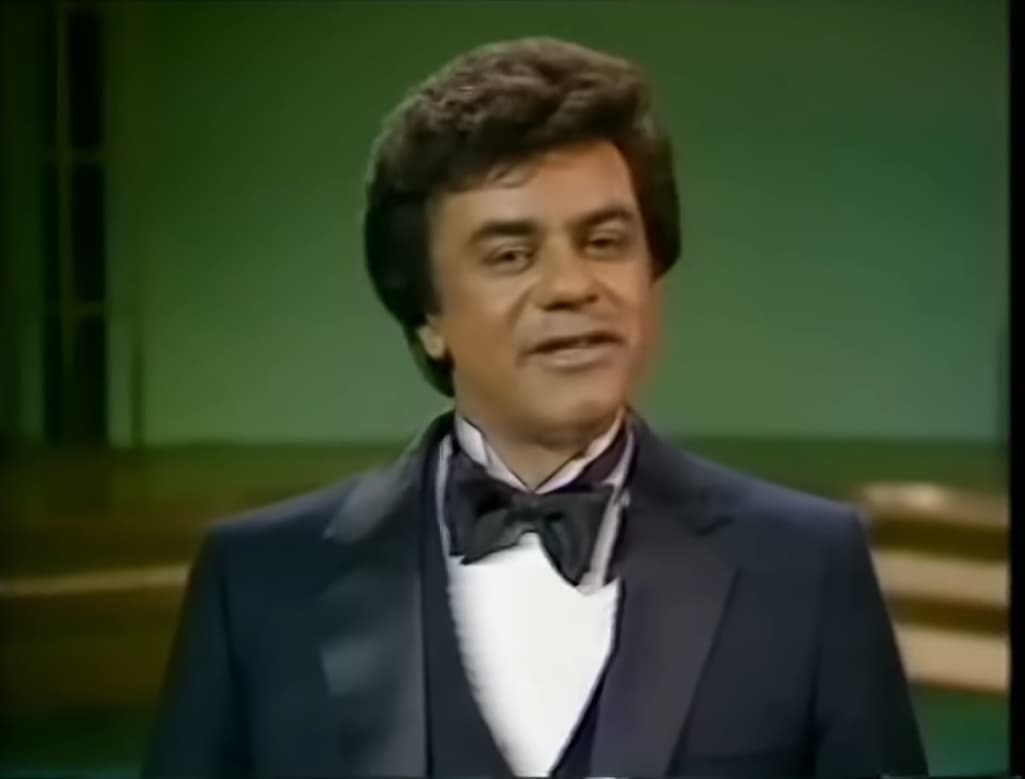
A melody that lingers like memory itself—where love is not recalled, but quietly relived
When Johnny Mathis recorded “Unforgettable”, he was stepping into a song that already carried history within it. Written by Irving Gordon and first immortalized by Nat King Cole in 1951, the song had reached No. 12 on the US pop chart in its original release. By the time Mathis revisited it for his 1959 album Open Fire, Two Guitars, “Unforgettable” was no longer just a song—it was a standard, a piece of emotional language shared across generations.
Mathis’s version was never intended to compete with the original. It did not enter the charts as a major standalone single, nor did it seek to redefine the composition. Instead, it offered something more intimate: a reinterpretation shaped by restraint, by nuance, and by the unmistakable tone that had already begun to define his artistry. Where Nat King Cole’s version carried a certain richness and authority, Mathis approached the song with a softness that felt almost confessional.
The arrangement on Open Fire, Two Guitars is striking in its simplicity. Gone is the sweeping orchestration often associated with traditional pop recordings of the era. In its place are delicate guitar lines that leave space—space for the voice, space for the listener, space for memory itself to enter. This minimalism changes the song’s emotional center. It no longer feels like a grand declaration. It becomes something closer to a quiet admission, spoken in a room where nothing needs to be proven.
Lyrically, “Unforgettable” has always been direct, almost disarmingly so. It does not rely on elaborate imagery or complex metaphor. Instead, it leans on repetition, allowing the word itself—“unforgettable”—to carry the weight of the feeling. In Mathis’s hands, that repetition takes on a different meaning. Each time the word returns, it feels less like emphasis and more like realization, as though the singer is discovering the truth of it in real time.
There is a certain stillness in this performance that sets it apart. Mathis does not rush the phrasing. He allows each line to settle, to linger just long enough before moving forward. It creates the impression that time itself has slowed, that the moment being described exists outside of the usual boundaries. This is not nostalgia in the conventional sense. It is something quieter, more reflective—a recognition of how certain people, certain feelings, remain present long after the moment has passed.
By the late 1950s, the musical landscape was shifting rapidly. Rock and roll had begun to dominate the charts, bringing with it a new kind of energy and immediacy. Yet recordings like “Unforgettable” by Johnny Mathis offered a different kind of experience. They did not compete with the noise of the moment. They existed alongside it, providing a space for reflection in an increasingly fast-moving world.
What makes this version endure is not its novelty, but its honesty. Mathis does not attempt to reinterpret the song through dramatic reinvention. He trusts the material, and more importantly, he trusts the listener. The performance feels less like a presentation and more like a shared understanding—an acknowledgment of something that does not need to be explained.
Over time, “Unforgettable” has come to represent more than a single recording or even a single artist. It has become a kind of emotional landmark, a song that people return to not for answers, but for recognition. Mathis’s version, with its quiet intimacy, contributes to that legacy in a way that feels deeply personal.
There is something profoundly human in the way the song unfolds here. It does not attempt to hold onto the past, nor does it try to recreate it. Instead, it allows the past to exist as it is—unchanged, unresolved, and yet still present. In that sense, “Unforgettable” becomes less about memory and more about presence.
And perhaps that is why it continues to resonate. Not because it tells a story that is new, but because it reminds us of something we already know—that certain voices, certain moments, certain feelings, remain with us, not as echoes, but as something quietly alive.