
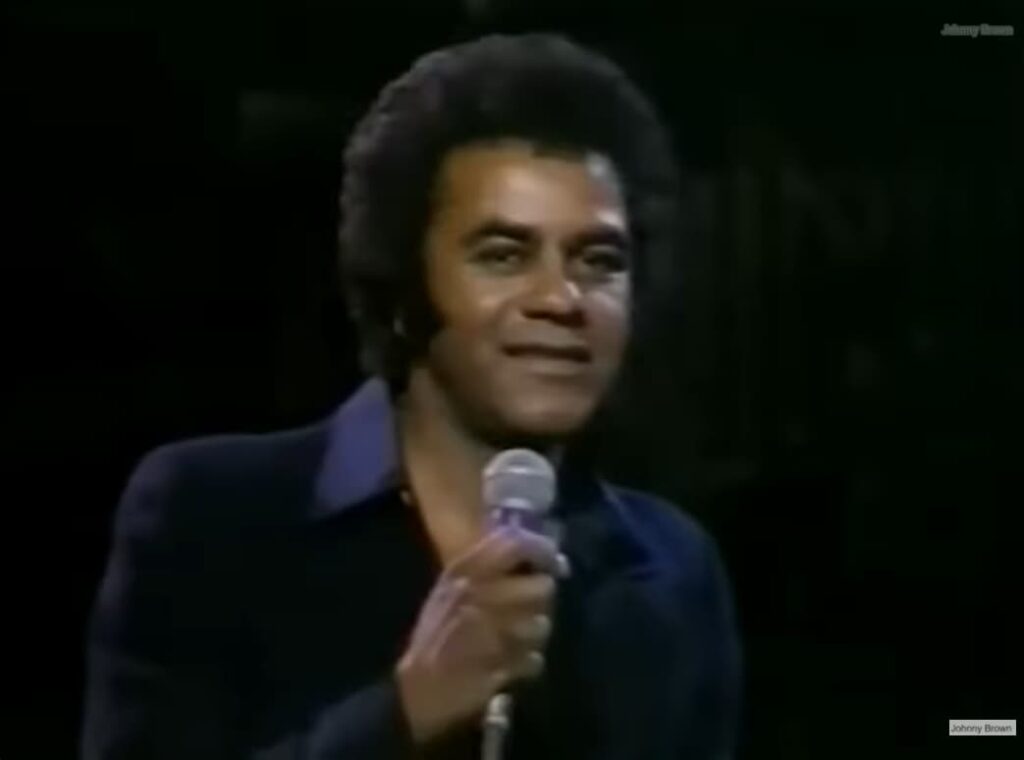
A voice meeting time itself—Johnny Mathis at the Royal Albert Hall becomes less a concert, more a quiet reckoning with memory, grace, and endurance
When Johnny Mathis stepped onto the stage of Royal Albert Hall in 1978, it was not simply another date on a tour schedule. It was a moment shaped by nearly two decades of musical presence, a gathering of songs that had already traveled far, now returning in a setting that demanded both reverence and restraint. The resulting recording, often referred to as “Johnny Mathis – Live at the Royal Albert Hall (1978)”, would later stand as one of the most quietly powerful documents of his career, even if it did not revolve around chart positions in the conventional sense.
By 1978, Mathis was no longer chasing the immediacy of the charts that had defined earlier successes like “Chances Are” or “Misty.” Instead, he had entered a different phase—one where the measure of a performance was no longer its position on the Billboard Hot 100, but its ability to hold a room in stillness. The Royal Albert Hall, with its vast dome and history of hosting the world’s most distinguished performers, offered exactly that kind of space.
There is something unmistakably different about a live recording in such a venue. The acoustics do not simply carry the voice—they reveal it. And in this performance, Mathis does not attempt to overpower the hall. He adapts to it. His phrasing becomes more deliberate, his timing more patient, as though he is allowing the room itself to breathe alongside him.
The setlist, drawn from the breadth of his catalog, feels less like a sequence of songs and more like a continuum of memory. Each piece arrives not as an isolated performance, but as part of a larger emotional landscape. There are no abrupt shifts, no attempts to surprise. Instead, there is a steady unfolding, a sense that everything belongs exactly where it is.
What stands out most in this concert is not vocal power, though that remains intact, but control. Mathis understands precisely when to hold back. He allows silence to become part of the performance, trusting that the audience will meet him there. In a space as grand as the Royal Albert Hall, that kind of restraint becomes its own form of strength.
The audience, too, plays a role in shaping the evening. Their presence is felt not through loud reactions, but through attentiveness. There is a shared understanding in the room—a recognition of what is being offered, and of what it requires in return. Applause comes, but it never interrupts the atmosphere. It simply acknowledges it.
Looking back, this performance exists at an interesting intersection in Mathis’s career. The late 1970s were a time of change in popular music, with newer sounds and styles beginning to dominate the charts. Yet here, in this hall, none of that feels immediate or pressing. The performance resists the idea of trend altogether. It stands apart, grounded in a tradition that values clarity of tone, emotional honesty, and the ability to communicate without excess.
There is also a sense of continuity in this recording—a reminder that music does not lose its meaning simply because time has moved forward. If anything, it deepens. Songs that may have once felt immediate now carry layers of experience. Lines that once seemed straightforward now resonate with something quieter, something more reflective.
In the end, “Johnny Mathis – Live at the Royal Albert Hall (1978)” is not defined by a single standout moment. It is defined by its consistency, its ability to maintain a single emotional thread from beginning to end. There are no dramatic peaks, no sudden turns. Only a voice, a room, and the passage of time moving gently between them.
And perhaps that is what gives the performance its lasting presence. It does not attempt to hold onto the past, nor does it try to redefine it. It simply allows it to exist—clear, unhurried, and quietly complete.