
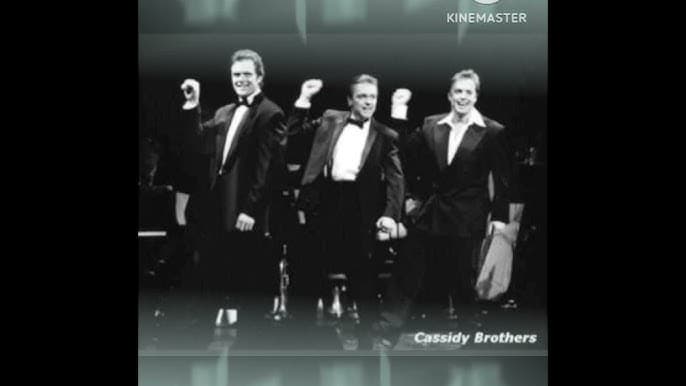
A fleeting moment where brotherhood meets theater, and charm turns uncertainty into something quietly unforgettable
There are performances that arrive with great expectation, and then there are those that feel like a gentle surprise, unfolding with a kind of ease that cannot be manufactured. When David Cassidy and Shaun Cassidy joined voices for “You Could Drive A Person Crazy”, it was not simply a duet between two well known figures. It was a moment where family, showmanship, and the lingering echoes of an earlier musical tradition came together in a way that felt both intimate and theatrical at once.
The song itself originates from the 1970 Broadway musical Company, written by the meticulous and often emotionally incisive Stephen Sondheim. Within that context, “You Could Drive A Person Crazy” was never intended as a conventional pop song. It functioned as a sharp, witty commentary on modern relationships, built around tight harmonies and rhythmic precision. The original cast recording, released in 1970, became highly respected within theatre circles, though it did not chart in the mainstream pop sense. Its influence, however, extended far beyond chart positions, shaping how storytelling could exist within music.
When the Cassidy brothers approached the song, they carried with them a very different kind of legacy. By the mid to late 1970s, David Cassidy had already experienced extraordinary fame through The Partridge Family, with hits like I Think I Love You reaching No. 1 on the Billboard Hot 100 in 1970. Shaun Cassidy, meanwhile, was establishing his own identity, scoring chart success with songs such as Da Doo Ron Ron, which also climbed to No. 1 in 1977.
Their collaboration on “You Could Drive A Person Crazy” did not aim for chart dominance in the traditional sense. It was not released as a major commercial single tied to chart performance. Instead, its significance lies in how it reframed a theatrical piece through the lens of two performers who understood both the demands of pop music and the discipline of stagecraft.
What makes their version particularly compelling is the interplay between their voices. The song demands precision, a near conversational timing that leaves little room for error. Yet in their hands, it feels natural, almost effortless. There is a sense that they are not merely performing the song, but engaging with it, allowing its humor and underlying tension to emerge without exaggeration.
Lyrically, the song explores the contradictions within romantic relationships, the way affection and frustration often exist side by side. It speaks of confusion, of emotional imbalance, of the quiet exasperation that can arise when love does not behave as expected. In the context of the Cassidy brothers’ performance, these themes take on an added dimension. There is a subtle contrast between the lightness of their delivery and the complexity of what is being expressed, creating a layered experience that invites reflection without demanding it.
There is also something quietly revealing in the fact that this performance exists somewhat outside the usual narrative of their careers. It is not tied to a major album release, nor is it remembered for chart positions or commercial milestones. Instead, it lingers as a moment of artistic curiosity, a glimpse into what happens when familiar voices step into unfamiliar material.
And perhaps that is where its lasting value lies. Not in numbers or rankings, but in the feeling it leaves behind. A sense of something briefly aligned—voices, timing, intention—before moving on again.
In the end, “You Could Drive A Person Crazy” remains exactly what its title suggests: a reflection on the delicate, often unpredictable nature of human connection. In the hands of David Cassidy and Shaun Cassidy, it becomes something quieter, more reflective. Not a declaration, but an observation. Not a conclusion, but a moment suspended in time, where everything is understood, even if nothing is resolved.