
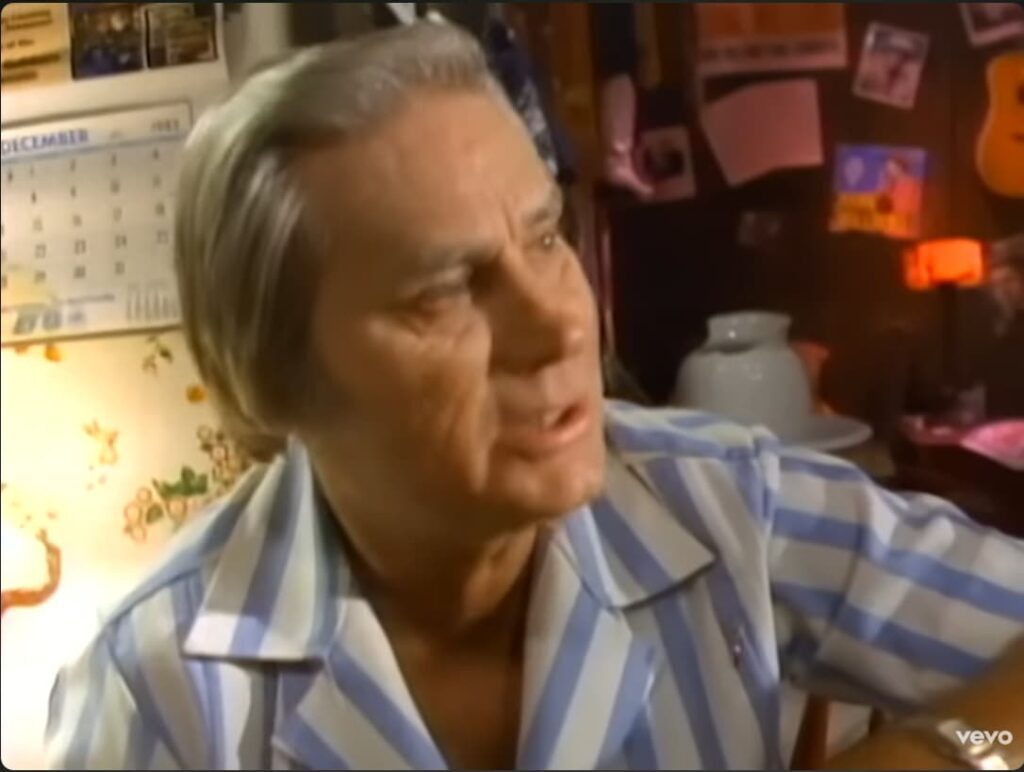
A heartfelt meditation on legacy, asking who will carry the soul of country music when the great voices fade away
Released in 1985, “Who’s Gonna Fill Their Shoes” by George Jones quickly rose to prominence, reaching No. 3 on the Billboard Hot Country Singles chart. At a time when country music was undergoing noticeable transformation—leaning toward a more polished, crossover-friendly sound—this song stood as a deeply personal and almost reverent reflection on the genre’s roots. It was not merely another hit for Jones; it was a statement, a question posed with both admiration and quiet चिंता for the future.
By the mid-1980s, George Jones had already lived several musical lifetimes. Known affectionately as “The Possum,” his voice carried the weight of experience—heartache, redemption, and survival. Having battled personal struggles and emerged with renewed clarity, Jones approached this song not as a young man chasing hits, but as a seasoned artist looking back on the giants who shaped him. That perspective gives “Who’s Gonna Fill Their Shoes” its emotional gravity.
The song itself is a roll call of legends: Hank Williams, Lefty Frizzell, Merle Haggard, Elvis Presley, and others are name-checked with a sense of reverence that feels almost sacred. These are not casual references; they are pillars of a musical tradition that defined generations. When Jones sings their names, there is an unmistakable tone of gratitude—but also a quiet тревога. The central question lingers: who will carry forward the authenticity, the storytelling, the soul that these artists embodied?
Musically, the arrangement is classic and unadorned, allowing Jones’s voice to remain front and center. There is no need for elaborate production here. The strength of the song lies in its sincerity. Each line feels like a conversation—perhaps shared over a late evening, when memories come more vividly and the past feels closer than ever. Jones does not preach or criticize; instead, he reflects, inviting the listener to consider the same question.
Behind the scenes, the song was written by Troy Seals and Max D. Barnes, two craftsmen who understood the emotional language of country music. They created something that resonated not only with Jones but with an entire audience who had grown up with these voices. In many ways, the song arrived at precisely the right moment—when the industry was beginning to shift, and there was a growing awareness that something essential might be slipping away.
What makes “Who’s Gonna Fill Their Shoes” endure is its universality. While rooted firmly in country music, its message extends beyond genre. It speaks to the passage of time, to the inevitability of change, and to the human desire to preserve what feels meaningful. There is a certain melancholy in acknowledging that no one can truly replace those who came before. Yet there is also a quiet hope—that their influence will continue, carried in spirit if not in exact form.
Listening to the song today, one cannot help but feel a sense of stillness. It invites reflection, not just on music, but on memory itself. The voices Jones sings about are more than entertainers; they are markers of moments, companions through different chapters of life. And as Jones poses his question, it becomes clear that perhaps it is not meant to be answered definitively. Perhaps it is meant to be felt.
In the end, George Jones did more than record another successful single. With “Who’s Gonna Fill Their Shoes,” he offered a tribute, a gentle reminder, and a question that continues to echo. It is a song that does not fade easily, because it speaks to something enduring—the recognition that while legends may pass, their echoes remain, quietly shaping the music and the memories that follow.