
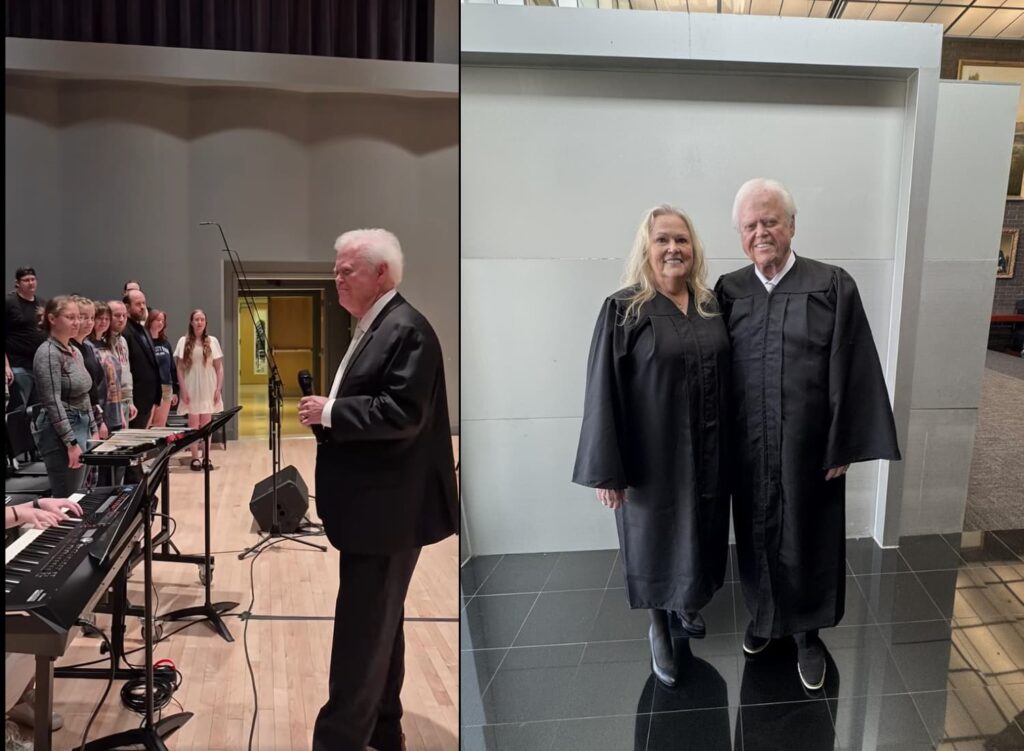
A song once carried by youthful harmony returns as a quiet statement of gratitude—“Love Me for a Reason” becomes a reflection on sincerity, time, and what truly endures
When Merrill Osmond stood before the graduating class at Snow College, the moment carried a meaning far beyond ceremony. Known as the lead voice of The Osmonds, Merrill was not simply there to speak, but to revisit a song that had once defined an era—“Love Me for a Reason.” Yet in this setting, accompanied by his own refined orchestral arrangement, the song no longer belonged to the charts or to the bright urgency of youth. It belonged to reflection.
Originally released in 1974 as part of the album Love Me for a Reason, the song marked a pivotal moment for The Osmonds. Moving away from their earlier pop image, they embraced a more mature, soulful direction. The single achieved notable chart success, reaching No. 10 on the Billboard Hot 100 and climbing even higher to No. 2 on the UK Singles Chart, confirming their ability to evolve with changing musical landscapes. Written by Johnny Bristol and Wade Brown, the song carried a message that felt simple on the surface, yet quietly profound: love, if it is to last, must be rooted in truth rather than illusion.
Decades later, as Merrill Osmond performed the song at Snow College, that message seemed to deepen with time. His voice, no longer driven by the bright urgency of youth, had taken on a different quality—warmer, steadier, shaped by years of experience both on and off the stage. There was no attempt to recreate the original recording note for note. Instead, he allowed the song to evolve naturally, giving space to each line, as though considering its meaning anew.
The orchestral arrangement played a crucial role in this transformation. Rather than the polished studio production of the 1970s, this version leaned into a fuller, more organic sound. Strings rose gently beneath the melody, brass added quiet emphasis, and the overall texture created a sense of depth that felt appropriate for the occasion. It was not grand in a dramatic sense, but it carried a quiet dignity—one that matched the setting and the moment.
What made this performance particularly resonant was the context. A graduation ceremony is, by nature, a point of transition—a space between what has been and what is yet to come. In that environment, “Love Me for a Reason” took on a slightly different meaning. It was no longer just a romantic plea. It became a broader reflection on authenticity, on the importance of being valued not for appearance or circumstance, but for something more enduring.
There is a certain honesty in the way Merrill approached the song that evening. He did not overstate its significance, nor did he attempt to reshape it into something it was not. Instead, he trusted the material. He allowed it to speak in its own voice, while quietly acknowledging the distance it had traveled—from a chart success in the 1970s to a reflective performance in a hall filled with anticipation for the future.
Looking back, this rendition of “Love Me for a Reason” does not compete with the original recording, nor does it try to surpass it. It exists alongside it, offering a different perspective. Where the original carried the energy of discovery, this performance carries the weight of understanding.
And perhaps that is what gives it its lasting impression. It reminds us that songs do not remain fixed in time. They change, just as the people who sing and listen to them change. Yet if the foundation is honest enough, the message remains intact.
In the end, Merrill Osmond’s performance at Snow College was not just about revisiting a familiar song. It was about recognizing what still holds true after everything else has shifted. And in that recognition, there is a quiet kind of comfort—one that does not need to be announced, only felt.