
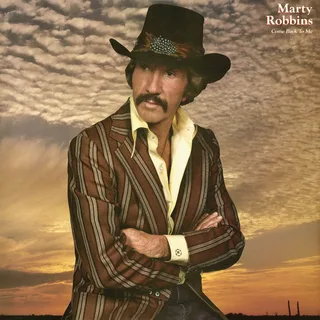
Marty Robbins – El Paso vs. Big Iron: A Duel Between the Romantic Tragedy of the Heart and the Cold Justice of the Frontier
For those of us who carry the dusty winds of the 1950s in our memories, the name Marty Robbins isn’t just a credit on a record sleeve; it is the voice of the American West itself. In 1959, he released an album that would become the blueprint for Western storytelling: Gunfighter Ballads and Trail Songs. Within this hallowed collection lie two titans, two towering monuments of narrative songcraft that have sparked a friendly “battle” among fans for over sixty years. To choose between “El Paso” and “Big Iron” is to choose between two different souls of the frontier—one fueled by the fire of a desperate love, and the other by the icy, steel-eyed resolve of the law.
“El Paso”, released in September 1959, was a revolutionary act. In an era when radio demanded three-minute pop songs, Marty Robbins insisted on a sprawling, four-minute-and-thirty-eight-second epic. It paid off handsomely, becoming the first country song to win a Grammy Award for Best Country & Western Recording and reaching Number 1 on both the Billboard Hot 100 and the Hot Country Singles charts. It is a masterpiece of obsession, following a young cowboy whose life is forfeit the moment he falls for the “wicked Felina.” The song is a slow, rhythmic descent into destiny, where the heat of the desert is matched only by the protagonist’s feverish need to return to the woman who caused his downfall. It is the ultimate romantic tragedy, ending in a final, bloody kiss that has left listeners misty-eyed for generations.
On the other side of the canyon stands “Big Iron”, released as a single in February 1960. If “El Paso” is a poem of the heart, “Big Iron” is a screenplay of pure tension. It tells the story of the Arizona Ranger who stepped into the town of Agua Fria to take down the outlaw Texas Red, a man with “twenty notches on his pistol.” The song peaked at Number 5 on the country charts, but its cultural shadow is perhaps even longer than its chart position suggests. It captures the mythical “High Noon” moment with a driving, relentless rhythm and a baritone guitar line that feels like the steady heartbeat of a man who knows he won’t miss. It is a song about duty, the heavy burden of the badge, and the lethal efficiency of justice.
The “battle” between these two tracks is really a question of what moves you more. Is it the sentimental, sweeping narrative of the doomed lover in West Texas, or the visceral, cinematic showdown in the streets of Agua Fria? “Big Iron” celebrates the heroic skill of a man who lives by a code, while “El Paso” mourns the man who is destroyed by his own emotions. For the older listener, these songs are more than entertainment; they are a bridge to a time when stories had a beginning, a middle, and a definitive, often tragic, end. We remember the first time we heard the “Mexican-flavored” guitar flourishes of the Grady Martin arrangement, or the way Marty’s voice climbed with such effortless grace as the Ranger drew his weapon.
In the end, perhaps there is no winner in this epic battle, because we are the beneficiaries of both. Whether you find yourself humming the tragic refrain of the cowboy dying in the dirt of El Paso or the triumphant tale of the Ranger with the “Big Iron” on his hip, you are participating in a tradition of storytelling that refuses to fade. These songs are the etched glass of our collective past—sharp, clear, and shining with a brilliance that modern music rarely dares to touch. They remind us that while the West may be won, the stories of the men who rode those trails will live as long as there is a voice as pure as Marty Robbins’ to sing them.