
A country voice revisits a universal ache, carrying Yesterday across time and tradition
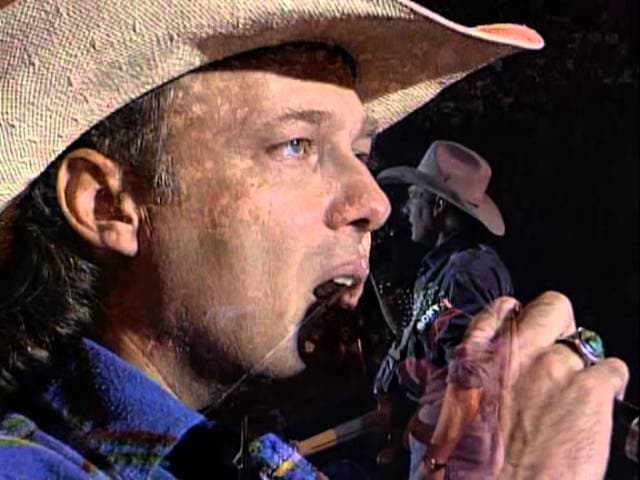
When Ricky Van Shelton stepped onto the stage to perform “Yesterday” at a Farm Aid concert in Irving, Texas, in early 1992, the moment carried a quiet gravity that went beyond set lists and applause. By then, Shelton was already recognized as one of country music’s most faithful traditionalists, a singer whose smooth baritone and unforced phrasing had restored classic values to a genre increasingly pulled by modern polish. Choosing “Yesterday” was not an act of novelty. It was a deliberate gesture, placing a timeless song into the hands of a voice shaped by country’s reverence for memory, loss, and emotional restraint.
Originally written by Paul McCartney and credited to Lennon McCartney, “Yesterday” first appeared on The Beatles’ 1965 album Help! In the United States, it was released as a single later that year and reached No. 1 on the Billboard Hot 100, ultimately becoming one of the most recorded songs in popular music history. Unlike many chart-toppers of its era, the song relied on remarkable simplicity: a single voice, a string quartet, and lyrics that spoke plainly of regret. Its commercial success was immense, but its deeper impact lay in its emotional honesty. “Yesterday” sounded like a confession whispered rather than proclaimed, and that intimacy is precisely what allowed it to travel so effortlessly across genres and generations.
By 1992, Ricky Van Shelton was navigating a period of transition. After a string of major successes including “Life Turned Her That Way”, “Somebody Lied”, and “From a Jack to a King”, all of which reinforced his reputation as a steward of traditional country values, Shelton was performing more selectively. His presence at Farm Aid, an organization founded in 1985 to support American family farmers, carried symbolic weight. Farm Aid concerts were not about spectacle; they were about solidarity, shared history, and songs that meant something beyond radio rotation. In that setting, “Yesterday” felt less like a Beatles classic and more like a shared memory passed gently from hand to hand.
Shelton never attempted to reshape the song dramatically. There was no need. His interpretation leaned into restraint, allowing the melody to breathe while his voice conveyed the song’s quiet sorrow. Country music has always understood that heartbreak does not require exaggeration. In Shelton’s performance, each line arrived with a calm acceptance, as if the singer already knew that longing cannot be undone, only acknowledged. This approach aligned naturally with the song’s original intent. McCartney had written “Yesterday” as a reflection on sudden emotional loss, a moment when life feels permanently divided into before and after. Shelton’s delivery honored that division, standing firmly on the side of memory.
Importantly, “Yesterday” was never released as a country single by Shelton, nor did it chart in his discography the way his original hits did. Its power resided elsewhere. Live, in Irving, it became a bridge between worlds: British pop and American country, the 1960s and the 1990s, youth and reflection. In the context of Farm Aid, the song took on an additional layer of meaning. It echoed the sense of things slipping away farms, livelihoods, simpler times while affirming that dignity remains even in loss.
What made Shelton’s rendition especially affecting was his refusal to dramatize. He trusted the song, and he trusted the audience. In doing so, he reminded listeners that great songs do not belong to one era or one genre. They endure because they speak truths that remain unchanged. “Yesterday” endures because regret, love, and memory never go out of fashion.
That night in Texas, the applause was respectful rather than explosive. It was the sound of recognition. A familiar song had been returned, gently, to a place where stories are told slowly and meaning lingers long after the final note fades.
 Music Legend