
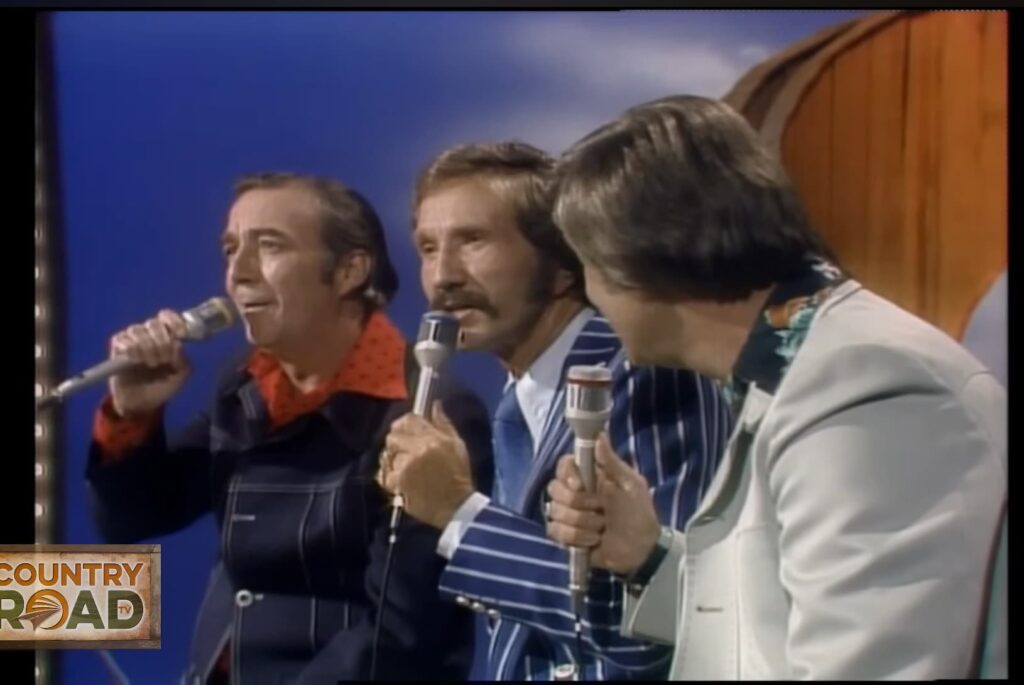
Three voices, one shared history, and a medley that carried the weight of country music’s collective memory
The medley performed by George Jones, Faron Young, and Marty Robbins stands as a rare and deeply resonant moment in classic country music, one where individual legacies briefly merged into a single emotional current. Unlike a standard single release tied to a specific chart debut, this medley belonged to a different tradition. It was born of recognition rather than promotion, of shared history rather than commercial intent. In bringing together George Jones, Faron Young, and Marty Robbins, the performance offered something far more lasting than a hit record. It offered perspective.
By the time these three voices were heard together, each had already secured a permanent place in country music history. George Jones, often called the greatest country singer of all time, had amassed an extraordinary run of chart success, including multiple No. 1 hits on the Billboard Hot Country Singles chart, most notably “He Stopped Loving Her Today”, which would later be widely regarded as the genre’s defining recording. His voice carried fragility, regret, and emotional truth in a way that felt almost unbearable in its honesty.
Faron Young, known as the “Hillbilly Heartthrob,” represented a different but equally vital thread. With numerous Top 10 country hits throughout the 1950s and 1960s, including “Hello Walls,” which reached No. 1 in 1961, Young brought charisma, phrasing, and a polished confidence to the genre. His singing style bridged honky tonk grit and mainstream accessibility, helping country music reach broader audiences without losing its emotional core.
Marty Robbins, meanwhile, stood as the great storyteller. His catalog included cinematic classics such as “El Paso”, which topped both the Country and Pop charts in 1960, and showcased his gift for narrative songwriting. Robbins’ smooth delivery and lyrical clarity gave his songs the feeling of oral history passed gently from one generation to the next.
When these three men came together for a medley, the result was not competition but conversation. Each voice entered with its own texture, shaped by different lives and experiences, yet all spoke the same emotional language. The medley format allowed fragments of their signature songs to flow into one another, blurring the boundaries between individual careers and revealing a shared emotional landscape.
Musically, the arrangement was deliberately restrained. There was no need for excess. The power lay in recognition. A familiar lyric here, a melodic turn there, each moment triggering memory rather than surprise. The transitions between voices felt natural, as if these songs had always belonged together, waiting for the right moment to be reunited.
The deeper meaning of this medley rests in what it represents about country music itself. Country has always been a genre built on continuity. Songs speak to one another across time. Voices echo long after they are first heard. In this performance, George Jones, Faron Young, and Marty Robbins embodied that continuity. They were not revisiting old songs out of nostalgia alone, but affirming their place within a living tradition.
There is also a quiet humility present in the way each artist steps forward and then steps back. No one voice dominates. No one moment seeks to overshadow another. Instead, the medley unfolds as a shared reflection on love, loss, pride, and endurance. These themes had defined their individual careers, and here they were allowed to coexist without explanation.
For listeners, the medley feels like sitting at a table where stories are told without embellishment. Each singer brings his truth, shaped by years of triumph and struggle, and places it gently alongside the others. The result is not spectacle, but depth.
In retrospect, this collaboration serves as a reminder of what country music once trusted most: sincerity. Long before genre boundaries blurred and production grew louder, songs were allowed to stand on their own emotional weight. This medley captures that ethos perfectly.
Today, the George Jones, Faron Young, and Marty Robbins medley endures not because of where it charted, but because of what it preserved. It preserved voices at their most honest, songs at their most human, and a moment when three paths briefly crossed to remind us that the strongest music is often born from shared understanding rather than singular ambition.