
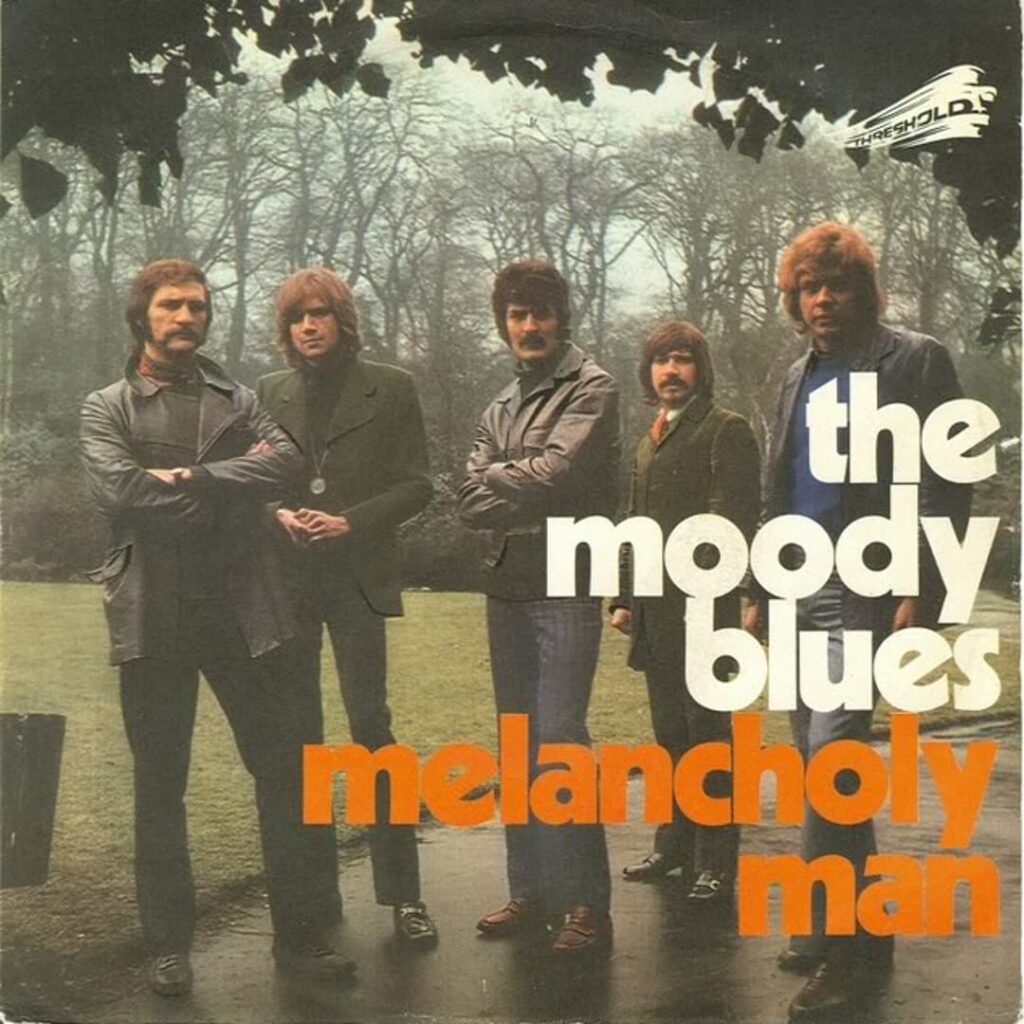
A quiet meditation on loneliness and belonging, where the human spirit looks inward and questions its place in a restless world
“Melancholy Man” stands as one of the most introspective and philosophically weighted compositions in the catalog of The Moody Blues, a band long celebrated for blending popular music with reflective depth. The song appears on their 1970 album A Question of Balance, an album that reached No. 1 on the UK Albums Chart and No. 3 on the Billboard 200 in the United States. While “Melancholy Man” was not released as a charting single, its presence within such a successful and influential album ensured its lasting resonance. It became a quiet cornerstone rather than a public anthem, known deeply by listeners who lived with the record rather than encountered it briefly on the radio.
Written and sung by Mike Pinder, “Melancholy Man” reflects a moment when The Moody Blues were deliberately pulling away from psychedelic excess and returning to a more grounded, human centered sound. The band had already explored grand concepts in earlier works like Days of Future Passed and In Search of the Lost Chord, but A Question of Balance was conceived as a response to life on the road and the growing sense of emotional dislocation that fame and constant movement can bring. Within that framework, “Melancholy Man” feels deeply personal, almost confessional.
The song opens with a sense of stillness. There is no urgency, no attempt to impress. Instead, it invites reflection. Musically, the arrangement is restrained, built around Pinder’s Mellotron, gentle percussion, and a melody that unfolds slowly, almost cautiously. This measured pace mirrors the emotional state of the narrator, a figure who observes the world with a mixture of sorrow, awareness, and quiet endurance. The music does not rush to comfort. It simply sits with the feeling.
Lyrically, “Melancholy Man” explores the experience of feeling out of step with the world. The narrator does not claim victimhood, nor does he seek resolution. He acknowledges his sadness as part of his identity, something shaped by understanding rather than despair. There is a sense that melancholy here is not weakness, but sensitivity. The song suggests that those who feel deeply often carry a heavier awareness of the world’s contradictions, its noise, and its indifference.
The story behind the song is closely tied to Mike Pinder’s outlook during this period. Known within the band as its spiritual and philosophical voice, Pinder often wrote about inner landscapes rather than external events. “Melancholy Man” can be heard as his reflection on modern life’s tendency to overlook quiet introspection in favor of constant motion. The narrator seems to stand slightly apart, observing rather than participating, not out of arrogance but out of emotional necessity.
What makes “Melancholy Man” enduring is its refusal to offer easy optimism. There is no sudden turn toward joy, no false reassurance. Instead, the song finds dignity in acceptance. It suggests that melancholy does not need to be cured. It can be understood, respected, and even valued. This perspective aligns closely with The Moody Blues’ broader artistic vision, which consistently treated emotional complexity as something to be explored rather than simplified.
Within A Question of Balance, the song serves as a moment of stillness amid broader concerns about humanity’s direction and inner conflict. While other tracks address collective questions, “Melancholy Man” turns inward, reminding us that large societal shifts are always reflected in individual emotional lives. Its placement on the album feels intentional, offering a pause, a breath, a chance to listen more closely.
Over the decades, “Melancholy Man” has remained quietly influential. It is rarely cited as a defining hit, yet it often becomes a deeply personal favorite. Its power lies in recognition rather than spectacle. The song understands that many lives are shaped not by dramatic moments, but by long stretches of quiet contemplation, uncertainty, and emotional honesty.
In the legacy of The Moody Blues, “Melancholy Man” represents the band at their most human. It does not attempt to solve the world’s problems or elevate the listener above them. Instead, it offers companionship in introspection. It reminds us that feeling out of place can itself be a form of awareness, and that sometimes the most meaningful music is the kind that speaks softly, stays close, and listens as much as it sings.