A Quiet Goodbye Beneath the Passing Year — “Walk Away” Becomes a Reflection of Time in Shaun Cassidy’s Boston Performance
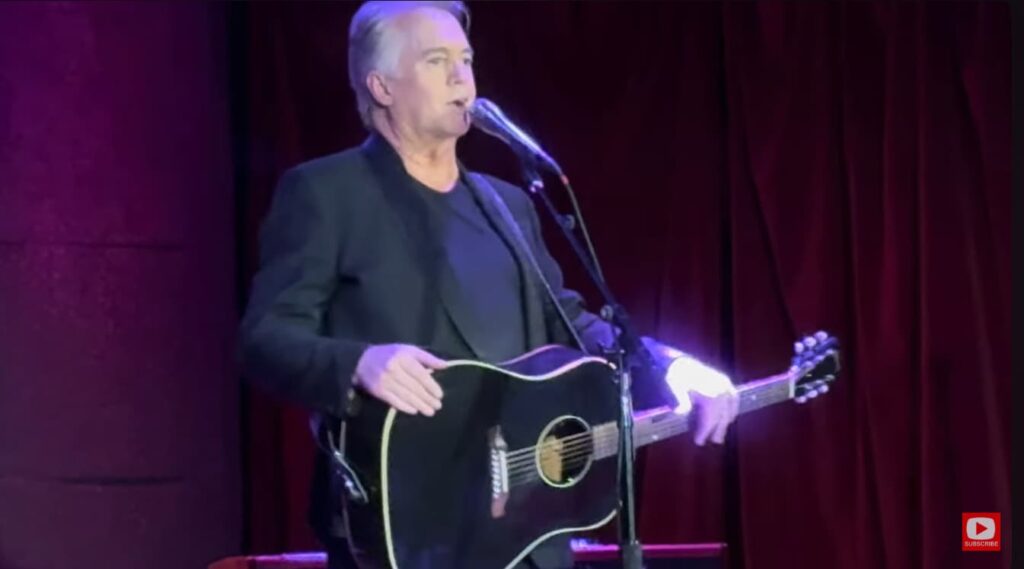
On a New Year’s Eve evening at City Winery in Boston, when Shaun Cassidy returned to the stage to perform “Walk Away,” the song no longer belonged to the bright, restless world that first shaped his career. Instead, it arrived softened by time, carrying with it the weight of years, memory, and the quiet understanding that comes only after life has unfolded in ways no chart position could ever predict.
Originally released in 1977 as part of the album Born Late, “Walk Away” did not achieve the same commercial prominence as “Da Doo Ron Ron” or “Hey Deanie.” It was not a major charting single on the Billboard Hot 100, and for many listeners, it remained a deeper cut within Cassidy’s early catalog. Yet songs like this often live longer than their chart performance suggests. They wait patiently, growing into something more meaningful as both artist and audience change with time.
By the late 1970s, Shaun Cassidy had already become one of the most recognizable figures of his generation. His rise was swift, fueled by a combination of television fame and musical success. With “Da Doo Ron Ron” reaching No. 1 on the Billboard Hot 100 in 1977, he was firmly placed within the landscape of pop music’s most visible young voices. But beneath that success lay songs like “Walk Away,” quieter in tone, more reflective in nature, hinting at an emotional depth that would only become clearer in later years.
The meaning of “Walk Away” rests in its simplicity. It tells of departure, not in anger, but in acceptance. There is no dramatic confrontation, no attempt to reclaim what has been lost. Instead, the song speaks of a moment when staying becomes more difficult than leaving, and the only honest choice is to step back and let silence take its place.
In its original form, the song carried the gentle melancholy of youth — the kind of sadness that feels immediate but not yet fully understood. The melody moves with restraint, allowing the vocal line to remain intimate, almost conversational. It is a song that does not insist on being heard loudly. It invites the listener closer.
Years later, during that New Year’s Eve performance in Boston, the song took on a different dimension.
Standing before an audience that had, in many cases, followed his journey across decades, Shaun Cassidy approached “Walk Away” not as a memory of his past, but as something still quietly relevant. The voice, naturally changed with time, carried a different kind of honesty. Where there had once been youthful clarity, there was now reflection. Where there had once been immediacy, there was patience.
The setting itself added to the atmosphere. City Winery, known for its intimate performances, allowed the music to exist without distance. There were no grand stages or elaborate productions, only the closeness of performer and audience sharing a moment at the edge of one year and the beginning of another.
In that context, “Walk Away” became more than a song about leaving a relationship. It became a meditation on time itself. The act of walking away could just as easily be understood as moving forward, leaving behind versions of ourselves that no longer belong to the present.
What makes this performance particularly moving is not nostalgia alone, but the way it transforms nostalgia into something quieter and more meaningful. The song does not attempt to recreate the past. It acknowledges it, gently, before letting it rest.
This is where Shaun Cassidy’s artistry reveals itself most clearly. Beyond the early fame and the familiar hits, there is an understanding of how songs evolve. Music, when carried across years, does not remain fixed. It absorbs experience, reshaping itself with every performance.
And so, on that New Year’s Eve in Boston, “Walk Away” did not feel like a farewell filled with regret. It felt like a necessary step, taken with calm and clarity.
A song once rooted in youthful emotion had become something else entirely — a quiet companion to the passing of time, reminding us that not every goodbye needs to be spoken loudly to be understood.
Video: