
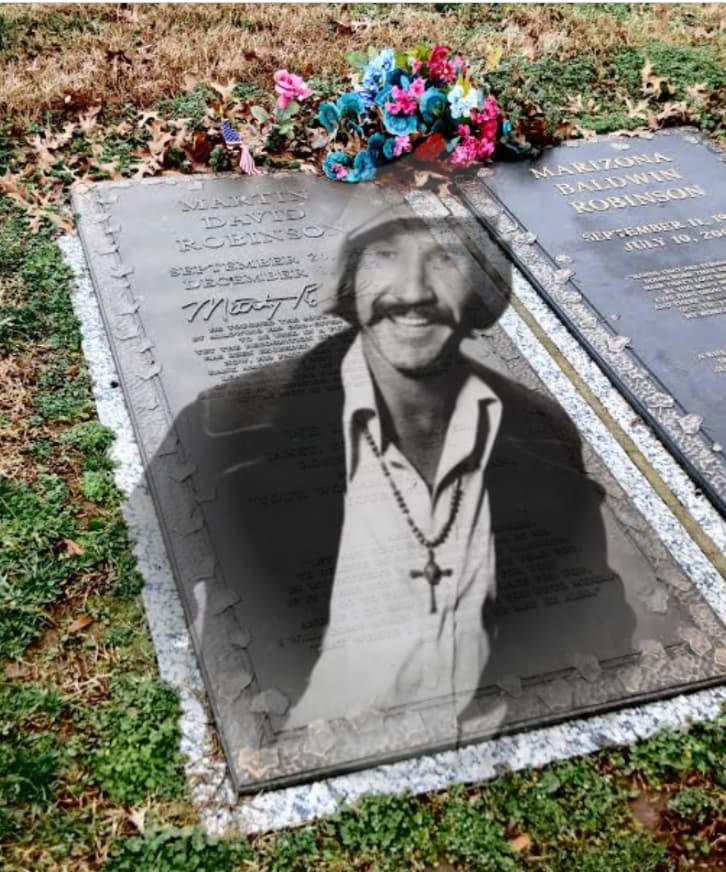
A singular voice falls silent, and an entire genre feels the weight of its own history.
When Marty Robbins died suddenly in December 1982 at the age of 57, the shock moved through country music with the force of a broken chord. By that point, Robbins was not merely a veteran artist but a pillar of the genre, an artist whose records had repeatedly climbed the charts across more than two decades, whose albums such as Gunfighter Ballads and Trail Songs had become permanent fixtures in the canon, and whose voice remained instantly recognizable to anyone who had grown up with country radio. This was not the fading of a forgotten name. This was the abrupt silence of a singer who had spent his life near the top of the charts and deep in the emotional memory of his audience.
To understand why country music mourned so openly, one must understand what Marty Robbins represented. He was a rare hybrid, a commercial force and a narrative craftsman. From the late 1950s onward, his recordings regularly crossed genre boundaries, appearing not only on country charts but also in the broader popular consciousness. His albums were not casual collections of songs. They were carefully sequenced emotional worlds, often rooted in storytelling traditions older than Nashville itself. Cowboys, outlaws, lonely travelers, doomed lovers. Robbins did not simply sing about them. He inhabited them.
There is no single song that can carry the full weight of his passing, because his career itself functioned like a long ballad, marked by peaks of commercial success and valleys of personal intensity. His voice was technically controlled yet emotionally restrained, a balance that allowed listeners to project their own experiences into his performances. Where others leaned on bravado or excess sentiment, Robbins trusted understatement. The tragedy in his songs often arrived quietly, as it did in life.
His sudden death from heart complications cut short a career that had never truly slowed. Even in his later years, Robbins remained creatively active, still recording, still touring, still commanding respect from younger artists who viewed him as both elder and example. In that sense, the mourning that followed was not nostalgic in nature. It was immediate and disorienting. Country music did not lose a memory. It lost a living voice.
Culturally, Robbins stood at a crossroads between eras. He carried the storytelling traditions of early country forward into the modern recording age without diluting their emotional core. His influence can be heard in the narrative ambition of later singer songwriters and in the continued popularity of story driven country ballads. When he died, it felt as though a direct line to the genre’s foundational spirit had been severed.
What remains is not simply a catalog of hits or a list of chart positions, impressive as those were. What remains is a body of work that continues to teach country music how to remember itself. In mourning Marty Robbins, the genre was forced to confront its own mortality, and in doing so, to recognize just how deeply one man’s voice had become woven into its soul.
 Music Legend