
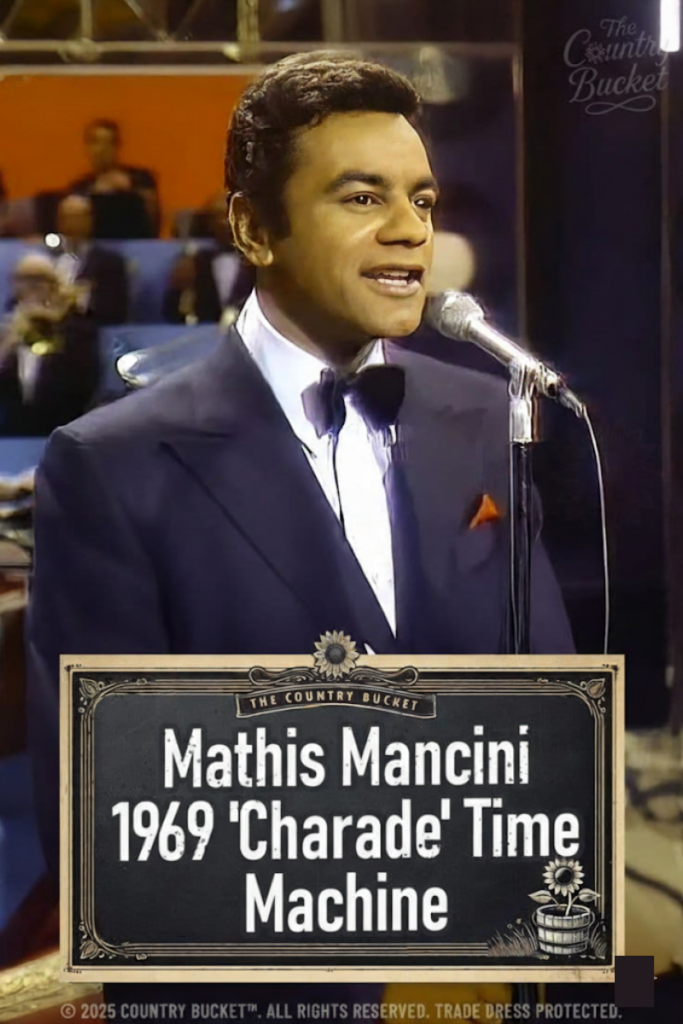
Two elegant moments where romance becomes cinema, and melody turns longing into something timeless and softly unforgettable
When Johnny Mathis released “Charade” and “It Had Better Be Tonight” in 1963, he was not simply interpreting popular songs of the moment. He was stepping into the world of film, atmosphere, and emotional suggestion, carrying with him a voice already associated with intimacy and refined restraint. These recordings arrived at a time when popular music and cinema were deeply intertwined, and Mathis proved uniquely capable of translating visual romance into sound. Both songs were issued during one of the most confident periods of his career, when his ability to balance pop sophistication with emotional warmth had already earned him a permanent place in American music.
“Charade”, written by Henry Mancini with lyrics by Johnny Mercer, was introduced as the theme song to the 1963 film of the same name starring Audrey Hepburn and Cary Grant. Mathis’s version was released shortly after the film’s premiere and quickly gained attention beyond its cinematic origins. On the Billboard Hot 100, “Charade” reached No. 12, an impressive showing for a song so closely tied to a movie narrative. It also performed strongly on adult oriented charts, where Mathis’s audience responded to its elegance and emotional ambiguity.
What makes “Charade” enduring is its sense of mystery. The lyrics speak of love as a game of shadows and half truths, where certainty is always just out of reach. Mathis does not attempt to resolve that tension. Instead, he leans into it. His phrasing is deliberate, almost conversational, allowing the listener to feel the uncertainty rather than simply hear it described. Mancini’s melody glides rather than insists, and Mathis follows its curves with remarkable control. The result is a performance that feels suspended in time, neither hopeful nor despairing, but quietly aware that love can be beautiful and elusive in equal measure.
Released around the same period, “It Had Better Be Tonight”, also known as “Meglio Stasera”, came from another cinematic source, the 1963 film The Pink Panther. Again composed by Henry Mancini, with English lyrics by Johnny Mercer, the song carries a very different emotional temperature. Where “Charade” whispers, “It Had Better Be Tonight” smiles knowingly. Mathis approached it not as a novelty but as a sophisticated invitation, full of charm and understated urgency.
On the Billboard Hot 100, “It Had Better Be Tonight” reached No. 50, a modest chart position that does not fully reflect its cultural impact. Over time, the song has become one of Mathis’s most recognizable uptempo recordings, often remembered for its playful rhythm and international flair. Yet even here, Mathis avoids exaggeration. His delivery remains smooth, controlled, and emotionally grounded. The flirtation in the song feels genuine, never forced, as if the romance is unfolding naturally rather than being performed.
Both songs were featured during a period when Johnny Mathis was expanding his artistic range without abandoning his core identity. He did not chase trends aggressively. Instead, he refined his craft, choosing material that suited his voice and emotional temperament. His ability to interpret film songs without making them feel theatrical is central to why these recordings continue to resonate.
The deeper meaning behind these performances lies in their emotional honesty. “Charade” reflects the uncertainty of love, the quiet doubt that lingers even in moments of closeness. “It Had Better Be Tonight” captures the fleeting nature of opportunity, the awareness that some moments ask to be lived fully before they disappear. Together, they present two sides of romance contemplation and invitation, both delivered with grace.
Listening to these songs now, one hears not just the elegance of early sixties pop, but the voice of an artist who understood that subtlety could be more powerful than declaration. Johnny Mathis never rushed the listener. He trusted them to feel their way through the song, just as he did. In that trust lies the lasting beauty of “Charade” and “It Had Better Be Tonight”, recordings that continue to linger quietly, like memories that return without being called.