
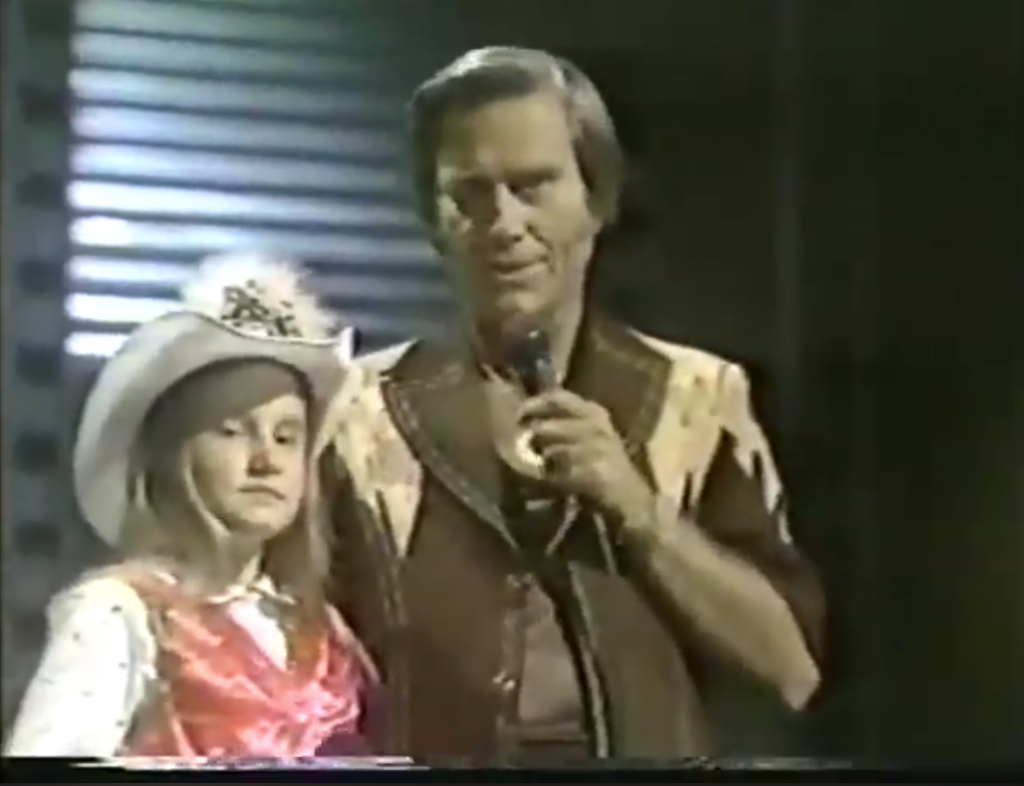
A Daughter’s Plea and a Father’s Redemption — “Daddy Come Home” Captures a Moment of Fragile Truth Between George Jones and Georgette Jones
In the long and often turbulent history of country music, few moments feel as deeply human as the performance of “Daddy Come Home” by George Jones and his daughter Georgette Jones during the 1981 HBO television special. It was not merely a musical duet. It was a quiet confession, a reconciliation unfolding in front of an audience, wrapped in the unmistakable voice of one of country music’s greatest legends.
By 1981, George Jones was already widely regarded as one of the most powerful vocal stylists country music had ever known. His career had produced monumental hits such as “He Stopped Loving Her Today”, which had just reached No. 1 on the Billboard Hot Country Singles chart in 1980 and revitalized his standing after years of personal struggles. Yet behind the triumph stood a life marked by hardship, addiction, broken relationships, and long absences from family. It was precisely this personal history that gave “Daddy Come Home” its emotional weight.
The song itself is not among the traditional chart-topping singles that defined radio playlists. Instead, its importance lies in its story. Written as a conversation between a daughter longing for her father’s presence and a father who has spent too much time lost on distant roads, “Daddy Come Home” feels almost painfully autobiographical when performed by George Jones and Georgette Jones.
During the HBO special recorded in 1981, the performance carried a rare authenticity that could not have been scripted. Georgette Jones, the daughter of George Jones and Tammy Wynette, stepped onto the stage with a gentle confidence that contrasted with the weight of the lyrics she was about to sing. Her voice, youthful yet steady, delivered the opening lines with a kind of innocent sincerity that seemed to echo years of quiet longing.
Then came the response from George Jones.
Few voices in the history of country music have carried the emotional gravity of Jones’s singing. By the early 1980s, his voice had matured into something almost supernatural—rich with pain, regret, wisdom, and resilience. When he answered his daughter’s plea within the song, it felt less like performance and more like an admission spoken aloud for the first time.
The lyrics revolve around a simple but powerful theme: the yearning of a child for a father who has been absent too long. In the hands of lesser performers, the song might have felt sentimental. But here, the emotional stakes were real. Anyone familiar with George Jones’s personal life understood that the story mirrored the very struggles that had nearly destroyed his career and family.
Musically, the arrangement remains rooted in classic Nashville tradition. Soft steel guitar lines drift through the background, accompanied by understated piano and gentle rhythm sections. The production wisely avoids grand gestures. Instead, it creates a quiet space where the voices can carry the full emotional burden.
What makes this performance unforgettable is the contrast between the two singers. Georgette Jones sings with hopeful clarity, her voice representing innocence and forgiveness. George Jones, by contrast, sings with the weariness of a man who understands how much time has already slipped away. The result is a duet that feels less like a song and more like a conversation across years of absence.
In the broader context of George Jones’s career, the early 1980s marked a period of renewal. Following his monumental comeback with “He Stopped Loving Her Today” from the album I Am What I Am, Jones began reclaiming his reputation as the greatest living interpreter of country heartbreak. Yet performances like “Daddy Come Home” revealed a more intimate dimension of his artistry—one that extended beyond romantic sorrow into the complicated terrain of family and redemption.
The 1981 HBO special preserved that moment in remarkable clarity. Television cameras captured subtle expressions: the careful way George Jones watched his daughter sing, the slight hesitation before delivering his lines, the quiet emotion that lingered in the pauses between verses.
These details transformed the performance into something timeless.
Country music has always excelled at telling stories of lost love, broken promises, and second chances. But rarely does a song embody those themes as authentically as “Daddy Come Home” did on that stage. It reminded listeners that behind every legend stands a human life—imperfect, wounded, yet still capable of grace.
And in that fragile exchange between father and daughter, one could hear not only the sorrow of the past, but also the quiet hope that reconciliation, however late, is always possible.