
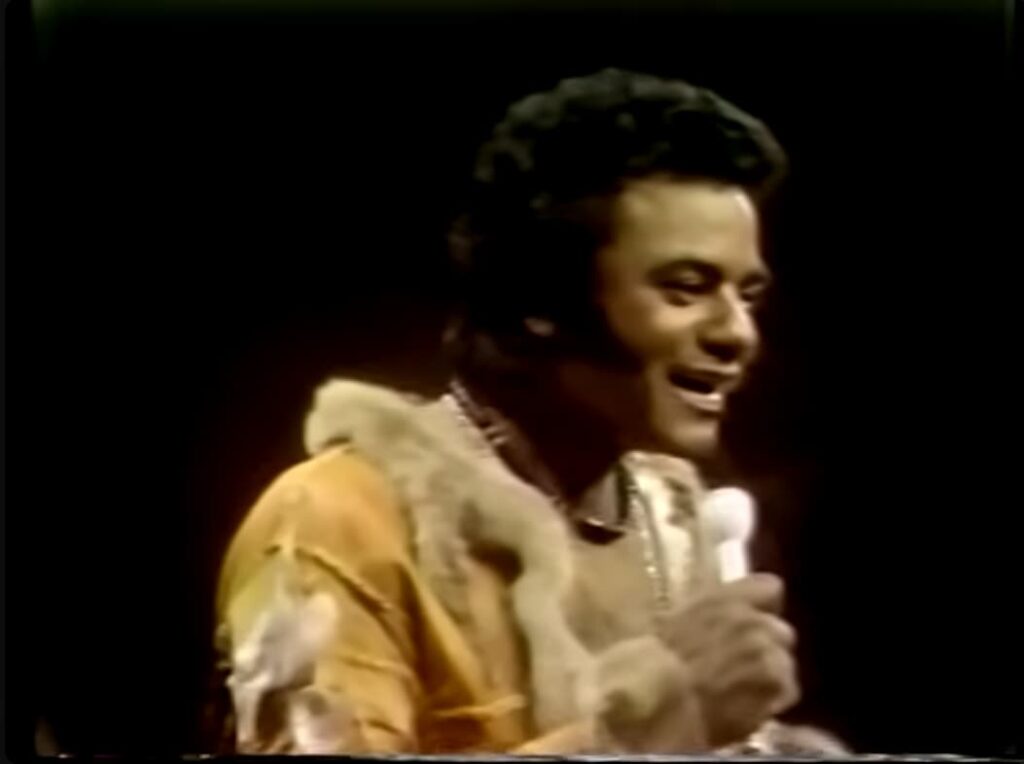
A Love Song Wrapped in Velvet — “I’m Stone In Love With You” Shows How Johnny Mathis Turned a Soul Classic Into Pure Romantic Elegance
When Johnny Mathis stepped onto a stage in Los Angeles in January 1974 to perform “I’m Stone In Love With You,” he was interpreting a song that had already touched millions of listeners, yet he managed to give it a distinctive emotional glow of his own. The composition itself was written by the celebrated Philadelphia songwriting team Thom Bell, Linda Creed, and Anthony Bell, and it first became a major hit for The Stylistics in 1972, reaching No. 10 on the Billboard Hot 100 and No. 1 on the Billboard R&B chart. By the time Mathis embraced the song, it had already proven its timeless appeal, but his interpretation revealed how deeply a great vocalist can reshape a familiar melody.
Johnny Mathis had long been known as one of the most graceful voices in American popular music. From the late 1950s onward, songs like “Chances Are,” “Misty,” and “It’s Not for Me to Say” had established him as a master of romantic expression. His style was built not on dramatic power, but on warmth and intimacy—a voice that seemed to speak directly to the listener rather than perform for a crowd.
By 1973 and 1974, Mathis was enjoying a renewed period of commercial success. His album I’m Coming Home (1973) marked a significant comeback, reaching No. 50 on the Billboard 200, while its title track climbed to No. 1 on the Billboard Adult Contemporary chart and No. 75 on the Hot 100. The record demonstrated Mathis’s ability to adapt to contemporary soul and pop influences while maintaining the refined vocal style that had always defined him.
Within this musical atmosphere, “I’m Stone In Love With You” fit beautifully into his repertoire. The song itself carries an emotional simplicity that resonates immediately. Its lyrics describe a love so complete, so certain, that no explanation seems necessary. There is no elaborate narrative, no dramatic conflict. Instead, the song celebrates devotion with calm confidence.
When Mathis performed the piece during his Los Angeles performance in January 1974, the atmosphere of the song changed subtly from its original soul arrangement. Where The Stylistics delivered the song with delicate falsetto harmonies and lush Philadelphia soul production, Johnny Mathis approached it with a more traditional pop elegance. His voice flowed smoothly across the melody, emphasizing warmth and sincerity rather than stylistic flourish.
The effect is striking. Mathis transforms the song into something almost timeless, as though the lyric could belong to any decade. His phrasing lingers gently on key lines, allowing the emotional message to settle slowly in the listener’s mind. It is not a declaration shouted from a rooftop; it is the quiet certainty of someone who knows exactly where his heart belongs.
Musically, performances of “I’m Stone In Love With You” during this period often featured soft orchestral arrangements, blending strings with understated rhythm sections. This style suited Mathis perfectly. Throughout his career, he thrived in arrangements that left space for subtle vocal shading. A small change in tone, a gentle pause between phrases—these details became the tools through which he expressed emotion.
There is also a deeper cultural significance behind Mathis choosing songs like this in the early 1970s. Popular music was changing rapidly during that era, with soul, funk, and contemporary pop reshaping the sound of radio. Yet Mathis demonstrated that the essence of a romantic ballad could survive any stylistic shift. By interpreting modern compositions through his own refined style, he built a bridge between generations of listeners.
Listening today to Johnny Mathis’s rendition of “I’m Stone In Love With You” reveals something quietly remarkable. The song does not depend on musical trends or elaborate production. Its power lies in sincerity—a simple melody carried by a voice that understands the meaning of emotional restraint.
That quality has always been the secret of Johnny Mathis. He never needed dramatic gestures or vocal fireworks to leave an impression. Instead, he relied on tone, phrasing, and the gentle honesty that runs through every note he sings.
And so when the final lines of “I’m Stone In Love With You” drift into silence, what remains is not just a love song. It is a reminder that some emotions, expressed with quiet grace, can linger in memory long after the music fades.