
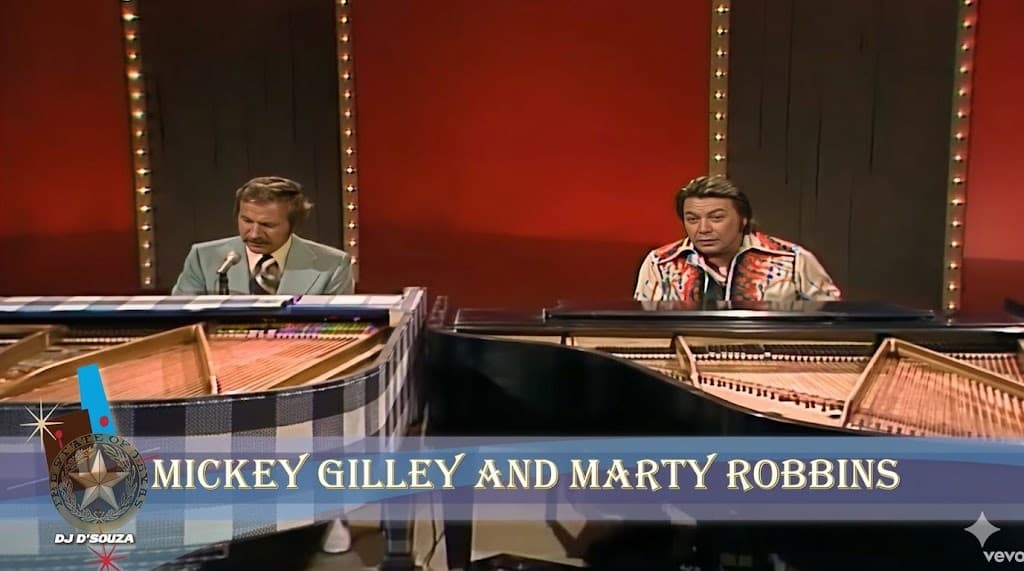
Mickey Gilley and Marty Robbins: When Honky-Tonk Swagger Met Velvet Soul
When Mickey Gilley sat down with Marty Robbins on the Marty Robbins Spotlight in the late 1970s, it was a meeting of two absolute icons of the era. Mickey Gilley was the king of the “Urban Cowboy” movement and the owner of the world’s most famous nightclub, while Marty was the undisputed statesman of the Western ballad.
This wasn’t just a guest appearance; it was a collision of two different types of “cool.”
The Piano Man Meets the Guitar Man
The energy on set during these episodes was electric. Mickey Gilley brought that driving, Jerry Lee Lewis-inspired piano style—pumping rhythms and bluesy trills—that made everyone want to get up and dance. Marty, ever the generous host, would lean against his guitar, watching Mickey’s fingers fly across the keys with a look of genuine admiration and a playful, competitive glint in his eye.
For the mature fan, this pairing was a dream. You had Marty Robbins, representing the cinematic, “Big Iron” tradition of Nashville, and Mickey Gilley, representing the neon-lit, jukebox-heavy sound of Pasadena, Texas. Together, they bridged the gap between the campfire and the honky-tonk.
“Don’t the Girls All Get Prettier at Closing Time”
One of the highlights of Gilley’s appearances was hearing him perform his massive hits like “City Lights” or “Don’t the Girls All Get Prettier at Closing Time.” Marty would often chime in with his signature crystalline harmonies, adding a layer of “Velvet” polish to Mickey’s gritty, rhythmic delivery.
The banter between them was legendary. Marty’s wit was sharp, and Mickey, with his Texas charm, could give as good as he got. They joked about the music business, their shared love for fast cars (Marty’s NASCAR passion and Mickey’s high-octane lifestyle), and the changing tides of country music.
A High-Fidelity Time Capsule
Watching these two together in the late 70s is a reminder of a very specific moment in American culture. This was the era of flared jeans, cowboy hats, and the “High-Fidelity” warmth of 2-inch tape recordings. The production on the Marty Robbins Show was pristine, capturing the percussive “snap” of Mickey’s piano and the resonant “hum” of Marty’s baritone in perfect balance.
“When Mickey Gilley started playing that piano, Marty didn’t just host—he became a fan. It was a moment where the glitz of the ‘Urban Cowboy’ era felt right at home with the timeless tradition of the West.”
A Shared Legacy of Entertainment
Both Marty and Mickey understood that they weren’t just singers; they were entertainers. They knew how to play to the camera, how to tell a joke, and how to make a live audience feel like they were part of a private party. Seeing them share that stage is a “souvenir” of a time when country music was expanding its boundaries while staying true to its soulful roots.
 Music Legend