
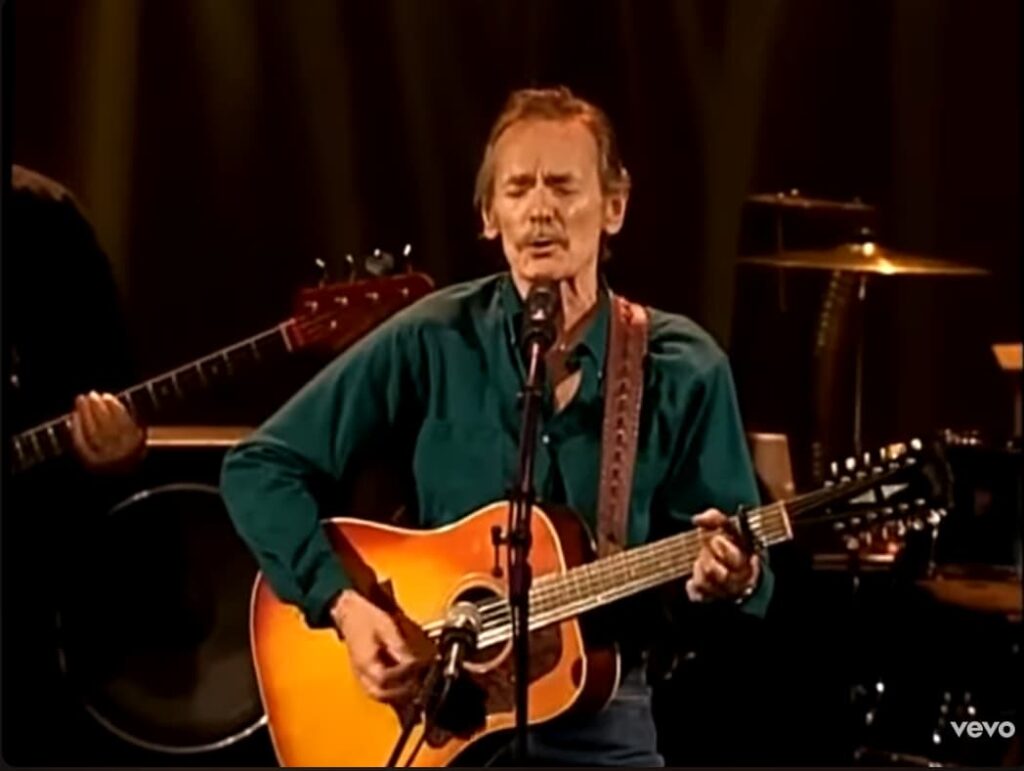
A bittersweet portrait of restless love and quiet regret—two songs woven into one timeless confession of a wandering heart
There is something quietly disarming about hearing “For Lovin’ Me / Did She Mention My Name” (Live In Reno) performed by Gordon Lightfoot—a moment where two of his earliest and most defining compositions are brought together into a single, reflective narrative. Though this live medley itself was never released as a charting single, the songs it draws from carry deep historical weight. “For Lovin’ Me,” written in the early 1960s, became widely known through covers by artists like Peter, Paul and Mary, while Lightfoot’s own version appeared on his debut album Lightfoot! (1966). Meanwhile, “Did She Mention My Name” served as the title track of his 1968 album, a record that marked his growing maturity as a songwriter.
Neither song was designed for the explosive commercial success that later greeted Lightfoot’s “Sundown” (No. 1 on the Billboard Hot 100, 1974), yet both compositions became foundational pillars of his reputation in the folk world. They established him not as a hitmaker chasing radio trends, but as a storyteller—one who understood the fragile, often contradictory nature of love long before it became fashionable to write about emotional vulnerability with such honesty.
“For Lovin’ Me” is, on its surface, deceptively simple. It tells the story of a man who admits—almost casually—that he cannot stay. There is no dramatic apology, no attempt to soften the truth. Instead, there is a kind of emotional detachment that feels both honest and unsettling. Lines drift by like passing scenery, suggesting a pattern of leaving before roots can take hold. In the hands of a lesser songwriter, the song might have felt cold. But Lightfoot imbues it with a quiet awareness—a sense that the narrator understands his own shortcomings, even if he cannot change them.
By contrast, “Did She Mention My Name” feels like the echo that follows such departures. It is softer, more introspective, and tinged with longing. The narrator is no longer the one leaving, but the one left behind—wondering if he is remembered, if his absence has left any trace at all. The emotional shift between the two songs is subtle but profound: from certainty to doubt, from movement to stillness.
When performed together in this Live In Reno rendition, the pairing becomes something more than the sum of its parts. It feels almost like a conversation between two versions of the same soul—one younger, restless, and unanchored; the other older, reflective, and quietly burdened by memory. This is where Gordon Lightfoot’s artistry reveals itself most clearly. He does not simply sing songs; he inhabits them, allowing time and experience to reshape their meaning.
The Reno performance itself carries a certain intimacy that studio recordings often lack. There is a warmth in the delivery, a sense that the audience is not merely listening, but sharing in something deeply personal. Lightfoot’s voice—never overly ornate—has, over the years, gained a textured richness. It is a voice that does not hide its age, and in doing so, becomes even more convincing. Every phrase feels lived-in, every pause meaningful.
What makes this medley particularly enduring is its emotional honesty. It does not attempt to resolve the tension it presents. There is no neat conclusion, no moral lesson neatly tied with a bow. Instead, it leaves the listener suspended between two truths: that love can be fleeting, and that its memory can linger far longer than expected.
In the broader landscape of folk music, these songs—and this performance—serve as a reminder of a time when songwriting was less about spectacle and more about sincerity. Before elaborate production and digital polish, there were voices like Gordon Lightfoot’s, carrying stories that felt both deeply personal and universally understood.
Listening to “For Lovin’ Me / Did She Mention My Name (Live In Reno)” today is like opening an old letter—one written in a steady hand, with words that have not faded despite the passing years. It does not demand attention. It earns it quietly, with a kind of grace that only time can bestow.