
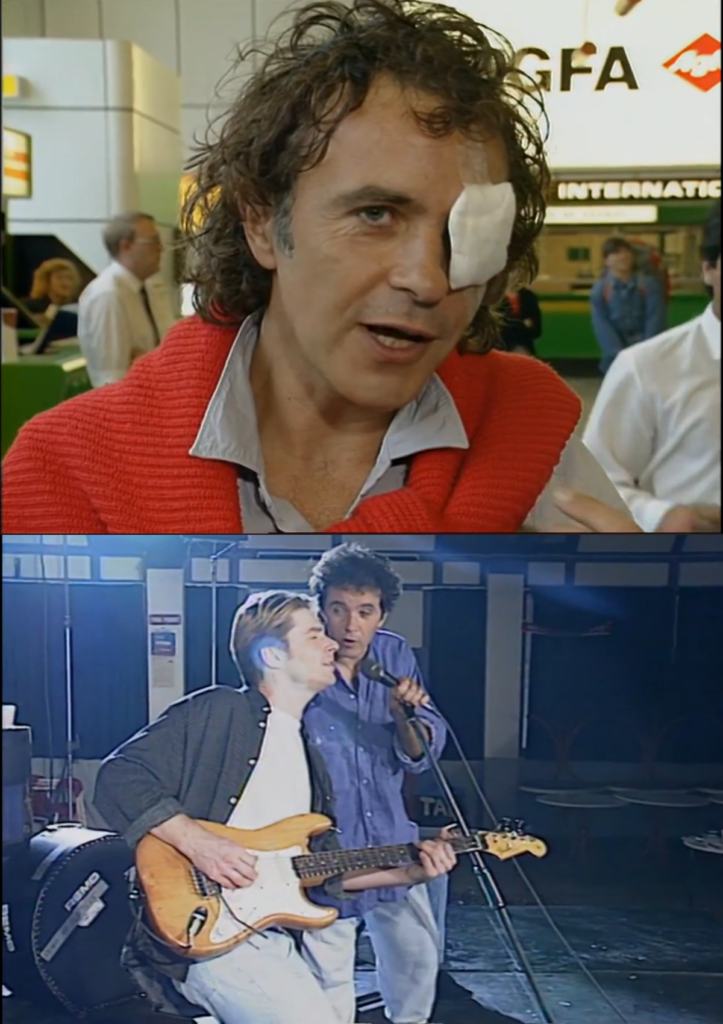
A moment of danger behind the glamour—when David Essex faced a real-life tragedy that could have changed everything
In the long, often romanticized history of 1970s pop culture, the story of David Essex carries not only the glow of fame but also a stark reminder of how fragile that fame can be. Among the many chapters of his career, one incident stands apart—an on-set accident involving a flintlock gun that brought him dangerously close to losing far more than a moment in time.
At the height of his popularity, when songs like “Rock On” (1973, UK No. 3 / US No. 5) and “Gonna Make You a Star” (1974, UK No. 1) had firmly established him as both a chart-topping musician and a screen presence, Essex was involved in film work that required period authenticity. It was during one such production that the accident occurred. A stunt involving a flintlock firearm—the kind that relies on gunpowder and sparks rather than modern cartridges—went wrong. When the weapon was discharged by a nearby performer, debris, powder, and flint fragments were propelled toward Essex’s face, striking his left eye.
What makes this moment particularly haunting is how ordinary it must have seemed just seconds before it happened. Film sets, even in that era, relied heavily on practical effects. Safety standards, while present, were not always as rigorously enforced or technologically supported as they are today. The line between performance and real danger could be perilously thin. And for David Essex, that line vanished in an instant.
The injury was serious. Eye trauma of this kind carries the risk of permanent vision damage—or worse, complete loss of sight. For a performer whose identity was so closely tied to his presence, his expression, and that unmistakable gaze that had captivated audiences, the implications were profound. It was not merely a physical injury; it threatened the very foundation of his career.
In the aftermath, as captured in archival footage from Thames Television, Essex appeared composed, even calm, as he spoke about the incident. There is something deeply revealing in that composure. Rather than dramatizing the event, he reflected on it with a kind of quiet resilience. It was as though he understood—perhaps more clearly than ever—the unpredictable nature of the life he had chosen.
This moment also reshaped how many viewed him. Until then, he had largely been seen through the lens of youthful charisma—a figure of admiration, even fantasy. But the accident introduced a different dimension: vulnerability. It reminded audiences that behind the image was a man exposed to the same risks, the same uncertainties, as anyone else working under demanding conditions.
In a broader sense, the incident speaks to an era of filmmaking that now feels distant. Today, digital effects and strict safety protocols have largely replaced the kind of practical stunts that once defined cinema. But in the 1970s, authenticity often came at a cost. The tools were real, the environments tangible, and the margin for error unforgivingly small.
For David Essex, the recovery marked not an end, but a continuation. He returned to his work, to his music, and to the public eye—carrying with him an experience that undoubtedly deepened his perspective. If anything, it added another layer to his artistry. The voice that audiences heard afterward was not just that of a pop idol, but of someone who had faced a moment where everything could have been lost.
Looking back now, the accident feels almost symbolic. It stands as a quiet counterpoint to the glamour of fame—a reminder that behind every spotlight lies a reality far less controlled. And yet, it is precisely this balance between light and shadow that gives David Essex’s story its enduring power.
He was never just the figure on the poster, nor only the voice on the radio. He was, and remains, a performer shaped by both triumph and trial—someone whose journey continues to resonate not because it was perfect, but because it was real.