
Two Songs, One Lasting Echo — “All I Have To Do Is Dream” and “Cathy’s Clown” Capture Love’s Tender Hope and Its Quiet Collapse
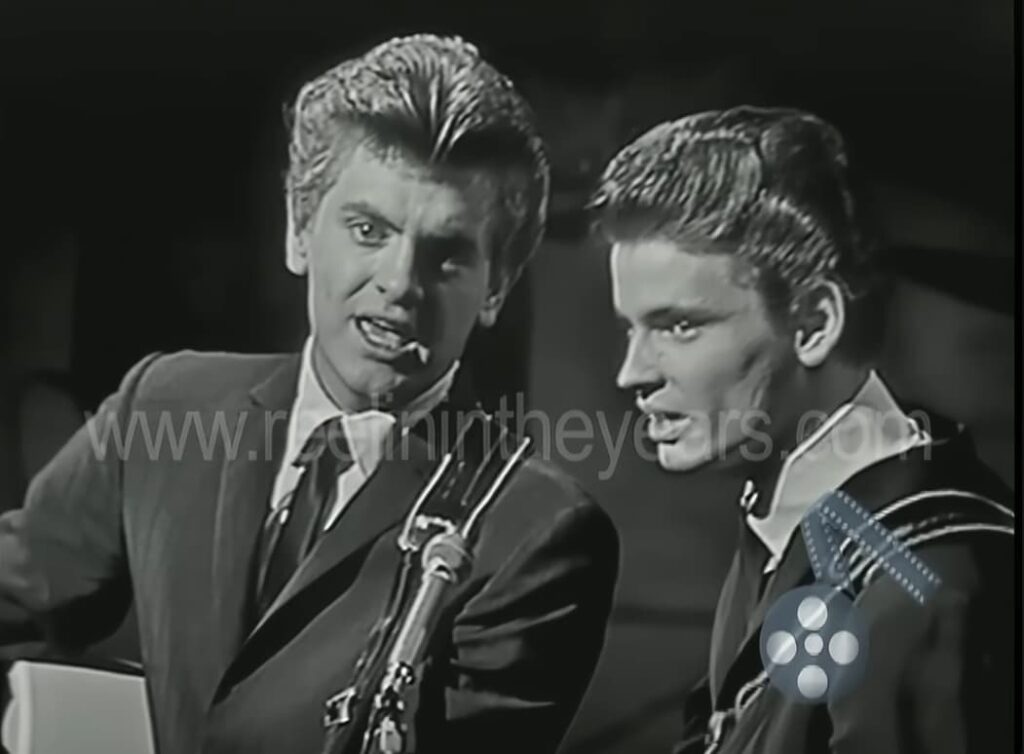
In the long, winding history of popular music, there are moments when two songs seem to speak to each other across time, forming a conversation about love that feels both complete and unresolved. That is precisely what happens when one listens to The Everly Brothers performing “All I Have To Do Is Dream” and “Cathy’s Clown” in the 1960 Reelin’ In The Years Archives footage. These are not merely recordings. They are emotional documents, capturing two sides of the same fragile human experience.
“All I Have To Do Is Dream,” released in 1958, became one of the most remarkable crossover successes of its era. It reached No. 1 on the Billboard Hot 100, No. 1 on the country chart, and No. 1 on the R&B chart, a rare achievement that underscored the universal appeal of its melody and message. Written by Boudleaux Bryant, the song is built on a simple but deeply resonant idea: that love, even when distant or unattainable, can still exist vividly within the quiet refuge of dreams.
The arrangement is delicate, almost weightless. A gentle guitar, a soft rhythm, and then the unmistakable harmony of Don and Phil Everly, voices so closely entwined that they seem less like two singers and more like a single emotional current. There is no strain, no excess. The performance feels effortless, as though the song itself had always existed, waiting only to be uncovered.
And yet, beneath that softness lies a quiet ache.
The lyric does not promise fulfillment. It does not guarantee that love will be returned. Instead, it offers something more modest, and perhaps more honest: the ability to hold on, even if only in dreams. It is a sentiment that lingers, especially with time, when one begins to understand that not all feelings are meant to find resolution.
By contrast, “Cathy’s Clown,” released in 1960, stands at the other end of that emotional spectrum. Also written by the Everly Brothers themselves, the song became their biggest hit, reaching No. 1 on the Billboard Hot 100 and holding that position for five consecutive weeks. It also topped the UK Singles Chart, marking a new level of international success.
Where “All I Have To Do Is Dream” drifts gently, “Cathy’s Clown” arrives with a sense of urgency. The rhythm is more pronounced, the vocal delivery more direct. There is a firmness in the tone, a subtle shift from longing to realization.
The story here is no longer about imagining love. It is about confronting its absence.
The narrator refuses to remain in a position of quiet humiliation, no longer willing to be “Cathy’s clown.” There is dignity in that decision, but also a trace of sorrow. Because even in rejection, the memory of what once felt possible does not easily fade.
When viewed together, these two songs reveal something profound about The Everly Brothers’ artistry. They were not simply performers of beautifully crafted melodies. They were interpreters of emotional truth, capable of expressing both the innocence of hope and the quiet strength required to walk away.
The 1960 archival performance preserves this duality in a way that studio recordings alone cannot fully capture. Watching them stand side by side, their voices blending with such precision, there is a sense of unity that extends beyond music. It reflects a partnership, a shared understanding that allows each song to breathe with authenticity.
In that moment, the contrast between the two songs becomes even more striking.
One speaks of love that exists in the imagination, untouched and idealized. The other speaks of love tested by reality, where illusions give way to clarity. Together, they form a complete narrative, one that feels deeply familiar, even decades later.
What endures most is not simply the success of these songs on the charts, though their achievements are undeniable. It is the feeling they leave behind.
Listening now, one might find that “All I Have To Do Is Dream” still carries a certain comfort, a reminder of a time when hope felt uncomplicated. And “Cathy’s Clown” offers something equally valuable — the quiet assurance that self respect can emerge even from disappointment.
Through these two songs, The Everly Brothers did more than define an era.
They gave voice to a cycle of emotion that continues to repeat, quietly, in the lives of those who listen.
And perhaps that is why, even now, their harmonies do not feel distant.
They feel remembered.
 Music Legend