
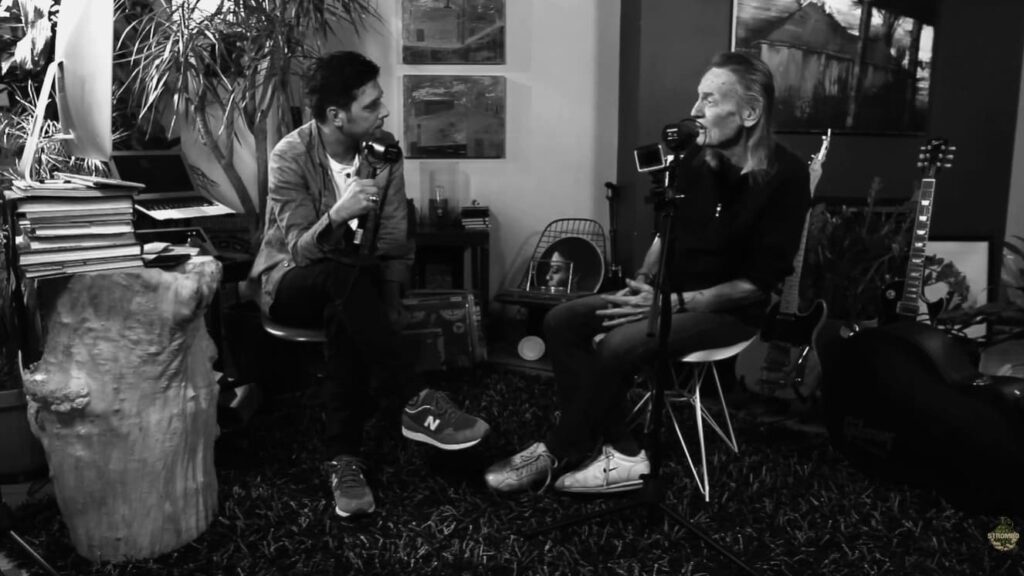
A quiet conversation that feels like a final chapter—Gordon Lightfoot reflects not on fame, but on the long road that shaped his songs
In his appearance on The Strombo Show, Gordon Lightfoot does not speak like a man revisiting past glory. There is no urgency to reassert his place in music history, no attempt to reshape how he is remembered. Instead, what emerges is something far more enduring—a calm, measured reflection from an artist who has already said everything he needed to say, not only in conversation, but across decades of songwriting.
By the time of this interview, Lightfoot’s legacy had long been established. His work in the late 1960s and 1970s placed him among the most respected singer-songwriters of his generation. Songs like “If You Could Read My Mind” reached No. 5 on the Billboard Hot 100 in 1971, while “Sundown” would go on to achieve No. 1 in 1974, marking the commercial peak of his recording career. Yet even these achievements, significant as they are, feel almost secondary when listening to him speak.
What becomes clear early in the interview is that Gordon Lightfoot has always approached music not as performance, but as documentation. His songs were never designed to impress—they were written to capture something as it was happening. A moment, a feeling, a realization that could not be held onto except through words and melody.
There is a particular stillness in the way he tells his stories. He does not dramatize the past. He recalls it with a kind of quiet acceptance, as though time has already placed everything in its proper context. When he speaks about writing “The Wreck of the Edmund Fitzgerald,” which reached No. 2 on the Billboard Hot 100 in 1976, there is no sense of self-congratulation. Instead, there is an awareness of responsibility—the understanding that some songs are not simply compositions, but acts of remembrance.
This perspective carries through the entire conversation. Fame is acknowledged, but not emphasized. Success is mentioned, but not celebrated in excess. What remains central is the work itself—the process of writing, the discipline of refining, and the patience required to allow a song to become what it needs to be.
Listening closely, one begins to notice that Lightfoot’s voice, even in conversation, carries the same qualities as his music. It is steady, unhurried, and precise. He chooses his words carefully, not out of hesitation, but out of respect for what they represent. There is no need to fill silence unnecessarily. In fact, the pauses often say as much as the sentences themselves.
There is also an undercurrent of distance—not detachment, but perspective. The years have not erased his connection to the past, but they have softened its edges. What once may have felt immediate now feels understood. This shift does not diminish the emotion; it refines it.
What makes this interview particularly compelling is that it reveals something often overlooked in discussions of legacy. It shows that the true measure of an artist is not only found in their most successful work, but in how they come to understand that work over time. Gordon Lightfoot does not revisit his songs to relive them. He revisits them to acknowledge them, to recognize the moments in which they were created, and then to let them remain where they belong—in the past, intact and unchanged.
There is a certain humility in that approach, but also a quiet confidence. It suggests that he does not need to reinterpret or redefine what he has done. The songs speak for themselves. They always have.
As the conversation unfolds, there is a growing sense that what is being shared is not just memory, but acceptance. Not resignation, but clarity. The understanding that a life spent in music is not measured by constant visibility, but by the lasting presence of the work itself.
And when the interview comes to an end, what lingers is not a particular quote or anecdote, but a feeling—a sense of having listened to someone who has reached a place where nothing more needs to be proven.
In that sense, The Strombo Show becomes more than just an interview. It becomes a quiet space where time, memory, and music intersect. A place where Gordon Lightfoot is not performing, not explaining, but simply existing alongside the songs that have come to define him.
And in that stillness, there is something rare: a reminder that the most enduring voices are often the ones that speak the least, and mean the most.
Video:
