
A Love So Gentle It Barely Speaks — “Chances Are” as a Whisper of Devotion That Time Could Never Fade
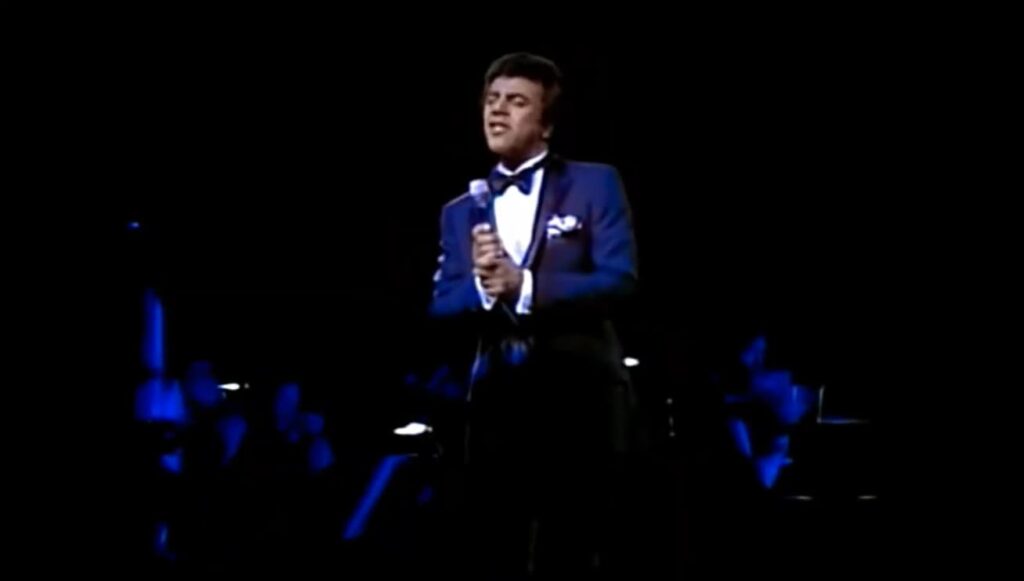
When Johnny Mathis returned to perform “Chances Are” live in Indiana in 1982, he was not simply revisiting a song from his youth. He was stepping back into a moment that had long since settled into the hearts of listeners, a song that had already proven itself not through noise or spectacle, but through quiet endurance.
Originally released in 1957, “Chances Are” became one of the defining recordings of Johnny Mathis’s career. The single reached No. 1 on the Billboard Most Played by Jockeys chart, No. 1 on the Best Sellers in Stores chart, and climbed to No. 4 on the Billboard Top 100, an extraordinary achievement that established Mathis as one of the most distinctive voices of his era. Written by Robert Allen and Al Stillman, the song earned a Grammy Award for Best Vocal Performance by a Male Artist, further cementing its place in the American musical landscape.
But statistics alone cannot explain why “Chances Are” continues to feel so deeply personal, even decades after its release.
The arrangement is deceptively simple. A soft orchestral backdrop, gentle strings that never overwhelm, and at the center, the voice—Johnny Mathis, smooth yet vulnerable, controlled yet filled with emotion that never needs to be forced. He does not push the lyric forward. He lets it unfold, almost as if he is discovering it in real time.
And that is where the magic lies.
By the time of this 1982 live performance in Indiana, there is a noticeable shift in the way the song is carried. The youthful brightness of the original recording has softened into something more reflective. The phrasing is slower, more deliberate. Each word feels considered, as though it carries the weight of years lived between the first recording and this moment on stage.
The meaning of “Chances Are” itself remains beautifully understated. It speaks of love, yes, but not in grand declarations. Instead, it lingers in uncertainty, in the quiet hope that feelings might be returned. “Chances are you think that I’m in love with you…”—it is not a confession, but a gentle suggestion, almost hesitant, as if afraid that saying too much might break the spell.
There is something profoundly human in that restraint.
In the 1950s, such tenderness felt natural, part of a musical language that valued subtlety. By the early 1980s, however, popular music had grown louder, more direct. And yet, when Johnny Mathis sings “Chances Are” in this later performance, it does not feel outdated. It feels timeless.
Perhaps because the emotion it captures does not belong to any one era.
Watching him in 1982, there is also an awareness of continuity. This is not an artist chasing relevance. This is an artist inhabiting his own history, comfortable within it. The audience does not demand reinvention. They recognize the song, and in that recognition, something unspoken passes between performer and listener.
A shared memory.
What makes this performance especially moving is the sense that nothing needs to be proven anymore. The voice, though matured, retains its clarity. The delivery is unhurried. There is space between the notes, and in that space, one can almost hear the passage of time itself.
It becomes less about the song as it was, and more about what it has become.
“Chances Are” is no longer just a romantic ballad from 1957. It is a reflection of enduring feeling, of moments remembered, of words that may have once been spoken softly in a different time, to a different person, under circumstances that can never quite be recreated.
And yet, when the melody begins, it all returns—if only for a few minutes.
That is the quiet power of Johnny Mathis.
He does not demand attention. He invites it. And once you are there, listening, the world seems to slow just enough to remember what it felt like when love was something you spoke of carefully, almost in whispers.
In that 1982 Indiana performance, “Chances Are” is no longer just a song.
It is a memory, still breathing.