
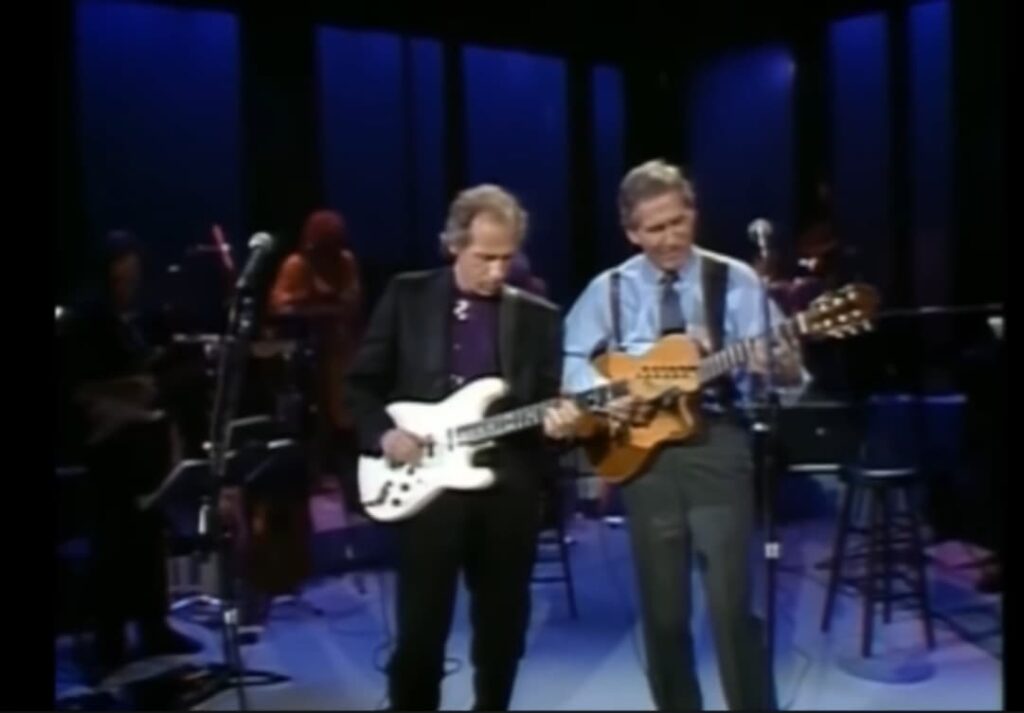
A Quiet Meeting of Two Masterful Hands, Where Time, Rhythm, and Memory Walk Side by Side
When Mark Knopfler and Chet Atkins came together, the result was never going to be ordinary—and their rendition of “Walk of Life” stands as a subtle yet deeply meaningful intersection between two musical worlds. Originally released in 1985 by Dire Straits as part of the landmark album “Brothers in Arms,” the song quickly became one of the band’s most recognizable hits, reaching No. 7 on the Billboard Hot 100 and climbing to No. 2 on the UK Singles Chart. Bright, rhythmic, and full of quiet optimism, it carried a sense of everyday resilience that resonated widely during its time.
Yet when revisited through the collaboration between Mark Knopfler and Chet Atkins, the song shed its polished, radio-friendly energy and took on a more reflective, almost intimate character. Their partnership, most notably captured in the 1990 album “Neck and Neck,” was not built on spectacle but on mutual respect—two guitarists who understood that the space between notes can often say more than the notes themselves.
The original “Walk of Life” was driven by a steady beat and a memorable keyboard hook, telling the story of a street musician who keeps playing no matter the circumstances. It was, in many ways, a celebration of persistence—the quiet dignity of continuing on one’s path, regardless of recognition or reward. But in the hands of Knopfler and Atkins, that story becomes less about the crowd and more about the journey itself.
There is something profoundly disarming in how these two artists approach the piece. Chet Atkins, with his warm, precise fingerstyle technique, brings a sense of grounded tradition, while Mark Knopfler adds his unmistakable phrasing—fluid, understated, and deeply expressive. Together, they transform “Walk of Life” into a conversation rather than a performance. It feels as though the song is being rediscovered in real time, each phrase exchanged like a shared memory rather than a rehearsed arrangement.
Though this instrumental interpretation was not released as a charting single, its significance lies far beyond rankings. The album “Neck and Neck” itself reached No. 27 on the Billboard 200 and was widely praised for its artistry, eventually earning a Grammy Award for Best Country Instrumental Performance. Within that context, their take on “Walk of Life” becomes part of a larger narrative—a meeting of generations, of styles, of philosophies about music.
The story behind this collaboration carries its own quiet weight. Chet Atkins, already a towering figure in country music, had long admired Mark Knopfler’s approach to the guitar—his ability to make each note feel intentional, almost conversational. Knopfler, in turn, regarded Atkins as a guiding influence, a figure whose work had shaped the very language he spoke through his instrument. When they finally recorded together, there was no sense of competition, only a shared understanding that music, at its best, is an act of listening as much as it is of playing.
Listening to their version of “Walk of Life,” one cannot help but feel the passage of time within it. The song no longer moves with the urgency of youth; instead, it walks—steadily, thoughtfully, aware of every step. The melody unfolds with patience, as if it has nothing left to prove. And in that patience, it reveals something deeper: the idea that life itself is not a race, but a series of moments, each carrying its own quiet significance.
In the end, this interpretation becomes less about the song’s original success and more about its enduring spirit. Mark Knopfler and Chet Atkins do not attempt to recreate the past—they honor it, gently reshaping it through their own experiences. The result is a version of “Walk of Life” that feels both familiar and entirely new, like a road traveled again after many years, where every turn holds both recognition and reflection.
And as the final notes fade, what remains is not just a melody, but a feeling—one of continuity, of craftsmanship, of two voices speaking through strings with a clarity that words could never quite achieve. It is a reminder that some songs do not simply belong to a moment in time; they continue to walk with us, quietly, patiently, long after the world has moved on.