
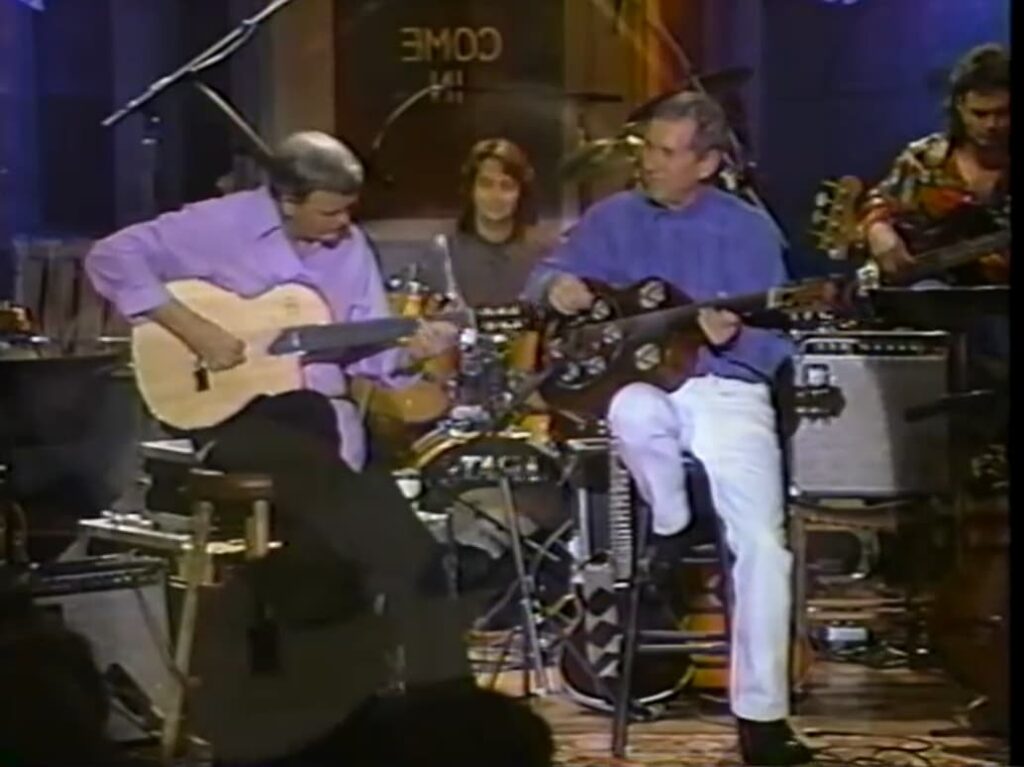
A Conversation Between Two Masters, Where Playfulness and Precision Become One
When Chet Atkins and Jerry Reed came together to record “Something,” they were not merely interpreting a song—they were reshaping it through the language of two guitars that had already defined an era of instrumental country music. Originally written by George Harrison of The Beatles and released in 1969 on the landmark album “Abbey Road,” “Something” quickly became one of the most celebrated love songs of its time, reaching No. 1 on the Billboard Hot 100 when issued as a double A side single with “Come Together.” It was a composition admired across genres, recorded by hundreds of artists, but in the hands of Atkins and Reed, it found a distinctly American, deeply intimate voice.
Their version appeared on the 1970 album “Me & Jerry,” a record that itself stood as a remarkable achievement. The album climbed to No. 2 on the Billboard Top Country Albums chart and crossed over to the Billboard 200, eventually earning the Grammy Award for Best Country Instrumental Performance in 1971. Though “Something” was not released as a charting single from the album, it became one of its most quietly admired tracks—less about recognition, more about refinement.
By 1970, Chet Atkins was already a towering figure, not only as a guitarist but as a producer who had shaped the Nashville Sound. His playing was known for its clarity, its elegance, and an almost architectural sense of space. Jerry Reed, on the other hand, brought something looser, more playful—his fingerstyle technique carried a rhythmic vitality that often felt just on the edge of unpredictability. When these two styles met, there was always the possibility of tension, but what emerged instead was conversation.
That is precisely what defines their rendition of “Something.” There are no lyrics, no need for them. The melody, so familiar in its original form, is passed back and forth between the two guitars with a kind of quiet respect. Atkins often takes the role of the steady narrator, presenting the theme with grace and restraint, while Reed responds with subtle embellishments, adding color without ever overwhelming the structure.
The beauty of this interpretation lies in its restraint. Where many versions of “Something” lean into its emotional weight, Atkins and Reed choose to soften it. They allow the melody to breathe, to exist without insistence. In doing so, they reveal something deeper—not the intensity of love as declaration, but its quieter, more enduring presence.
There is also an undercurrent of mutual admiration in the performance. These are not two musicians competing for attention; they are listening as much as they are playing. Each phrase seems to anticipate the other, creating a sense of unity that feels almost effortless. And yet, beneath that ease is a lifetime of discipline, of understanding not only the instrument, but the spaces between notes.
The decision to include a Beatles composition on “Me & Jerry” was itself significant. It reflected a moment when country music was beginning to engage more openly with the broader musical landscape. Rather than resisting change, artists like Chet Atkins found ways to interpret it on their own terms, bringing new material into the fold without losing their identity.
Over time, this version of “Something” has come to represent more than a successful adaptation. It stands as a testament to the versatility of both artists, and to the idea that a great song can exist in many forms without losing its essence. In their hands, the song becomes less about its origin and more about its possibility.
Listening now, there is a sense of calm that runs through the performance. It does not demand attention; it invites it. It is the kind of music that reveals itself slowly, offering more with each return. And perhaps that is its greatest strength—it does not try to impress. It simply exists, confident in its simplicity.
In the end, Chet Atkins and Jerry Reed do not attempt to redefine “Something.” They allow it to become something else—something quieter, more reflective, and in its own way, just as profound.
 Oldies Songs