
A Gentle Promise of Innocence, Where Love Is Simple, Unspoken, and Still Believed In
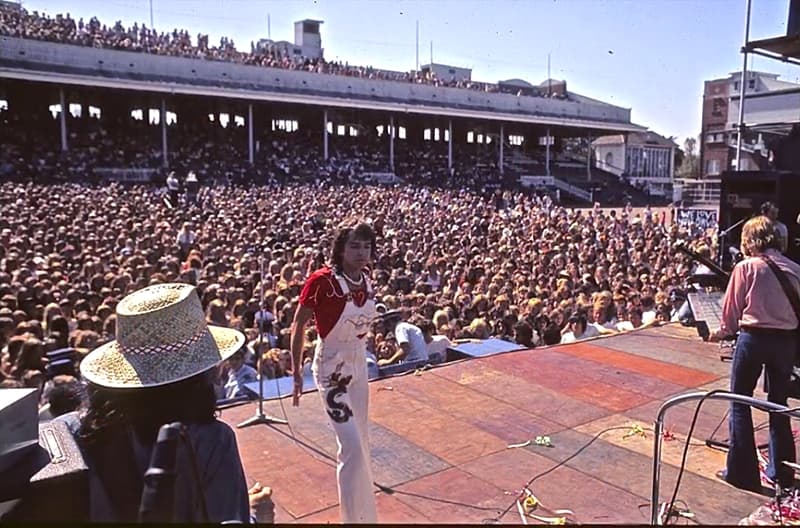
When David Cassidy performed “The Puppy Song” at Randwick Racecourse, Sydney, Australia on March 2, 1974, the moment carried more than the excitement of a live appearance—it reflected a turning point in his artistic identity. Originally written by Harry Nilsson in 1969 and first recorded for his album “Harry,” the song had already established itself as a quiet, heartfelt expression of longing. But in the hands of David Cassidy, it found a new audience—one that was growing alongside him, learning to hear beyond the image that had first brought him fame.
Cassidy’s version of “The Puppy Song” appeared on his 1973 album “Dreams Are Nuthin’ More Than Wishes,” marking a deliberate shift away from the television-crafted persona of his early career with The Partridge Family. While the song was not released as a major charting single in the same way as his earlier hits like “Cherish” or “How Can I Be Sure,” its importance lies in something less measurable—its role in revealing a more introspective side of an artist often defined by youthful adoration.
By early 1974, David Cassidy was navigating an unusual kind of fame. The crowds that gathered at venues like Randwick Racecourse were immense, their energy almost overwhelming. Yet within that atmosphere, “The Puppy Song” offered a moment of stillness—a quiet contrast to the surrounding noise. It was not designed to excite or energize; it was meant to connect.
The performance itself reflects this contrast beautifully. As Cassidy begins the song, there is a noticeable shift in tone. The exuberance that often characterized his stage presence softens, replaced by something more measured, more sincere. His voice, while not technically overpowering, carries a fragile honesty that suits the song’s simplicity. He does not attempt to embellish it. Instead, he allows the melody to remain as it was written—gentle, almost childlike in its directness.
And that simplicity is precisely where the song finds its strength.
At its core, “The Puppy Song” is about longing—not for grandeur or recognition, but for something small, pure, and uncomplicated. The desire for a puppy becomes a metaphor for a deeper need: companionship without conditions, affection without pretense. It speaks to a kind of emotional clarity that often fades with time, replaced by complexities that are harder to name.
In the context of Cassidy’s career, this choice of song feels particularly meaningful. At a time when he was often seen through the lens of celebrity, performing “The Puppy Song” was a way of stepping outside that image, if only for a few minutes. It allowed him to present something more personal, more grounded.
There is also a quiet poignancy in the setting itself. An open-air venue, a vast crowd, and yet a song that feels as though it belongs in a much smaller space. This contrast heightens the emotional impact. The listener becomes aware not just of the performance, but of the distance between the artist and the audience—and the effort to bridge that distance through something as simple as a melody.
Musically, the arrangement remains understated, allowing the lyrics to take center stage. There are no dramatic shifts, no moments of overt intensity. Everything unfolds at a steady, unhurried pace, as though the song itself understands that its message does not need to be forced.
Looking back, performances like this reveal a side of David Cassidy that is sometimes overlooked. Beyond the headlines, beyond the hysteria of his early fame, there was an artist searching for authenticity—for songs that could carry meaning beyond the moment.
And “The Puppy Song” offered exactly that.
It did not promise answers. It did not attempt to resolve the complexities of life. Instead, it held onto something quieter—a belief that even in a world that often demands more than it gives, there is still value in wanting something simple, something kind, something real.
As the final notes drift away, the applause returns, the energy rises again. But for a brief moment, the noise has softened, and what remains is a feeling that lingers longer than the performance itself.
Because sometimes, the smallest wishes are the ones that stay with us the longest.