
A Lifetime Measured in Love, Where Every Passing Year Becomes a Quiet Testament
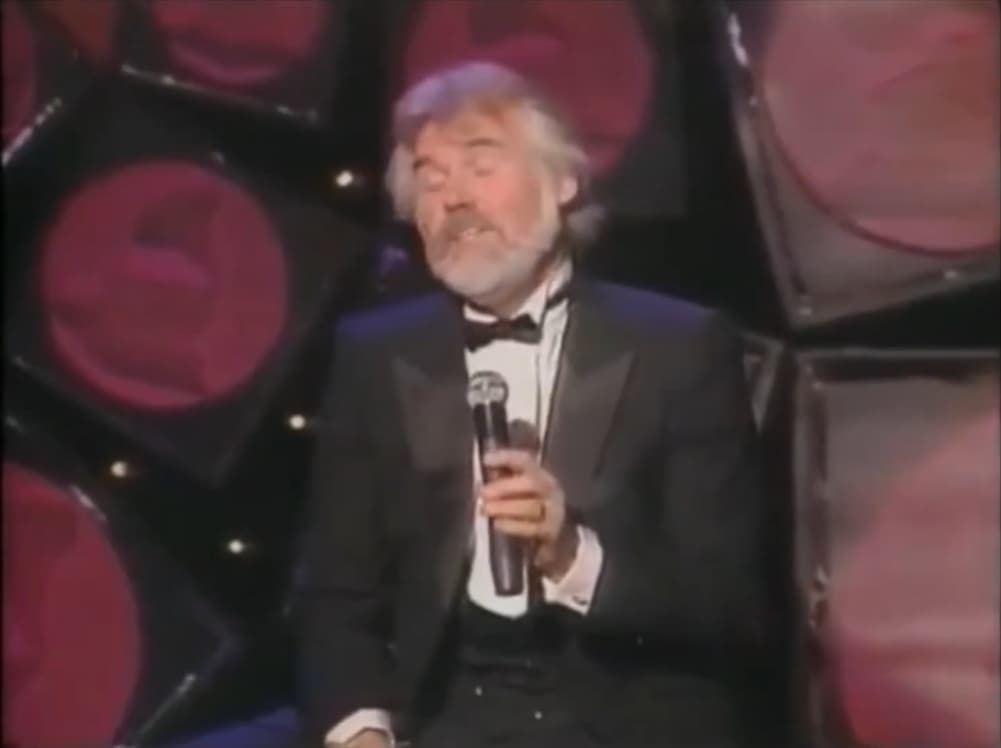
When Kenny Rogers stood on the stage of the 25th Grammy Awards in 1983 to perform “Through the Years,” he was presenting more than one of his signature songs—he was offering a reflection on time itself. Originally released in 1981 as part of the album “Share Your Love,” the song had already reached No. 1 on the Billboard Adult Contemporary chart and climbed to No. 5 on the Billboard Hot Country Singles chart, with a respectable showing on the Billboard Hot 100 as well. Written by Steve Dorff and Marty Panzer, “Through the Years” quickly became one of the defining ballads of Rogers’ career, not for its chart dominance alone, but for the way it seemed to speak directly to the passage of a shared life.
By the time of that 1983 Grammy performance, Kenny Rogers had firmly established himself as one of the most recognizable voices in American music. Yet what set him apart was never just his success—it was his ability to deliver a song as though it had been lived, not merely recorded. And “Through the Years” is perhaps the clearest expression of that gift.
The performance itself is marked by a striking simplicity. There is no attempt to overwhelm the audience with spectacle. Instead, Rogers stands steady, allowing the song’s narrative to unfold with quiet dignity. His voice—warm, slightly weathered, unmistakably human—carries each line with a sense of familiarity, as though the words have been carried for a long time before being spoken aloud.
What makes this particular moment resonate so deeply is the context. The Grammy stage, often associated with celebration and recognition, becomes in this instance a place of reflection. The song does not reach outward; it turns inward. It invites the listener to consider not just the idea of love, but its endurance—its ability to remain present through change, through uncertainty, through the quiet accumulation of years.
At its core, “Through the Years” is a song about constancy. It speaks of a relationship that has weathered time, one that has seen both clarity and doubt, yet has remained intact. The lyrics do not dwell on dramatic events; instead, they focus on the small, persistent acts of presence that define a lasting connection. This is where the song finds its truth—not in grand declarations, but in steady affirmation.
In the 1983 performance, Kenny Rogers does not attempt to reinterpret the song. He does not need to. Instead, he allows it to settle into its natural rhythm, trusting that its meaning will emerge without force. There is a noticeable restraint in his delivery, a refusal to exaggerate emotion. And in that restraint, the emotion becomes even more apparent.
Musically, the arrangement remains faithful to the original recording, with its gentle piano lines and soft orchestration. But live, there is an added sense of immediacy. The notes feel closer, less distant, as though they are unfolding in real time rather than being recalled from memory.
There is also something quietly revealing in the way Rogers carries himself throughout the performance. He does not perform as someone seeking approval. Instead, he appears as someone sharing something already understood. This subtle distinction changes the entire atmosphere. The audience is not being asked to respond—they are being invited to remember.
Within the broader landscape of early 1980s music, “Through the Years” stands apart for its sincerity. At a time when production styles were evolving rapidly, the song remains rooted in simplicity. It does not chase trends. It does not rely on novelty. Its strength lies in its clarity.
Over time, the song has become more than a recording. It has become a marker—something people return to when reflecting on their own lives, their own relationships, their own passage through time. And in performances like this one at the 25th Grammy Awards, that role becomes even more apparent.
As the final notes fade, there is no dramatic conclusion. Only a quiet sense of completion, as though the story continues beyond the stage.
Because “Through the Years” was never meant to capture a single moment.
It was meant to hold many of them—gently, faithfully, and without ever needing to raise its voice.